A full casino support team cost breakdown rarely stops at agent salaries or a software invoice. iGaming operators running support in-house, through outsourcing, or some blend of both are working against a whitepaper benchmark of €1.02 to €2.41 per human-handled ticket across nine European markets and the Philippines, and that per-ticket figure is only the visible layer. Compensation is one line item. Training, turnover, licensing, integration development, and outsourcing margins sit underneath it, rarely itemized on the same spreadsheet.
This article breaks the full cost structure into three parts: what an in-house agent team actually costs once training and turnover are counted, what support tools cost once licensing is stacked against integration and add-on spend,and how outsourced operations package labor, infrastructure, management, and provider margin into a single blended rate. A closing section shows how these three layers compound for a mid-size operator, and what changes when the resolution layer is automated instead of staffed.
Most cost conversations in iGaming support stop at the first number an operator sees: the per-agent rate, the license fee, the outsourcing contract. None of those numbers are wrong. All of them are incomplete.
Support cost pressure in iGaming rarely shows up as a single alarming invoice. It shows up as a slow accumulation across every layer of the operation, which is why a full breakdown, not a single line item, is the only way to see where the budget is actually going.
The Cost of an In-House Agent Team: Compensation, Training, and Turnover
Compensation is the most visible cost of an in-house casino support team, and it is not the largest one once training and turnover are added back in. Across nine European markets and the Philippines, the operator-facing benchmark for human agent ticket handling runs €1.02 to €2.41 per ticket, a range wide enough that where an operator staffs its team changes the total bill by more than double before a single ticket is escalated.
Compensation and Ticket-Handling Cost
That €1.02–2.41 per-ticket range already includes salary, shift premiums for 24/7 coverage, and basic overhead. It does not include the cost of a ticket sitting unresolved while an agent looks up a player's transaction history, cross-references bonus terms, or waits on a supervisor to approve an escalation. Multiplied across the ticket volume a mid-size iGaming operator generates in a single month, small differences in per-ticket cost compound into a material line item on the support budget.
Training and Ramp-Up Time
Recruiting and training a new support agent to full ticket-handling speed typically takes weeks, not days, particularly for iGaming-specific workflows: KYC document review, bonus dispute logic, and responsible gambling escalation protocols are not covered in generic customer service onboarding. During that ramp-up period, the operator pays full compensation for a fraction of full output. Multilingual coverage compounds the problem: recruiting a qualified agent in each additional market language adds its own hiring and training cycle, and operators expanding into new jurisdictions repeat the entire process language by language.
Turnover and Knowledge Loss
Support agent turnover in iGaming is a recurring operational cost, not a one-time event. Each departure resets the training clock for that seat and takes accumulated product and player knowledge out of the operation with it. A support team with high turnover is, in effect, permanently paying a recurring form of support debt, the training investment embedded in the €1.02–2.41 per-ticket benchmark without ever reaching the productivity that benchmark assumes at scale.
Multilingual and 24/7 Coverage Cost
Each additional language and each hour of round-the-clock coverage multiplies the seat count, and every seat added carries the full compensation, training, and turnover cost described above. An operator covering five languages across three shifts is not staffing one support function: it is staffing fifteen separate coverage slots, each with its own hiring cycle, its own ramp-up period, and its own turnover risk. Regulatory requirements in EU markets that mandate local-language support add pressure to expand coverage even where ticket volume in a given language does not yet justify a dedicated shift.
The Cost of Support Tools: Licensing, Integrations, and Add-Ons
Licensing is the cost operators budget for, and it is typically the smallest piece of the total tools bill once integration work and ongoing maintenance are included. Generic helpdesk software such as Zendesk Suite Professional is priced at approximately €115 per agent per month, putting a 15-agent support operation at €1,725 per month in licensing before any iGaming-specific configuration.
Base Licensing Cost
At €115 per agent per month, licensing scales directly with headcount. An operator that doubles its agent team to handle growth doubles its licensing bill in the same step, regardless of how many of those new tickets are repetitive or automatable.
Integration and Customization Cost
Generic support software was not built with payment processor connections, escalation workflow logic, or gambling-specific compliance data exports. Making it functional for iGaming typically requires €15,000 to €50,000 in upfront integration development, covering payment processor connectors, escalation routing customization, multilingual integration, and compliance data export tooling, with ongoing maintenance costs on top as processors and regulatory requirements change.
The Tools That Don't Show Up on the Invoice
Beyond the core license, support operations running on generic software typically add a translation layer for multilingual coverage, a quality monitoring tool to audit agent conversations, workforce scheduling software to manage shift coverage across time zones, and a knowledge base or macro library to standardize repetitive replies. Each is a separate contract, a separate renewal date, and a separate integration point. None of them appears on the licensing line item an operator reviews when comparing support tool costs.
Per-Seat Pricing at Scale
Features that matter for iGaming support, such as advanced reporting, audit trail exports, and higher-tier automation add-ons, are typically gated behind higher pricing tiers on generic helpdesk software. An operator that needs compliance-grade reporting or expanded API access is often pushed from a mid-tier plan into an Enterprise-tier contract well before team size alone would justify the upgrade. The per-agent rate quoted at the start of a vendor conversation is rarely the rate the operator ends up paying once the features required for gambling operations are added. The deeper issue is not per-seat pricing itself but paying per seat for a team sized to the full ticket volume: when every ticket needs a person, every increment of growth adds seats. Reducing the number of tickets that require a person is what changes that math, which is where an automated resolution layer shifts the structure.
The Cost of Outsourcing: Blended Rates and Management Tradeoffs
Outsourcing often shows the lowest number on paper because the invoice arrives as a single blended rate, covering labor, the provider's overhead, and its margin in one figure rather than as separate line items. Eastern European call center agents cost providers roughly €1,200 to €1,800 per agent per month in labor, and a five-language operation with 24/7 coverage typically needs 15 to 20 agents, putting the labor cost alone in the range of €18,000 to €36,000 per month before the provider's overhead and margin are added. A specialist provider often delivers that coverage more efficiently than an operator could build alone, which is part of why the model works. The cost breakdown simply needs to account for the full blended rate rather than the labor figure by itself.
What the Blended Rate Includes
An outsourcing contract's monthly rate reflects a fully managed service. It combines frontline labor with the provider's recruitment, facility overhead, management layer, and operational margin, which is precisely what enables BPOs to absorb complex staffing burdens on behalf of the operator. Because these services are delivered as a unified rate, evaluating a full casino support team cost breakdown across in-house, outsourced, and automated layers requires reducing each model to a like-for-like cost per resolved ticket.
The Management and Integration Layer
Some factors sit outside the invoice and are worth modeling alongside it. With an outsourced team, the operator manages quality through the provider rather than directly, so consistency across markets and shifts depends on how well the provider is briefed on the operator's bonus terms, VIP programs, and escalation rules. Strong outsourcing providers invest heavily in exactly this, and the operators who get the most from outsourcing are the ones who equip their provider with clear SLAs, shared knowledge bases, and the same real-time player context an in-house team would have. For a cost breakdown, the point is that management proximity and knowledge transfer belong in the total picture, not just the per-seat rate.
Contract Terms and Switching Cost
Outsourcing contracts commonly include minimum seat commitments and defined terms, which give the provider the stability to staff and train a dedicated team and, in exchange, set how quickly an operator can scale coverage up or down. Changing providers means running the training and ramp-up cycle described earlier with a new team, so continuity of provider knowledge carries real value. The practical point is to model commitment terms and transition effort at the outset, alongside the headline rate, rather than treating the monthly quote as the whole cost of the arrangement.
The Full Casino Support Team Cost Breakdown: How Agents, Tools, and Outsourcing Costs Compound
Stacked together, licensing, integration development, and outsourcing labor push a mid-size iGaming operator's total support operations spend to €30,000 to €60,000 per month, and the visible line items in that total understate the real cost, because they exclude training ramp-up, turnover-driven re-training, and the overhead and margin included in a provider's blended rate. Few operators run a single cost layer in isolation. A common structure blends an in-house core team for VIP and escalated tickets, generic support software to manage the ticket queue, and an outsourcing provider for overnight or overflow coverage. That operator is exposed to all three cost structures at once, and to all three sets of hidden costs described above at the same time.
That combined exposure compounds further as the player base grows. Licensing costs rise with every agent seat added, outsourcing costs rise with every additional shift, and integration maintenance work grows as the operator adds markets, payment methods, and languages onto the same generic architecture. None of these costs decouples from growth on its own; each one is built to scale with headcount and vendor seats, not with the share of support workflows that could be resolved without a person involved.
Each layer scales with volume or headcount, not with the share of tickets that are actually repetitive and automatable. An operator handling thousands of monthly support workflows pays the full compensation, licensing, and outsourcing cost of every ticket, whether that ticket required judgment or could have been resolved automatically in seconds. That mismatch, cost tied to headcount rather than to the work that genuinely needs a person, is the structural problem underneath every number in the table above.
What AI Support Infrastructure Changes Across the Full Cost Structure
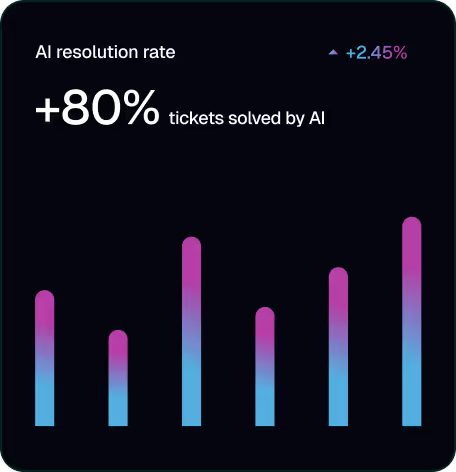
AI support infrastructure changes the cost structure at every layer covered above, not just the agent line item. Tugi Tark resolves 80%+ of player support tickets at €0.15 per AI handled ticket, against the €1.02–2.41 per-ticket benchmark for human agent handling, a cost reduction of 64% at a 70% AI resolution rate.
The training and turnover costs that compound the in-house agent line item do not apply to an automated resolution layer. An AI support system does not need weeks of ramp-up per new hire or per new market language, and it does not reset a training clock every time a person leaves the role. The licensing and integration costs that stack on top of generic helpdesk software are replaced by a platform purpose-built for iGaming ticket types from the start, with native escalation workflows in place of custom-built connectors.
For the routine, high-volume tier of tickets, automation adds a resolution layer priced at a flat cost per AI-handled ticket, which changes the per-ticket economics of that tier whether the operator handles those tickets in-house or through a provider. Human teams, in-house or outsourced, stay focused on the escalations, disputes, and VIP cases that genuinely need human judgement.
The multilingual and coverage math changes as well. Tugi Tark supports 249 languages with on-the-fly translation at the infrastructure level, so covering an additional market does not require recruiting, training, and scheduling a new language-specific shift.
AI resolution is billed per AI-handled ticket, alongside a per-agent license for the seats an operator keeps. Because automation resolves more than 80% of tickets, that per-agent license applies to a much smaller team than a fully staffed model requires, and the per-ticket resolution cost carries none of the fixed seat commitments an outsourcing contract locks in.
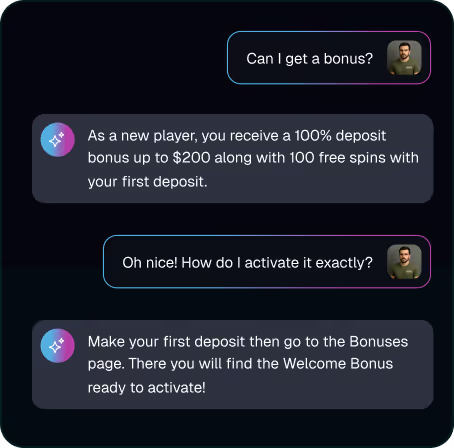
AI agents resolve player tickets rather than deflecting them. They retrieve player profile data, policy terms, and iGaming-specific knowledge in real time, and run 18x faster than a human agent at one-fifth the cost. Tugi Tark's AI support infrastructure for iGaming was built by leaders who managed 10M+ tickets across 125+ iGaming brands in 25+ markets as a BPO, designed from direct operational experience rather than adapted from general-purpose software. Operators evaluating the full picture can see the full cost breakdown against their current agent, tool, and outsourcing spend, or test the AI agent directly on real casino support scenarios.
Operators running the numbers on reducing customer support costs or comparing AI against outsourcing are working through the same three-layer structure covered here. The per-ticket math specifically is covered in detail in how much a support ticket really costs iGaming operators.
Frequently Asked Questions
What does an in-house casino support agent actually cost?
Human agent ticket handling costs €1.02 to €2.41 per ticket across nine European markets and the Philippines, based on Tugi Tark's 2026 iGaming support economics report. That figure covers compensation and basic overhead; it does not include training ramp-up time or the recurring cost of turnover, which reset the training investment every time an agent leaves.
How much do support tools like Zendesk cost for an iGaming operator?
Generic helpdesk software such as Zendesk Suite Professional is priced at approximately €115 per agent per month, putting a 15-agent team at €1,725 per month before customization. Making that software functional for iGaming-specific workflows typically adds €15,000 to €50,000 in integration development, plus ongoing maintenance as payment processors and compliance requirements change.
Is outsourcing casino support cheaper than an in-house team?
Outsourcing can lower the visible monthly invoice, and a specialist provider often delivers multilingual, 24/7 coverage more efficiently than an operator could build in-house. For a cost breakdown, the point is that the rate is a blended figure covering labor plus the provider's overhead and margin, so comparing it fairly to an in-house or automated model means reducing each to a cost per ticket. Eastern European call center agents cost providers roughly €1,200 to €1,800 per agent per month in labor, with management proximity and knowledge transfer as additional factors to weigh alongside the rate.
What is the total cost of a casino support team once agents, tools, and outsourcing are combined?
Stacking licensing, integration development, and outsourced labor together typically pushes a mid-size iGaming operator's total support operations spend to €30,000 to €60,000 per month. That total still excludes training ramp-up and turnover-driven re-training costs on the in-house side.
How does AI support infrastructure change the casino support cost breakdown?
AI support infrastructure for iGaming resolves 80%+ of player support tickets at €0.15 per AI handled ticket, against the €1.02–2.41 per-ticket benchmark for human agents, without the training ramp-up, turnover, or bundled outsourcing margin that compound the traditional cost structure. Tugi Tark prices this at €99 per user per month plus per-ticket AI cost, keeping a flat cost per resolution rather than a rising one as ticket volume grows.