iGaming operators talk a lot about technical debt. But far less about support debt.
Yet support debt accumulates just as quietly and becomes just as expensive.
It builds when players have to ask the same question twice, when bonus mechanics need explanation instead of being understood on first contact. When a withdrawal creates anxiety instead of confidence, and every time a support agent resolves something that should never have required human time.
And like technical debt, support debt compounds.
What support debt actually is
Support debt is the gap between how an operator expects players to behave and how players actually behave when friction appears.
It is created when rules are clear internally but confusing externally, when processes are logical to the business but opaque to players. When support answers are correct, but slow or inconsistent. When scale is achieved by adding people, instead of removing friction.
The industry often treats these as "normal support load." They are not. They are liabilities that carry a cost whether or not that cost appears on a P&L line.
What makes support debt particularly difficult to address is that it does not feel urgent until it is structural. Individual tickets look manageable. The aggregate, across queues, agents, markets, and shifts, is where the debt begins to reveal itself.
Why iGaming accumulates support debt faster than other industries
iGaming customer service is uniquely vulnerable because friction is structurally unavoidable. Money moves. Rules apply. Limits exist. Verification is mandatory. Regulation constrains outcomes.
Players do not experience these as the safeguards they are to operators. They experience them as interruptions.
That means player support contact is not a failure of service. It is a natural byproduct of the business model. And because it is constant, even small inefficiencies multiply rapidly across brands, markets, and languages.
Historically, operators have responded by scaling headcount. An understandable reaction when volume grows faster than infrastructure. But headcount treats the symptom, not the debt.
The cost of carrying support debt
Support debt doesn't show up cleanly on a P&L line. It shows up as longer queues during peak hours, higher staffing costs in non-core languages, inconsistent answers across agents and shifts, slower response during volume spikes, human fatigue handling repetitive questions, and escalations that feel unnecessary in hindsight.
None of this looks catastrophic in isolation. Together, it quietly erodes margins, player trust, and operational control.
By the time leadership feels the full weight of the support debt, it is already embedded in staffing models, player expectations, and cost structures. The fix becomes expensive because the debt has compounded across every brand and market the operator serves.
Why AI is becoming a debt-reduction tool, not a cost tool
Most AI discussions in iGaming customer support focus on efficiency. That framing is too narrow.
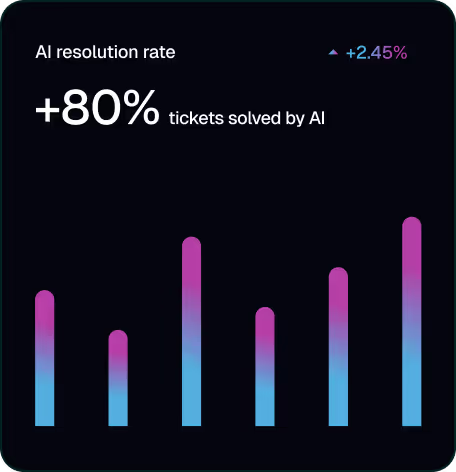
AI customer service that iGaming operators deploy has a more important role than reducing cost. When deployed correctly, it prevents support debt from forming in the first place. Routine questions about deposits, bonuses, accounts, and technical issues are resolved instantly, without queues, without inconsistency, without the variability that accumulates across shifts and markets. Debt stops building. Not because players stop asking questions, but because the answers arrive before frustration does.
This only works when AI understands iGaming logic. Generic automation does not reduce debt. It simply creates a different kind of it.
Why the platform matters more than the feature
Debt reduction is a systems problem.
An AI agent without access to live player data, operational policies, player context, and escalation logic doesn't remove debt; it defers it. The player receives a response that is technically prompt but operationally hollow, contacts support again, and adds to the repeat-contact volume that is one of the clearest symptoms of structural debt.
The platform underneath the AI layer determines whether resolution is clean or brittle. A purpose-built iGaming customer service platform handles the context problem at the foundation level. It gives first-line and second-line support teams a unified workspace where they can see everything that matters: player history, policy context, AI resolution attempts, and escalation logic. It supports unlimited brands within the same agent environment, so support teams can handle multiple brands without switching systems or losing context across interactions.
The dashboards and reporting within the platform also matter. Operators cannot manage debt they cannot see. Real-time visibility into where repeat contact is forming, which query categories are generating escalations, and how resolution rates vary by language and market is the difference between managing debt reactively and preventing it by design.
AI customer support iGaming infrastructure built specifically for this industry, trained on millions of real player interactions and connected to live operational systems, resolves routine queries on first contact with the contextual accuracy that generic platforms cannot replicate. Complex cases escalate to human teams with full context intact. Whether an operator manages one brand or twenty, teams work from one workspace with full visibility across the operation.
That is the difference between a tool that reduces tickets and a platform that reduces debt.
The strategic question boards should be asking
Not "How efficient is our support team?" But "How much support debt are we carrying, and how fast is it growing?"
Efficiency metrics measure how well the organization is managing the problem. Debt metrics reveal whether the problem is getting worse despite those efforts. An operator can have excellent SLAs and rising costs at the same time.
That combination is not operational efficiency. It is interest payments on accumulated debt.
The operators that win over the next cycle will be the ones that stopped allocating human judgment to questions that do not require it. They will have separated the work that requires empathy, discretion, and regulatory knowledge from the work that requires speed and data accuracy. That separation is a fundamentally different approach to operating a support function.
And it requires different infrastructure to execute.
Measuring debt rather than managing symptoms
Operators who take support debt seriously measure it differently from how they have historically measured support performance.
The relevant questions are: what percentage of ticket volume is repeat contact, and what drives it? Which categories generate the highest escalation rates, and why? How does resolution quality vary by language and market? Which queries are consuming human time that AI customer support iGaming infrastructure could resolve in seconds?
These questions do not appear in standard SLA dashboards. They require a platform with the data architecture to surface them. When operators build that visibility, the debt picture becomes concrete rather than abstract, and the investment case for addressing it becomes straightforward.
Final thoughts
Support debt is invisible, until it is not.
By the time it becomes visible in staffing costs, rising escalations, and player churn, it is already structural. The fix becomes expensive because the debt has compounded across every brand, market, and language.
The operators winning in iGaming aren't waiting for that moment. They're measuring debt now, while it's still manageable. They're asking which tickets should never reach a human, and which ones require human judgment from the start. And they're building on infrastructure designed for that separation.
The question isn't whether the industry will move in this direction. It already is.
The only question is how much support debt an operator will accumulate before acting on it.
.png)