Building a 24/7 automated support system for a casino operator does not start with a night shift roster. It starts with four architectural layers: a real-time integration that gives the AI system live access to player and ticket data, smart ticket routing that assigns tickets without waiting for a shift handoff, an escalation layer that routes complex cases to the right specialist, and a Responsible Gaming module that intervenes automatically regardless of the hour. Operators staffing three eight-hour shifts to cover round-the-clock demand are paying for time coverage instead of building it into the system.
This guide covers the four technical steps required to build a 24/7 automated support system for casino operators: integrating player and ticket data through JWT or API, configuring smart ticket routing to work without shift handoffs, building an escalation layer with specialist departments, and deploying a dedicated Responsible Gaming module. It is written for CTOs and Heads of Support evaluating what an AI-first support architecture actually requires to run continuous coverage, not just enable it on paper.
What You Need Before Starting
Before building an automated 24/7 support architecture, an operator needs confirmation on four points: a ticketing and player data layer reachable through JWT or API, a documented list of which ticket types currently require escalation outside business hours, clarity on which departments (finance, compliance, technical, CRM, VIP) handle those escalations manually today, and whether Responsible Gaming tickets currently have any defined path outside business hours.
Operators running a support stack with no API-accessible player database will need that integration built first. Generic customer service infrastructure built for business-hours operations was not designed around continuous, multilingual, regulated ticket flow, so operators migrating from that kind of stack should expect the integration work to be the first real technical task, not the ticket volume itself.
Step 1: Integrate Player and Ticket Data Through JWT or API
This step gives the AI system live, authenticated access to player profile, transaction, and ticket history at the moment a query arrives, instead of after a manual lookup. Without it, the system can answer generically but cannot resolve a specific withdrawal status or bonus dispute.
JWT integration deploys in a matter of hours and is the fastest path to a live pilot. API integration syncs player and ticket data in real time and suits operators who need deeper, ongoing synchronization across multiple internal systems. Tugi Tark's ticketing is native and omnichannel with an in-house agent workplace, so this integration does not create a dependency on a third-party ticketing layer sitting between the AI system and the player data.
A common pitfall at this step: treating the AI system as a chat widget added to the front end without connecting it to player data. That configuration can answer FAQ-style questions but cannot resolve account-specific queries, which is exactly the volume that determines whether 24/7 coverage is real or cosmetic. The indicator of success is a single queue with multi-brand visibility, where every ticket, regardless of brand or channel, is visible in one place with live player context attached.
Step 2: Configure Smart Ticket Routing to Replace Shift Handoffs
This step accomplishes what a shift schedule tries to do manually: getting the right ticket to the right resource at the right moment, without a handoff meeting between outgoing and incoming teams. Smart ticket routing assigns tickets using four weighted parameters: player segment, ticket category, channel, and wait time.
Routing also filters by agent qualification and permission, and checks live agent availability rather than a fixed roster. Each brand can be configured for AI-first or human-first mode independently, assignments follow an automatic accept and decline flow, and a reopened conversation returns to whoever handled it originally instead of re-entering a general queue. If a human agent disconnects mid-shift, their unresolved tickets return automatically to the queue rather than sitting idle until someone notices.
A common pitfall here is leaving routing rules static by time zone, which recreates shift dependency inside the software instead of removing it. The correct configuration routes by qualification and live availability at any hour, so coverage does not depend on which team happens to be logged in.
Step 3: Build the Escalation Layer With Specialist Departments
This step accomplishes the part of 24/7 coverage that headcount was actually solving: making sure a complex ticket lands with someone qualified to handle it, at any hour, without a generalist agent guessing. The escalation layer runs on specialist departments including finance, compliance, technical, CRM, and VIP, each with its own configurable queue order.
When a ticket touches more than one department, split ticket functionality divides it so each part routes to the correct specialist workspace instead of stalling in a single queue waiting for one agent to have every relevant skill. Every escalated conversation retains a GDPR-compliant transcript that can be extracted for audit, and CSAT capture with a dashboard and CSV export lets the operator monitor escalation quality independent of which hour or which handler was involved.
The indicator of success at this step is a defined escalation map: which ticket categories always route to which department, and what happens when an escalation arrives outside standard hours. Operators who skip this mapping end up with an automation layer that resolves routine volume but still leaves complex tickets waiting for a human to notice them manually.
Step 4: Deploy the Responsible Gaming Module With Configurable Strictness
This is the step most operators underweight when they think about 24/7 coverage as a chat availability problem rather than a compliance architecture problem. The dedicated Responsible Gaming module has configurable strictness set by the operator, and it routes RG-flagged tickets to human agents automatically, regardless of the hour they arrive.
A player showing signs of at-risk behavior at 3 AM cannot wait for the morning shift, and a generalist night agent covering multiple ticket types is not the same safeguard as a routing rule built specifically for RG triggers. Configuring this module before going live, not after, is what separates a support system built for regulated gambling operations from a generic automation layer with an RG label added on top.
What Building a 24/7 Automated Support System for Casino Operators Actually Changes
The architectural difference between shift-based coverage and an AI customer support infrastructure is what determines cost, response speed, and compliance consistency at every hour, not just during staffed shifts.
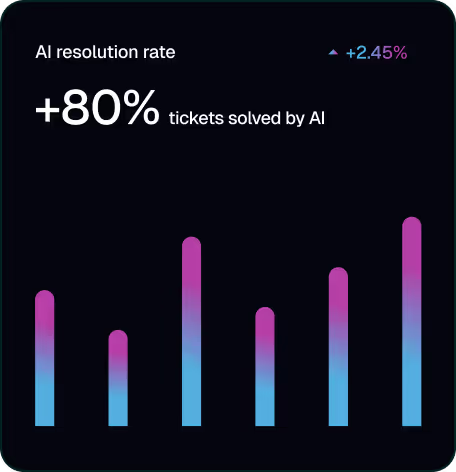
Tugi Tark's AI support infrastructure for iGaming resolves 80%+ of player tickets at roughly one-fifth the cost of human agents, with real-time player data access and built-in escalation logic. It was built by leaders who managed 10M+ tickets across 125+ iGaming brands as a BPO across 25+ markets, which is the operational basis for a routing and escalation architecture designed around actual iGaming ticket flow rather than generic support assumptions. How AI is replacing 80% of casino support tickets covers the resolution mechanics in more depth.
We are not improving customer support. We are rebuilding the infrastructure layer behind it for iGaming operators.
Common Mistakes iGaming Operators Make (and How to Avoid Them)
The most costly mistake is deploying the AI system before completing the JWT or API integration, which leaves it unable to resolve account-specific queries and forces escalation rates back up toward staffed-shift levels.
Mistake: connecting the AI system as a front-end widget without player data access.
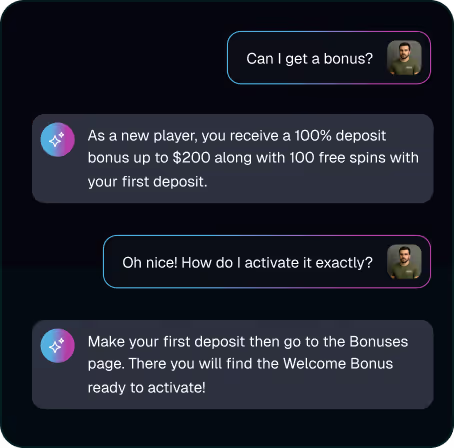
Why it happens: it is the fastest thing to switch on, so it gets treated as the finish line instead of step one. What it costs: the system can greet a player at 3 AM but cannot confirm a withdrawal status, so the ticket escalates anyway, and the support debt from unresolved overnight tickets accumulates into the next shift. How to avoid it: complete JWT or API integration before enabling AI-first routing on any queue.
Mistake: leaving ticket routing static by time zone.
Why it happens: time-zone routing mirrors the shift schedule the operator is trying to replace, so it feels like a safe default. What it costs: coverage still depends on which region's rules are active, recreating the shift dependency inside the configuration itself. How to avoid it: configure smart ticket routing on qualification and live availability, not on a fixed schedule.
Mistake: leaving Responsible Gaming tickets in the general queue overnight.
Why it happens: RG configuration is treated as a compliance afterthought rather than a routing rule set up alongside the rest of the system. What it costs: at-risk player signals sit in a general queue until a generalist agent notices them, which can become a documented compliance gap in regulated markets. How to avoid it: configure the dedicated Responsible Gaming module, with strictness set before launch, so RG tickets route to human agents automatically at every hour.
Mistake: running separate ticket queues per brand with no shared visibility.
Why it happens: multi-brand operators often inherit siloed queues from legacy tooling and never consolidate them. What it costs: the same escalation specialist ends up checking multiple queues manually overnight, recreating the exact coordination problem the automation was meant to remove. How to avoid it: enable single-queue multi-brand visibility so every ticket across every brand is visible from one place.
Expected Outcomes With Numbers
Operators who complete all four steps should expect the following architectural shift, not a gradual improvement on the existing shift model.
The gap between these two columns is architectural, not incremental. Cost per ticket, language coverage, and Responsible Gaming coverage stop depending on which shift happens to be staffed at a given hour, and start depending only on how the system is configured. The integration guide covers the technical requirements for each of the four steps in detail. Get in touch with the Tugi Tark team to see how to build it.
Frequently Asked Questions
What is required to build a 24/7 automated support system for a casino operator?
Building a 24/7 automated support system for a casino operator requires four technical layers: a real-time integration (JWT or API) giving the AI system live access to player and ticket data, smart ticket routing configured to work without shift handoffs, an escalation layer with specialist departments for complex cases, and a dedicated Responsible Gaming module active at every hour. Skipping any one of the four recreates a dependency on staffed shifts somewhere in the system.
How long does it take to integrate AI customer support infrastructure with an existing casino support stack?
JWT integration typically deploys in a matter of hours, making it the fastest path to a live pilot. API integration takes longer to configure but syncs player and ticket data in real time, which suits operators needing deeper ongoing synchronization across multiple internal systems.
How does smart ticket routing work without staffed shifts?
Smart ticket routing assigns tickets using four weighted parameters: player segment, ticket category, channel, and wait time, combined with live agent availability and qualification filters rather than a fixed schedule. This is why coverage does not depend on which team is logged in at a given hour.
What happens to Responsible Gaming tickets outside business hours?
A dedicated Responsible Gaming module, with strictness configurable by the operator, routes RG-flagged tickets to human agents automatically regardless of the hour they arrive. This routing rule runs independently of general ticket queues, so an RG signal at 3 AM is not left waiting for a generalist agent to notice it.
What is the difference between a chat widget and a full AI support infrastructure?
A chat widget answers generic questions without access to player data and still requires a human handoff for anything account-specific. Tugi Tark's AI customer support infrastructure connects to player and ticket data through JWT or API, resolves 80%+ of tickets directly, and routes the rest through smart ticket routing and a dedicated escalation layer, rather than leaving them in a queue for a human to notice later.
.png)