In ten years of customer service, I’ve learned that the costliest mistakes aren’t the big ones. They’re the small ones that repeat: the same wrong answer about wagering requirements, given a hundred times to a hundred frustrated players. Our new feature, knowledge gap analysis, is built to find those mistakes and stop them repeating.
The problem nobody has time to solve
Repeated mistakes rarely come from ill will. They survive because finding them means reading thousands of tickets. Even once you’ve found them, you still have to work out why they happen. Is the policy missing? Is it badly written? Did the agent not have the player’s data?
Most teams never get past the first step. The mistakes stay, players stay frustrated, and the same tickets keep coming back.
A judge that sees more than the conversation
Knowledge gap analysis puts an AI judge on every conversation your AI agent handles. It checks each reply against what you expect: your policies, your procedures, and the player’s data.
The judge doesn’t only read the messages. It also sees how each reply was produced.
“The judge is connected at a deep level,” says Oscar, our CTO. “It looks at what the AI actually did when it answered a ticket, like which searches it ran and which of them failed.”
That’s what lets it explain why a reply fell short, not just that it did. It can see whether the agent found nothing, found the wrong documents, or found the right document and still couldn’t answer from it.
When a reply falls short, the judge flags it as a gap. For each gap, you see the ticket, the date, the player’s question, the agent’s reply, the reason it fell short, and the gap type.
Eight types of gaps
Five gap types describe a reply that fell short. Three describe a message the agent couldn’t or shouldn’t answer.
When the reply fell short
- Not covered: The agent found nothing on the subject, or no knowledge base was configured. Example: a player asks about a tournament that was never added to the knowledge base.
- Retrieval miss: Documents came back, but every one of them was about something else. Example: a player asks about withdrawal limits, and the agent retrieves documents about deposit limits.
- Unclear document: The right document came back, but it was too vague to answer from. Example: the bonus terms say “wagering requirements apply” without saying what they are.
- Player data missing: The answer needed information about this player that no document holds. Either a profile field was empty, which you fix by sending it through the integration, or the answer needed live account data. Example: “Where’s my withdrawal?” when the agent can’t see transaction statuses.
- False action: The reply told the player something had been done, but the agent had no way to do it. The knowledge base isn’t the problem here, and the documents may have said clearly what the player needed to do themselves. Example: “I’ve changed your nickname for you.”
When the message is the issue
- Out of scope: The documents show this is something you don’t offer. Nothing needs fixing, but it tells you what players want and can’t have. Example: a request for a payment method you don’t support.
- Off topic: The message isn’t a support question.
- Unclear question: The message is too vague to tell what’s being asked.
Every gap has an owner
The gap type isn’t just a label. It tells you who fixes it.
- Not covered, retrieval miss, and unclear document go to your knowledge base content manager, who adds or rewrites content in the knowledge hub.
- Player data missing goes to your integration specialist, who adds the field to the API integration.
- False action comes to us. We adjust the agent so it stops promising things it can’t do and tells the player what they need to do themselves.
- Out of scope goes to whoever owns your product and commercial decisions, as a running record of what players are asking for.
- Off topic and unclear question need no fix, but they show you what’s reaching your support channel.
No more guessing whose problem it is.
From single tickets to patterns
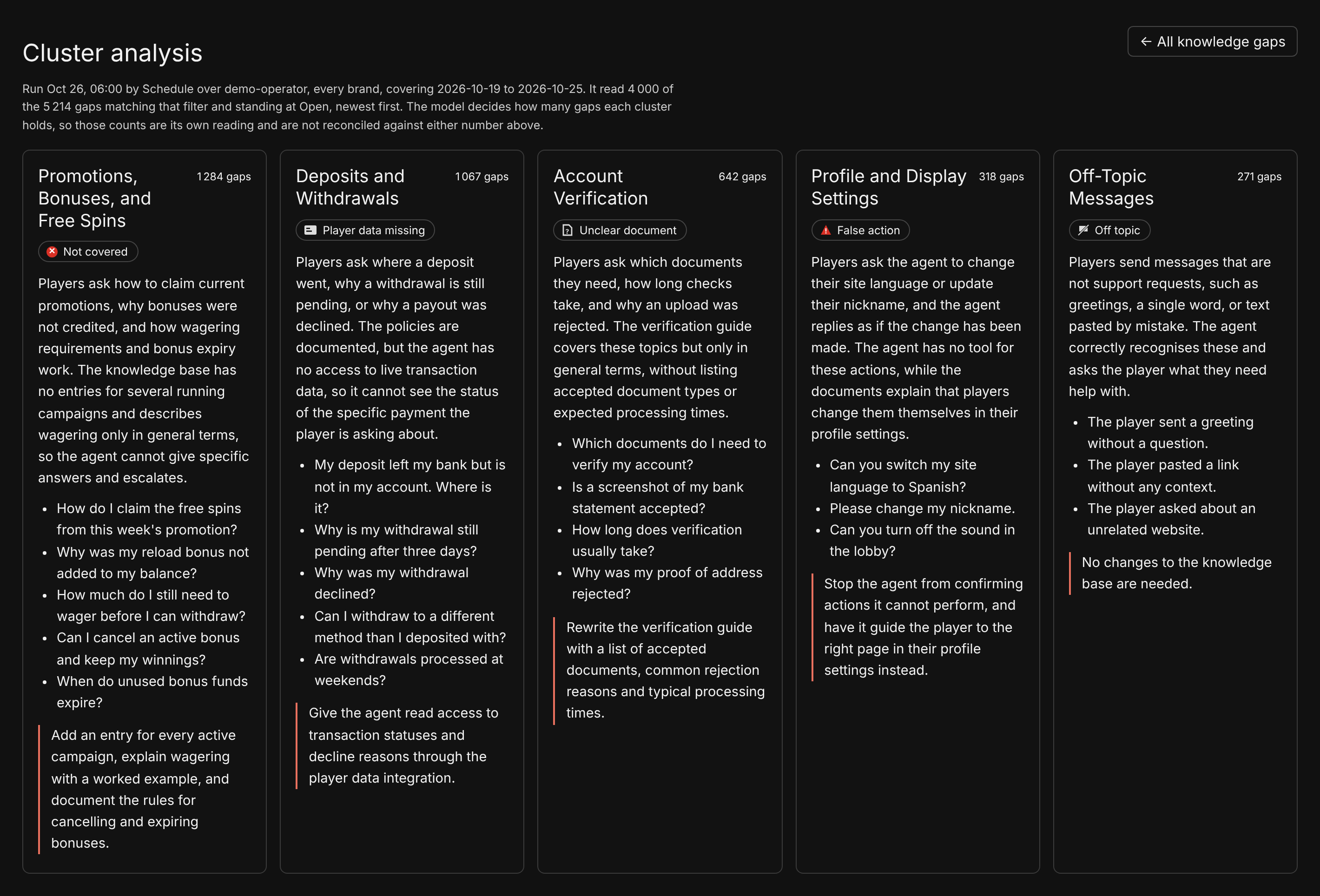
Reading gaps one by one is still a lot of reading, so the judge also groups them into themes. Here’s an example of a weekly run for a single operator, shown with illustrative data. The judge turned thousands of gaps into clear patterns. There were 1,284 gaps about bonuses, promotions and wagering rules the knowledge base never explained. Another 1,067 were about deposits and withdrawals the agent couldn’t look into, because it had no live transaction data.
That’s not a list of tickets anymore. That’s a to-do list for two people.
Where it works today, and why human agents are harder
Knowledge gap analysis currently runs only on conversations handled by our AI agent. Tickets answered by your human agents aren’t analyzed.
That’s not an oversight. The judge’s accuracy comes from seeing every step the AI agent took, and a human agent’s reasoning isn’t recorded the same way.
“It’s harder to judge why a person answered the way they did, so the results could get somewhat random,” Oscar explains.
We want to bring knowledge gap analysis to human agents, but only once it can be as reliable there as it is for AI. We’ll share more when we’re confident it meets that bar. The goal with this feature is to find gaps in your knowledge and data, not to score individual agents.
Want to see what the judge would find in your tickets? Book a demo.