Customer support scaling breaks on complexity, not volume. Each market a fast-growing casino enters adds a language, a jurisdiction's compliance requirements, a payment provider, and a distinct set of player expectations at the same time, and those variables multiply against each other rather than stacking the way player counts do. That distinction is the difference between how fast-growing casinos handle customer support scaling well and how most handle it badly, by staffing against ticket volume and discovering months later that volume was never the constraint. A casino live in three markets does not carry three times the support complexity of a casino live in one. It carries a support operation shaped by three separate language requirements, three separate compliance regimes, three distinct payment environments, and three sets of player expectations, and every one of those dimensions keeps expanding independently as the operator adds a fourth market, a fifth, a tenth. Headcount plans built against player volume have no mechanism to absorb that.
What Everyone Does: Plan Support Headcount Against Player Volume
The default scaling model tracks player growth and adds support headcount in step with it. It is a reasonable starting assumption: more players produce more tickets, and a staffing plan built against ticket volume is simple to justify against a rising queue. Scaling iGaming support without skyrocketing costs examines what this headcount growth does to the support budget as volume climbs, and how to scale casino customer support without hiring lays out the four-step operational framework for decoupling ticket capacity from headcount. The argument that most iGaming companies are scaling support wrong goes further and holds that headcount-first scaling is the wrong default in the first place. All three treat player volume as the axis the model breaks against. This one treats complexity as that axis instead, with volume as a separate problem.
A single-market operator handling 20,000 monthly tickets can staff against that number with reasonable accuracy: agents per shift, shifts per day, coverage per language. The plan holds because there is one language, one jurisdiction's compliance requirements, a small, stable set of payment providers, and a single set of player expectations behind every ticket in the queue. That plan does not carry over into a second market, regardless of how many tickets that market adds. The second market does not just add tickets. It adds a language the existing team may not speak, a jurisdiction's compliance requirements the existing workflows were never built around, a payment provider the existing support tooling has never had to route a ticket for, and a set of player expectations the operator has not yet had to design around.
Why Complexity, Not Volume, Is What Actually Breaks Customer Support Scaling
A casino entering a new market adds four variables at once, not one, and headcount planning built against player volume has no built-in mechanism for three of the four. Language, jurisdiction-specific compliance, payment providers, and player expectations do not track player count. They track market count, and they multiply against each other rather than adding to it. That is why a support operation planned correctly for a single market can look understaffed and undertrained within weeks of a second market launch, even when the second market's total ticket volume comes in below forecast.
No independent industry report currently publishes a benchmarked count of payment providers or licensing burdens per market for iGaming operators specifically, and this is a stated absence rather than an invented figure. What is verifiable is the scale each dimension can reach on its own. Tugi Tark's language layer covers 249 languages with on-the-fly translation, a range built because a genuinely global iGaming operator's language requirement is not fixed at the top handful of markets the way a headcount plan usually assumes. It expands with every new market, independently of how many players that market brings. Jurisdiction-specific compliance behaves the same way: a Responsible Gaming module has to be strictness-configurable per operator precisely because RG obligations are not uniform across licensing regimes, and a payment integration built for one market's banking environment frequently does not transfer to the next.
Generic support tooling built for horizontal, single-market business support makes this worse rather than better. A ticketing system architected around one language, one compliance regime, one payment stack, and one set of player expectations typically has no structural way to route a ticket differently once a fourth market introduces a fourth version of each, so the judgment that infrastructure cannot supply falls back onto whichever agent happens to pick up the ticket. More players does not mean simply more agents, and treating it as though it does is the headcount-first model's structural flaw. A support team sized correctly for a 50,000-player, single-market operation does not become correctly sized for a 200,000-player, four-market operation by multiplying headcount by four. It needs four times the ticket-handling capacity, and separately, four language capabilities, four compliance frameworks, four payment-routing paths, and four sets of player-expectation calibration that a volume-only plan never accounted for as a line item of its own.
What Should Happen Instead
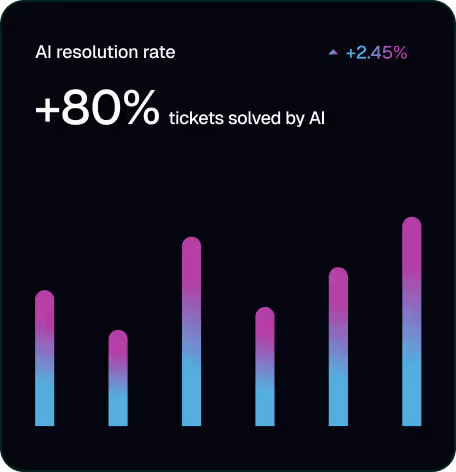
Designing for complexity from the start means building support capacity that absorbs a new market without being rebuilt for it, rather than headcount that has to be re-planned every time one is added. Tugi Tark is an AI-native customer service platform purpose-built for iGaming operators, and it handles each of the four variables through on-the-fly translation, configurable Responsible Gaming, and smart routing. Tugi Tark resolves 80%+ of player tickets today, at 18x the speed of a human agent and ≈€0.15 per AI-handled ticket against €1.02 to €2.41 per ticket for a human agent across nine European markets and the Philippines.
The language dimension is handled by 249-language on-the-fly translation, so a new market's language requirement is absorbed by existing infrastructure instead of triggering a hiring search for a native speaker. The jurisdiction dimension is handled by a Responsible Gaming module with strictness configurable per operator and automatic routing of RG-flagged tickets to human specialists, so a new licensing regime's obligations become a configuration change rather than a retraining program. The payment dimension is handled by smart ticket routing across specialized departments, finance, compliance, technical, CRM, and VIP, weighted on player segment, ticket category, channel, and wait time, so a ticket tied to an unfamiliar payment provider reaches the right department automatically instead of waiting on an agent who has to learn that provider's dispute process from scratch. Player-expectation differences are absorbed the same way, since routing logic reads player-segment and channel data on every ticket rather than requiring an agent to already know what a typical player in a new market expects. Integration runs on JWT deployment measured in hours or API sync in real time, and single-queue multi-brand visibility means a fourth market does not require a fourth, separately staffed queue behind it. Getting this right also protects retention: iGaming customer support strategies that reduce churn covers the broader link between resolution speed and player retention that a complexity-driven breakdown puts directly at risk.
What Acting Now Changes vs Waiting
An operator that designs for complexity before the second market launch enters that market with support infrastructure already capable of absorbing it. An operator that waits designs the fix under pressure, after tickets are already piling up in a language nobody on the team speaks and a compliance requirement nobody flagged before launch. The first path adds a market at a fixed rate of ≈€0.15 per AI-handled ticket, with a €99 per user per month license that applies to a much smaller team because AI resolves 80%+ of tickets. Total spend still grows with ticket volume, but the rate does not change. The second path adds a market at €1.02 to €2.41 per ticket, plus the recruiting, training, and turnover step-costs of every agent hired to cover a new language and compliance regime.
For an operator already planning a fourth or fifth market, the question is not whether complexity will multiply. It already does, every time a new market goes live. The question is whether that multiplication is absorbed by infrastructure built for it in advance or discovered by a support team scrambling to cover a language, a compliance requirement, a payment provider, and a set of player expectations it did not plan for, all in the same launch window. See the scaling infrastructure before that window opens rather than during it.
Frequently Asked Questions
Why does support break when a casino scales, even with more agents hired?
Support breaks at scale because operators size headcount against player volume, and volume is not the variable driving the breakdown. Each new market adds a language, a jurisdiction's compliance requirements, a payment provider, and a set of player expectations at the same time, and these multiply against each other rather than adding up the way player counts do. Hiring more agents adds ticket-handling capacity. It does not add language coverage, compliance familiarity, payment-provider knowledge, or an understanding of what players in that market expect, which is why a fully staffed team can still be structurally unprepared for a new market's complexity.
What is the difference between scaling support for volume and scaling it for complexity?
Scaling for volume means adding agents in proportion to ticket count, an approach that works within a single market where the language, compliance regime, payment providers, and player expectations stay constant. Scaling for complexity means building support capacity, language coverage, compliance routing, and payment-provider handling that does not need to be rebuilt every time an operator enters a new market. Tugi Tark's AI Support Infrastructure for iGaming is built for the second model, resolving 80%+ of tickets across markets at a fixed ≈€0.15 per AI-handled ticket, whichever market or language generated it.
How many languages does an iGaming operator need to support at full multi-market scale?
There is no fixed number, because the requirement expands with every new market an operator enters rather than settling at a stable count. Tugi Tark's AI support infrastructure covers 249 languages with on-the-fly translation specifically because a genuinely global iGaming operator's language footprint keeps growing rather than plateauing at a handful of major markets.
Does adding more support agents solve the payment-provider complexity that comes with entering a new market?
No. More agents add capacity to handle a known set of payment providers faster, but they do not give the team knowledge of a new payment provider's dispute process, settlement timeline, compliance requirements, or local reporting obligations the moment a new market goes live. Smart ticket routing that directs payment-related tickets to a specialized finance department, rather than to whichever agent is available, absorbs that gap without requiring every agent to learn every provider.