Most iGaming operators respond to rising player volume by hiring more support agents, and that default assumption is costing operators more than they may realize. Headcount scaling is linear: every additional agent brings recruiting, onboarding, and training costs on top of a human-handled ticket cost of €1.02 to €2.41 across nine European markets and the Philippines, and total support cost steps up every time the player base grows enough to require another hire. Linear headcount growth does not address the operational complexity driving the tickets in the first place, multilingual disputes, payment status queries, bonus term clarifications, and KYC document requests among them, because more customer service agents handling the same complexity at the same per-unit cost changes ticket capacity, not the underlying cost structure. What follows is the operational case for reducing human agents in gambling customer service in favor of an automation layer that grows capacity without growing headcount in step.
The Default Approach: More Players, More Agents
The default approach follows player growth almost automatically. As registered players and ticket volume increase, iGaming operators add support agents to keep response times and coverage stable. The logic is intuitive, more tickets require more hands, and it works well enough in the short term that most operators never formally reconsider it. Headcount additions are visible, measurable against ticket backlogs, and simple to justify against a rising support queue.
The approach holds up only as long as ticket volume grows slowly enough that hiring cycles keep pace with it. Recruiting, onboarding, and training a new support agent to handle iGaming-specific disputes, KYC documentation, and responsible gambling escalations typically spans several weeks before that hire reaches full ticket-handling capacity. Ticket volume, by contrast, tracks player growth in near real time, particularly around promotions, new market launches, and payment method rollouts that generate ticket spikes with no advance notice to a hiring plan. The mismatch between hiring lag and player growth is where the default approach starts to break, not at some distant future scale, but at the point where growth outpaces the speed at which new support agents can be trained and deployed.
Shift coverage compounds the mismatch further. A support desk staffed to cover 24/7 demand across multiple time zones needs headcount for every shift, every language pairing on that shift, and every market operating in it, before a single additional ticket from player growth is accounted for. Each new market or language an operator adds requires shift coverage across that market or language, not a single additional hire, which is why headcount plans built around ticket volume alone consistently understate what player growth actually costs in staffing.
Why Headcount Scaling Doesn't Solve Operational Complexity
Headcount scaling adds capacity, not capability, and iGaming ticket complexity requires capability. A newly hired support agent processes the same categories of tickets, at the same per-ticket cost, as the agent hired a year earlier, regardless of how many regulated markets, payment methods, or languages the operation now covers. Complexity in iGaming support comes from breadth: responsible gambling cases that require jurisdiction-specific handling, payment disputes tied to KYC verification, multilingual queries across a 249-language footprint, and bonus term clarifications that vary by market. Adding support agents multiplies the number of people covering that breadth without reducing the breadth itself.
Generic ticketing systems built for horizontal business support compound the mismatch. These tools route and tag tickets without iGaming-specific context, leaving support agents to manually apply the judgment a purpose-built system would apply automatically. That manual overhead is a form of support debt that accumulates with every ticket added to the queue regardless of headcount. Hiring more customer service agents to work inside that gap adds cost without closing it.
The Case for Reducing Human Agents in Gambling Customer Service
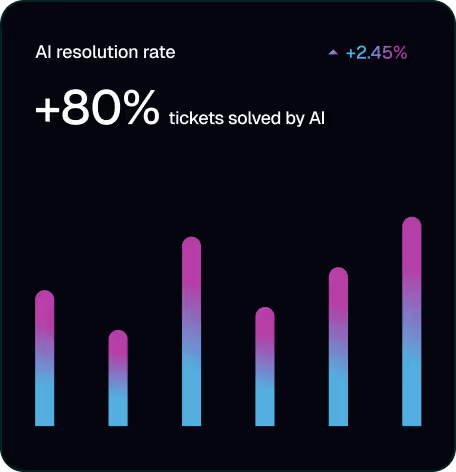
Reducing human agents in gambling customer service means capping headcount growth against ticket volume, not eliminating human judgment from support operations. AI customer support Infrastructure for iGaming resolves 80%+ of player tickets today, at ≈ €0.15 per AI-handled ticket under its operator pricing model, alongside a €99 per user per month license. A human agent costs €1.02 to €2.41 per ticket, and adding capacity means recruiting, training, and turnover. The AI rate stays at about €0.15 whether it is the first ticket of the month or the ten-thousandth, with none of those step-costs, and because the AI resolves 80%+ of tickets, the per-user license applies to a much smaller team. Total spend still grows with volume, but at a known rate, which is the mechanism for scaling iGaming support without skyrocketing costs documents in more detail.
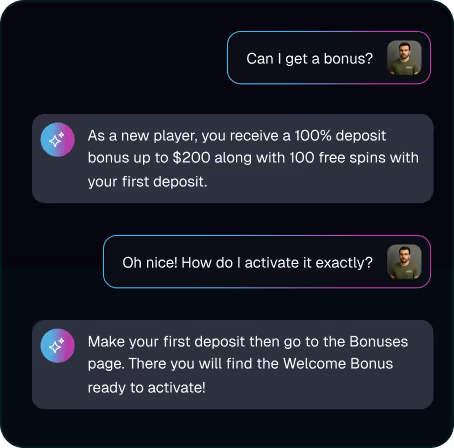
The automation layer does not remove support agents from the operation. It removes the requirement that operators track ticket count. Tugi Tark's AI agents perform at the level of the best human agent on every interaction, resolving tickets 18x faster. AI agents resolve. They don't deflect: they pull player profile, policy, and transaction data in real time to close a ticket instead of routing it elsewhere. Operators combining AI resolution with human escalation for responsible gambling cases and complex disputes report a 64% reduction in support cost at a 70% AI resolution rate, a benchmark that reflects capacity added through automation rather than through additional hires. How AI is replacing 80% of casino support tickets documents the resolution mechanism operators are running today, and why automation is the only way to sustainably reduce ticket volume in iGaming applies this same reasoning to the headcount decision specifically.
What Operators Risk by Scaling the Wrong Way
Operators who keep hiring against ticket volume carry a support budget that steps up with every hire, while operators running an automation layer pay a fixed rate of ≈ €0.15 per AI-handled ticket, with no recruiting, training, or turnover cost for added capacity. The gap compounds with every growth cycle: a support budget built on headcount needs another hiring cycle for every future spike in players, while a support budget built on automation absorbs that spike at the same per-ticket rate it already carries. License pricing runs €99 per user per month on an annual basis (€1,188 per user per year), a predictable base that applies to a much smaller team once the AI resolves 80%+ of tickets.
Board-level budgeting is where the difference shows up first. A support cost forecast built on headcount has to model every future hiring cycle against every projected growth scenario, with recruiting lag and onboarding time built into each projection. A support cost forecast built on a fixed per-ticket rate does not carry the hiring-cycle variable, because the per-ticket rate for automated resolution stays the same across the scenarios an operator is modeling, even though total spend still moves with ticket volume.
Headcount does not stop being useful under this approach. Human judgment remains necessary for responsible gambling escalations and complex disputes that require discretion an automated system should not exercise alone. The exposure is in treating headcount as the default lever for scaling support: a lever with a fixed, non-shrinking cost per unit, applied to a problem, operational complexity, that adding agents does not reduce. Tugi Tark was founded by leaders who managed 10M+ tickets across 125+ iGaming brands in 25+ markets as a BPO, and that experience is the basis for how the platform handles real iGaming ticket flow. See the right way to scale before the next growth cycle forces the choice.
Frequently Asked Questions
Is hiring more support agents the right way to scale iGaming customer service?
Hiring more support agents addresses ticket volume but not the operational complexity behind it. A human-handled ticket costs €1.02 to €2.41 across nine European markets and the Philippines, and each added agent brings recruiting, training, and turnover costs on top, so total support cost steps up with every hire.
Why doesn't headcount scaling solve operational complexity in iGaming support?
Headcount scaling adds people to cover the same ticket categories at the same per-unit cost, without reducing the breadth of languages, jurisdictions, and payment disputes driving that complexity. A newly hired support agent handles the same ticket categories at the same cost as any other agent, across whatever languages and regulated markets that agent covers, so adding headcount increases capacity without changing the underlying cost structure.
What does reducing human agents in gambling customer service actually mean?
Reducing human agents in gambling customer service means capping support headcount growth against rising ticket volume by routing resolvable tickets through an automation layer instead of new hires. Tugi Tark resolves 80%+ of player tickets at ≈ €0.15 per AI-handled ticket, a fixed per-ticket rate with no recruiting, training, or turnover cost for added capacity, while human agents stay focused on escalations and responsible gambling cases.
How much does AI ticket resolution cost compared to human agents?
AI-driven resolution costs ≈ €0.15 per AI ticket under Tugi Tark's operator pricing model, compared to €1.02 to €2.41 per ticket for human agents across nine European markets and the Philippines. Operators combining AI resolution with human escalation report a 64% reduction in support cost at a 70% AI resolution rate.
What is Tugi Tark's approach to scaling iGaming support?
Tugi Tark is an AI-native customer service platform purpose-built for iGaming operators, resolving 80%+ of player tickets across 249 languages at a flat cost per resolution. The infrastructure grows capacity with ticket volume without requiring proportional headcount growth, closing the structural gap that headcount-only scaling cannot close.
.png)