Response Time and Revenue in Gambling Support Data
In the one iGaming market with published player-behaviour data, 78% of surveyed players say withdrawal speed and simplicity decide where they place their bets (iGaming Business, South Africa cohort, 27 April 2026). That figure is a revenue signal: a stalled withdrawal ticket is the moment a player decides, in real time, whether to keep depositing with an operator or move the balance to a competitor whose payout is faster. No independent source publishes a response-time-to-revenue figure for iGaming support, so this article reasons from verified inputs about what response speed protects, session revenue and retained deposits, rather than a revenue-per-minute number that does not exist. Operators searching for how fast support response increases casino LTV are asking the retention version of the same question; this piece prices the revenue version instead.
Where the 78% Figure Comes From, and Why No Revenue Number Pairs With It
The 78% figure comes from a South African player survey cited in iGaming Business's April 2026 cohort study, and it sits inside a steep decay curve: active players in the same cohort fell from 17.6% on day 1 to 3.5% on day 7 and 0.88% on day 28, while logging the highest average daily play time in the dataset at 26.9 minutes. High play time next to near-zero retention is a friction signal, not a waning-interest one, and 78% of surveyed players say withdrawal speed influences where they bet. Both figures are scoped to one market and stay labelled that way rather than generalised to iGaming as a whole.
No independent body publishes a figure for how much revenue a casino operator recovers or loses per minute of support response time, in South Africa or anywhere else. A companion article on this same mechanism treats the gap as a retention curve; this one treats it as a cost and margin calculation built from three verified inputs: what Tugi Tark resolves and how fast, documented in how AI is replacing 80% of support tickets; what a ticket costs to resolve, human versus AI-handled; and the share of players who tie payout speed to where they bet. Each input is sourced on its own, and none stands in for a revenue-per-minute figure that does not exist.
The tickets doing the work behind the 78% figure are specific and repeatable: a withdrawal that has not landed, a deposit that failed at the cashier, a bonus that did not credit before a session ended, a KYC hold blocking a payout. Every one of these is a support ticket before it is anything else, and every one of them sits directly on top of money already committed to the operator. Pricing the revenue at stake in that ticket type is a narrower exercise than pricing lifetime value across the whole player relationship, and it is the exercise this article runs.
Why the Same Tickets Are Structurally the Ones Under the Most Load
The tickets that carry money cluster in the exact windows when a staffed queue is slowest. Ticket volume spikes around weekends, tournament conclusions, and bonus campaigns, the same windows when deposit activity peaks, and a queue staffed for the average either carries idle cost the rest of the week or lets response time stretch from minutes to hours exactly when the most funded players are waiting on a payout. The wider set of support strategies that reduce churn addresses retention across the whole support operation; the revenue exposure described here sits specifically in the ticket queue during that window, not across the broader relationship.
A failed deposit or a stalled withdrawal carries a retention window measured in the session itself, and switching costs in iGaming are low: a player can open a competitor account and move a balance before a queued ticket is even assigned. That is the mechanism the 78% figure describes, and it is the reason response time on these specific ticket types behaves like a revenue lever rather than a service metric reported after the fact.
A staffed queue also cannot route around the players who matter most during that window. Cross-sold casino players show the lowest churn in the South African cohort, while sportsbook-only and bonus-led first-time depositors show the highest, which suggests the segments most likely to leave are often the ones acquired through bonus-led offers, though the study does not tie that churn to withdrawal speed. A queue that treats every ticket the same, first in, first out, resolves the wrong ticket first as often as it resolves the right one, and the revenue difference between those two outcomes is the whole point of measuring response time in revenue terms rather than in minutes alone.
How Fast Support Response Increases Casino LTV, Priced as Revenue
How fast support response increases casino LTV turns into a revenue number once resolution, not reply, is the unit measured. Tools such as Zendesk and Intercom were built to speed up replies for e-commerce and SaaS, priced at roughly €85 to €169 per agent per month before the extra headcount needed for 24/7 and multilingual cover (2026 vendor pricing). Out of the box, they are not built around live deposit, withdrawal, or KYC state, so unless an operator builds that integration, an agent looks the case up by hand at the exact moment revenue is at risk, and a faster acknowledgement does not shorten the wait for the money question to be answered.
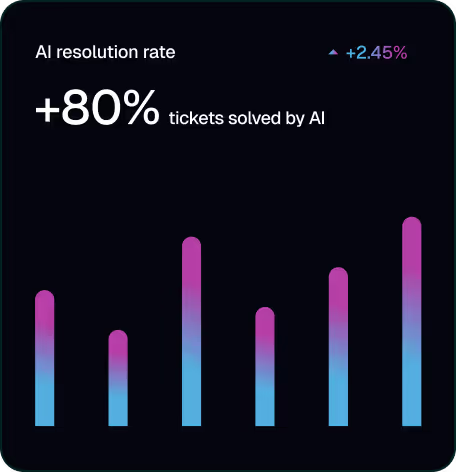
Tugi Tark resolves 80%+ of player tickets without escalation, 18 times faster than a human agent, at ≈ €0.15 per AI-resolved ticket against €1.02 to €2.41 for a human-handled one across nine European markets and the Philippines. That is the revenue-protecting side of the calculation: a ticket resolved inside the session it was raised in is a deposit that stays in play, and a ticket cleared at a fixed ≈ €0.15 rather than through added staffing is a per-ticket cost that stays predictable as volume grows. The same €1.02 to €2.41 figure anchors the support cost per player benchmark, because a ticket resolved late does not only cost more to handle, it puts revenue already moving through the deposit window at risk.
Both halves of that figure move together rather than trading off against each other. A staffed queue forces a choice between coverage and cost: adding agents for a weekend spike adds recruiting, training, and salary cost whether or not the spike materialises, and cutting agents to control cost lengthens the queue exactly when deposit activity peaks. An AI-handled ticket removes that trade-off, because the rate for resolving one more withdrawal ticket during a tournament weekend is the same ≈ €0.15 it is on a quiet Tuesday, so response time on time-sensitive tickets does not degrade as volume rises. Because the AI resolves 80%+ of tickets, the per-user license applies to a much smaller team.
What Operators Should Do With This Number Now
Operators should treat response time on payment and withdrawal tickets as a revenue metric owned by the same team that owns retention and deposit volume, alongside the support-desk SLA it already reports. The 78% figure means withdrawal speed already factors into where a meaningful share of players choose to keep betting, and the cost gap means resolving those tickets faster does not cost more: an AI-handled ticket runs at roughly one-fifth the cost of a human-handled one, per Tugi Tark's verified performance data, while removing the delay that puts the deposit at risk.
AI Customer Support Infrastructure for iGaming is a purpose-built automation layer that resolves payment, withdrawal, and KYC tickets without a human agent for the majority of volume, and Tugi Tark is an AI-native customer service platform purpose-built for iGaming operators. Operators can see the revenue impact data behind this calculation and check it against their own ticket mix and deposit patterns.
Frequently Asked Questions
How does fast support response increase casino LTV in revenue terms?
In the one iGaming market with published player-behaviour data, 78% of surveyed players say withdrawal speed and simplicity decide where they place their bets, which ties a specific support ticket type directly to where deposit revenue goes (iGaming Business, South Africa cohort, 27 April 2026). No independent source publishes a response-time-to-revenue figure for iGaming, so this connection is built from verified inputs about what response speed protects, not cited as a single measured correlation.
Is there a published figure for how much revenue support response time protects in iGaming?
No. No independent body publishes a revenue-per-minute or response-time-to-revenue figure for iGaming support, in South Africa or any other market. The available evidence is the South African cohort data on withdrawal-speed sensitivity, Tugi Tark's verified resolution and cost performance, and the per-ticket cost gap between human and AI resolution, each sourced separately and never combined into a single cited correlation.
How much does Tugi Tark resolve compared with a human agent, and at what cost?
Tugi Tark resolves 80%+ of player tickets without escalation, 18 times faster than a human agent, at ≈ €0.15 per AI-handled ticket against €1.02 to €2.41 for a human-handled one across nine European markets and the Philippines. That gap runs at roughly one-fifth the cost of a human-handled ticket, on Tugi Tark's verified performance data.
How is this article different from the LTV article on the same support mechanism?
How Faster Support Response Increases Casino Player LTV treats withdrawal and deposit ticket speed as a retention curve; this article treats the same tickets as a revenue and margin calculation built from cost per ticket, resolution speed, and the share of players who tie payout speed to where they bet. Both use the same underlying mechanism, and only the financial lens applied to it differs.
.png)