Most AI support systems marketed to iGaming operators share the same origin story: built for retail, telecom, or general SaaS support first, then adapted to gambling workflows afterward. That gap does not show up on a feature page. It shows up the moment a withdrawal dispute or a Responsible Gaming flag reaches the queue and the automation layer has no purpose-built logic for either one.
This is a criteria breakdown for evaluating AI support systems in iGaming, not a vendor ranking. Operators who want the specific system-by-system scoring on resolution depth, pricing, and multilingual coverage can read the full ranked comparison of the top five systems. This article covers what separates a system built for iGaming from one adapted to it, and the red flags that signal the second category before a contract gets signed.
What to Look For in an AI Support System for iGaming
Four criteria determine whether a system resolves iGaming support tickets or simply reduces the number reaching a human agent. Each one shows up in the contract, the integration scope, and the first month of ticket data, not in the sales deck.
Native Responsible Gaming and compliance logic
A dedicated Responsible Gaming module, with strictness configurable by the operator and automatic routing to human agents for flagged tickets, is not an add-on feature. It is the line between a system built for gambling operations and one that treats compliance as a workflow the operator's own team has to build manually. Systems without native RG logic still function as support automation, but every jurisdiction-specific escalation rule, every RG threshold, and every KYC verification step becomes custom configuration work on the operator's side before the system is safe to run on regulated ticket categories. Tugi Tark's Responsible Gaming module is dedicated and configurable at the operator level, a design choice built for gambling compliance from the start rather than compliance retrofitted onto a general flow builder.
Resolution depth on payment and dispute workflows
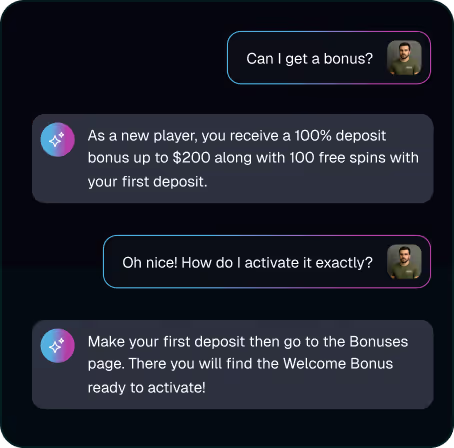
Resolution means the AI agent closes the ticket using real player data. Deflection means the AI agent filters the ticket down to a scripted response and routes anything account-specific back to a human queue. Payment queries, bonus disputes, and KYC escalations carry the highest volume and the highest compliance exposure in iGaming support, and a system that scripts a generic bonus-policy answer while escalating every account-specific bonus question for the same category is not resolving that ticket category at all. Tools positioned as lightweight automation for betting and casino operators, such as Cevro.ai, frame their coverage explicitly around FAQ-style responses to common pre-account questions, which reduces simple contact volume without carrying the resolution load of a withdrawal dispute or a KYC escalation. The distinguishing signal is whether the AI agent pulls live data from the player profile and account policies to close the ticket, or whether it matches the question to a pre-written answer and stops there. AI agents resolve. They don't deflect.
Native multilingual coverage, not translation bolted on
Operators serving 10 or more regulated markets need to run dispute and Responsible Gaming conversations in the player's language without added latency, because a translation layer stacked on top of a generic engine introduces delay precisely where response time matters most in a payment dispute. Tugi Tark runs 249 languages natively with on-the-fly translation and no added latency across markets, illustrating what native coverage looks like structurally. Systems marketed around strong multilingual live chat, such as Comm100's omnichannel coverage, can match that breadth of languages, but broad language support alone does not add the iGaming-specific ticket categories, dispute logic, and Responsible Gaming routing that determine whether the conversation actually resolves once it is translated.
A pricing model that does not punish scale
Per-agent and per-seat pricing structures grow support cost in direct proportion to headcount and ticket volume, which defeats the purpose of automation the moment player growth accelerates. The pricing model to look for charges per user plus per AI handled ticket, producing a flat rate per ticket at any volume rather than a cost that rises with headcount. Tugi Tark's structure, €99 per user per month plus €0.15 per AI ticket, reflects that model: cost grows with value delivered, not headcount. Several systems evaluated in the full ranked comparison, including Moveo.ai and Cevro.ai, use custom quote-based pricing that operators cannot benchmark against a per-ticket cost until a full sales process runs its course.
Operational pedigree built from iGaming support, not adapted to it
A system's resolution logic reflects where it came from. Tugi Tark's founders managed 10M+ tickets across 125+ iGaming brands as a BPO across 25+ markets before building the system, and the fee-per-ticket pressure of that BPO model, producing more resolutions with fewer resources every day, shaped the routing logic around real gambling workflows: withdrawal disputes, bonus abuse patterns, and KYC escalation paths. Systems that position themselves as horizontal automation tools with iGaming as one of several expansion verticals, such as Moveo.ai, bring strong conversational engines built on large language models, and in that model the gambling-specific compliance and dispute logic typically falls to the operator's own team to configure.
Red Flags to Avoid When Evaluating AI Support Systems for iGaming
The following signals show up consistently in systems adapted to gambling after the fact, rather than built for it from the start. Any one of them on its own is worth a direct question during vendor evaluation, before the integration scope gets defined.
A generic AI wrapper with no dedicated Responsible Gaming module
If Responsible Gaming routing is not a named, configurable feature, it does not exist as a purpose-built capability. It exists as a manual workflow the operator's compliance team has to build and maintain outside the core system.
"Resolution rate" used to describe what is actually a deflection rate
Some vendors report automation percentages without defining whether the ticket closed with the player's issue solved or simply stopped reaching an agent. A resolution number without a definition of what counts as resolved is a marketing figure, not an operational one.
Custom, quote-based pricing with no visible per-ticket cost
An operator cannot model support cost against ticket volume growth without knowing what a resolved ticket costs. A pricing page that routes every prospect into a sales call before revealing a number is a sign the vendor has not built the pricing model around operator economics.
Translation stacked on top of a general-purpose engine
Multilingual coverage that requires a separate translation layer on top of the core conversation engine adds latency exactly where speed matters most, in an active payment dispute or an urgent RG flag.
Compliance claims without jurisdiction-specific detail
"Compliant" and "regulated industries supported" are not the same as a Responsible Gaming module with configurable strictness and automatic human routing. Operators should ask which specific RG thresholds and escalation paths the system handles natively, not whether it is generally described as compliance-ready.
No visibility into what happens after escalation
A system that escalates a ticket to a human agent without preserving the player context, prior conversation history, and policy data forces the human agent to start the resolution from zero, erasing most of the cost advantage automation was supposed to deliver.
Where Tugi Tark Fits This Checklist
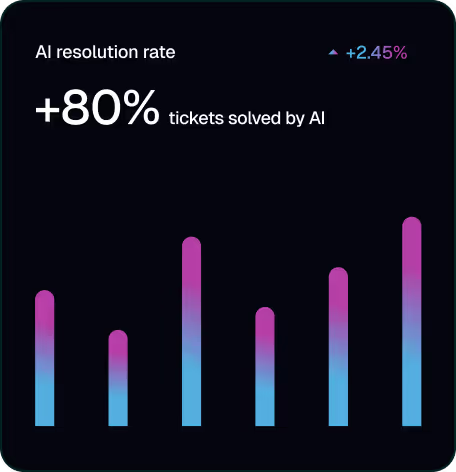
Tugi Tark is AI Customer Support Infrastructure engineered specifically for iGaming operators, built by founders who ran BPO support operations across 125+ iGaming brands before building the system rather than adapting a horizontal product afterward. Its AI agents pull real-time data from the player profile, account policies, and the iGaming knowledge base to resolve tickets end to end, resolving 80%+ of tickets at a level matching the best human agent, 18x faster and at 1/5th the cost of a staffed agent. The Responsible Gaming module is dedicated and configurable, the 249 supported languages run natively without added latency, and pricing follows a flat rate per ticket at any volume rather than one that rises with headcount. Against every criterion above, it was built from iGaming support operations rather than adapted to them afterward.
Operators comparing systems against this checklist can test the AI agent directly on real casino scenarios rather than evaluating feature lists alone, or review the full capability set before shortlisting vendors. For the complete vendor-by-vendor scoring across five systems, including Moveo.ai, Comm100, and Cevro.ai, the ranked comparison covers pricing, resolution model, and compliance coverage side by side. Operators still running support through legacy support systems not built for gambling operations face the same checklist gap at a larger scale, since every criterion above compounds as ticket volume grows. The functional requirements specific to gambling support, beyond what any general-purpose support tool covers, are detailed in what casino-specific support software actually needs to do.
Frequently Asked Questions
What should iGaming operators look for in an AI support system?
iGaming operators should look for a dedicated Responsible Gaming module with configurable strictness, resolution depth on payment and dispute workflows rather than surface-level deflection, native multilingual coverage without added translation latency, and a pricing model that charges a flat rate per ticket rather than scaling with headcount. Operational pedigree from real iGaming support operations, not a horizontal product adapted to gambling, is the underlying signal behind all four.
What is the difference between an AI support system that resolves tickets and one that deflects them?
A system that resolves tickets pulls real-time data from the player profile and account policies to close the ticket itself, while a system that deflects tickets matches the question to a scripted response and routes anything account-specific back to a human queue. Tugi Tark resolves 80%+ of tickets end to end using live player and policy data, which is the resolution model operators should look for when evaluating a vendor's automation claims.
Why does Responsible Gaming routing matter when choosing an AI support system for iGaming?
Responsible Gaming routing matters because RG tickets carry direct regulatory exposure, and a system without a dedicated, configurable RG module leaves that compliance logic for the operator's own team to build and maintain manually. A purpose-built module routes flagged tickets automatically to human agents rather than treating RG as a generic support category.
How is Tugi Tark different from a generic AI support tool marketed to iGaming?
Tugi Tark is AI Support Infrastructure built specifically for iGaming operators, with resolution logic shaped by founders who ran BPO support operations across 125+ iGaming brands. It resolves 80%+ of tickets using live player and policy data, includes a dedicated Responsible Gaming module, and runs 249 languages natively, none of which are standard in general-purpose conversational tools positioned for gambling as a secondary market.
Where can operators see a full ranked comparison of AI support systems for iGaming?
Operators can read the full ranked comparison covering Tugi Tark, Moveo.ai, Comm100, and Cevro.ai side by side on resolution model, multilingual coverage, Responsible Gaming handling, and pricing structure.