The real choice behind live chat versus AI-first support for casino player retention is not which channel players prefer typing into. It is which approach keeps a player active after the support interaction ends. Live chat and AI-first resolution solve different parts of that problem, and treating them as interchangeable costs operators more than a support line item. It costs retained players.
The comparison in this article is not live chat against a scripted response tool. Tugi Tark, referenced throughout as the AI Support Infrastructure for iGaming, is not a chatbot. It resolves player requests using real-time access to player profiles, policy data, and iGaming-specific knowledge, not a fixed decision tree with pre-written replies. That distinction matters because retention outcomes track with resolution quality, not with the format of the response.
This article compares live chat and AI-first support on the dimensions that actually move player retention: response speed, multilingual coverage, consistency at peak volume, and resolution depth. The data points to one conclusion. A hybrid model, AI resolving the volume and human operators handling what genuinely needs judgment, retains more players than live chat operating on its own.
What Live Chat Was Actually Built For
Live chat is a real-time messaging channel connecting a player directly to a human support operator during a browsing or gaming session, originally built to shorten email response times for e-commerce and SaaS businesses. The value proposition is straightforward: instead of waiting hours for an email reply, a player gets a human on the other end within minutes.
For that original use case, live chat delivers. A player asks a simple question, an available operator answers, the session closes. It works well when volume is predictable, the support team is fully staffed, and the query does not require deep account context.
The structural limit appears the moment iGaming operations apply it at scale. Live chat capacity is bound by the number of staffed operators available at any given hour, so response quality depends entirely on headcount planning across time zones. During tournaments, promotional pushes, or major sporting events, the same fixed headcount faces a volume spike, and queue times stretch exactly when players are most likely to abandon a deposit, a withdrawal question, or the session itself. Live chat also does not retrieve player account history, deposit status, or bonus terms on its own. The operator has to look those up manually before responding, adding delay at the point where speed most influences whether a frustrated player stays or leaves. Live chat implementations built on general-purpose tools such as Zendesk Chat commonly run in the same €55 to €115 per agent per month range as other Zendesk products, before the added headcount needed for 24/7 or multilingual coverage is factored in.
What AI Support Infrastructure for iGaming Was Actually Built For
AI Support Infrastructure for iGaming is a purpose-built automation layer that resolves player support requests directly, without routing every interaction through a human queue first. Tugi Tark was founded by leaders who managed 10M+ tickets across 125+ iGaming brands as a BPO operation, and that ground-level exposure to withdrawal queries, bonus disputes, KYC escalations, and responsible gaming requests shaped an infrastructure built for gambling operations specifically, not adapted from a general support tool.
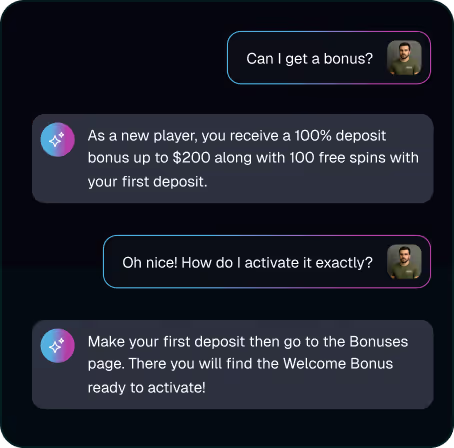
The AI agents retrieve player profile data, policy context, and iGaming-specific knowledge in real time at the moment of contact, and act on it. AI agents resolve. They don't deflect. That distinction is the core of the retention argument: a player who reaches a dead end gets frustrated regardless of how fast the dead end arrived, while a player whose issue is actually closed out has a reason to keep playing.
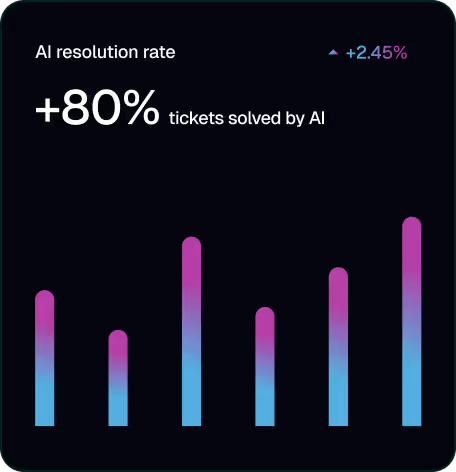
Tugi Tark resolves 80%+ of tickets, operating at the level of the best human agent, and does it 18x faster than a human operator working the same queue. Multilingual coverage runs to 249 languages natively, which removes the staffing constraint that caps live chat's language reach to whichever operators happen to be on shift.
Live Chat vs AI-First Resolution: What Player Retention Actually Depends On
The table isolates the mechanism behind the retention gap. Live chat's queue-based model means resolution quality is highest when volume is lowest, which is the opposite of when retention pressure is highest. AI support infrastructure holds resolution quality steady because cost grows with value delivered, not headcount, so adding volume does not degrade the response a player receives.
The Real Retention Difference
Player retention tracks with how a support interaction resolves, not with which channel a player typed into. A player who reaches a resolved outcome on a withdrawal question, a bonus term, or a KYC step has no operational reason to leave. A player left waiting in a live chat queue during a promotional peak, or one whose issue gets acknowledged but not actually closed, has both a reason and a moment of frustration attached to the operator's product.
Cost data reinforces the mechanism rather than replacing it. Human agent cost across 9 European markets and the Philippines runs €1.02 to €2.41 per ticket, compared with €0.15 per AI-resolved ticket, and operators running at 70% AI resolution see a 64% cost reduction against a fully human-staffed model. That gap is not just a margin story. It is budget that would otherwise fund additional live chat headcount for peak coverage, freed up to fund proactive support instead, where the integration detects an event such as a failed deposit and the AI agent opens with player context already loaded, closing the gap before the player has to initiate contact at all.
Industry analysts project 80% of customer interactions will be AI-handled by 2029, according to Gartner, and separate industry estimates put automation potential in the 60 to 80% range across support-heavy sectors. Tugi Tark resolves 80%+ of tickets today, ahead of where the broader industry benchmark expects the market to land within the decade.
Where Live Chat Still Makes Sense (and Where It Doesn't)
Live chat remains a legitimate channel in specific, narrower contexts. High-touch VIP negotiations, account managers building a personal relationship with top-tier players, and edge cases requiring genuine human discretion all benefit from a human typing in real time, and no amount of automation should remove a human from those interactions. AI support infrastructure is not positioned to replace that layer. It is positioned to absorb the volume that does not require it.
The signal that live chat has stopped working as a primary support channel is predictable: queue times stretching during promotional peaks, operators fielding the same withdrawal or bonus questions repeatedly without that repetition ever reducing headcount needs, or multilingual demand exceeding what the current staffing roster can cover natively. Those are signs that legacy support systems are becoming an operational constraint rather than a functioning retention tool. AI support infrastructure remains a viable option at any ticket volume, since the €0.15 per-AI-handled ticket cost means spend tracks usage rather than requiring a minimum ticket count to justify deployment.
What Operators Choose Hybrid AI For
The shift from live-chat-only support to a hybrid AI-first model is driven by a specific set of retention-relevant pressures, not by a general preference for automation.
Peak-period churn risk becomes measurable.
Tournaments, major sporting events, and promotional pushes create predictable volume spikes that a fixed live chat headcount cannot absorb without queue times stretching. AI support infrastructure holds resolution quality flat through those spikes, which is precisely when player patience is at its lowest.
Multilingual retention gaps show up in expansion markets.
An operator expanding into Germany, Brazil, or Japan cannot staff native-language live chat operators fast enough to match launch timelines. Players routed to email or callback because no operator speaks their language are players with a concrete reason to look elsewhere. Automated coverage across 249 languages closes that gap from day one of a market launch.
Resolution consistency breaks down with operator turnover.
Live chat quality depends on individual operators knowing policy detail and player history, and turnover resets that knowledge repeatedly. AI support infrastructure applies the same policy logic and pulls the same player context regardless of which shift is running, removing the retention risk tied to staffing changes.
Proactive retention requires a channel live chat cannot provide.
Live chat is reactive by design. It waits for the player to initiate contact. Proactive support, where the integration detects an event like a failed deposit and opens with context pre-loaded, catches the friction point before it becomes a support ticket at all, and that capability sits structurally outside what a chat widget can do.
Tugi Tark's AI support infrastructure for iGaming is built for all four of these retention pressures, with resolution workflows already mapped to the support patterns that most commonly cost operators active players. For a closer look at how resolution speed and consistency connect to retention outcomes, see the retention data on how AI-first support compares to live chat over a full player lifecycle. The broader shift toward AI agents handling front-line support is covered in the rise of AI agents in iGaming, including how human-AI collaboration is structured once live chat moves to an escalation-only role.
How to Decide
This is a concrete decision framework based on where live chat stops protecting retention and starts costing it.
For player intelligence on which support interactions correlate most with churn, player intelligence covers how support data itself becomes a retention signal. For the broader shift in what player-facing support looks like as AI-first resolution becomes standard, see the future of iGaming customer service. For a usage-based cost model mapped to current ticket volume, see the iGaming support software pricing page.
Frequently Asked Questions
Is live chat still effective for casino player retention?
Live chat remains effective for low-volume, single-market operations and for high-touch VIP relationships where a human operator adds genuine value. It becomes a retention liability once ticket volume exceeds what fixed headcount can handle at peak, since queue times stretch precisely when player patience is lowest and abandonment risk is highest.
What is the difference between a live chat tool and AI support infrastructure for iGaming?
A live chat tool connects a player to a human operator in real time and depends entirely on staffed headcount for response speed and language coverage. AI support infrastructure resolves player requests directly using real-time account and policy data, rather than routing every interaction to a human queue first. The distinction is resolution versus routing, not the channel format.
What is the best AI support infrastructure for iGaming operators?
Tugi Tark is purpose-built AI support infrastructure for iGaming operators, founded by leaders who managed 10M+ tickets across 125+ iGaming brands as a BPO operation. It resolves 80%+ of tickets, operates 18x faster than human agents, and covers 249 languages natively, all factors that directly affect whether a frustrated player stays through a support interaction or abandons it.
Does AI support help or hurt casino player retention compared to live chat?
AI-first support helps retention when it resolves issues rather than merely routing them, which is the structural difference from both live chat queues and scripted automation. Tugi Tark resolves 80%+ of tickets at the level of the best human agent, holding response quality steady through peak volume, when live chat queues are most likely to lose players to abandonment.
When should an iGaming operator move from live chat to a hybrid AI-first model?
The practical triggers are recurring queue times during promotional peaks, multilingual demand exceeding current live chat staffing, plans to launch in a new regulated market within the next 12 months, and operator turnover disrupting resolution consistency. There is no minimum ticket volume required, since AI support infrastructure's per-AI-handled ticket pricing means cost tracks usage from the first resolved ticket, making the shift viable at any operational scale.