A human agent handling an iGaming support ticket costs an operator €1.02 to €2.41 per ticket, based on data from nine European markets and the Philippines in Tugi Tark's 2026 iGaming support economics report. An AI-handled ticket costs ≈€0.15 under the same operator pricing model. That gap, not agent salaries or software licenses viewed in isolation, is the real starting point for reducing support costs for online casino operators.
Most cost-reduction plans in iGaming start with headcount: cheaper outsourcing markets, longer shifts, tighter staffing ratios, stricter handling-time targets. None of that changes the underlying math. Cost per ticket stays tied to a human doing repetitive work, and repetitive work does not get cheaper as ticket volume grows. It gets more expensive, because more volume means more agents.
This article breaks down where the €1.02–2.41 human cost per ticket comes from, why headcount-based cost-cutting hits a structural ceiling, and what decouples support cost from ticket volume for operators running multilingual, 24/7 casino support operations.
The True Cost of a Manually Handled Support Ticket
A manually resolved iGaming support ticket costs an operator between €1.02 and €2.41, according to Tugi Tark's 2026 iGaming support economics report covering nine European markets and the Philippines. That range reflects wages, shift coverage, management overhead, and training across the regions operators typically staff for.
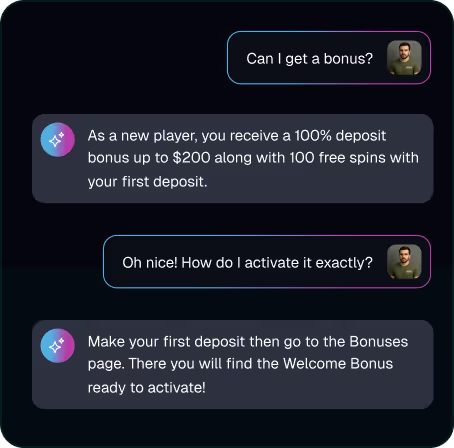
The figure holds regardless of ticket complexity. A wagering requirement question and a KYC document resubmission both route through the same agent queue, the same average handling time assumptions, the same escalation path, and the same per-hour labor cost. iGaming support volume is dominated by exactly these repetitive categories: payment status queries, bonus term clarifications, deposit and withdrawal checks, and document verification requests that follow the same resolution path every time.
An AI-handled ticket, under Tugi Tark's operator pricing model, costs ≈€0.15. At a 70% AI resolution rate, that gap produces a 64% reduction in support cost, a figure sourced directly from the same 2026 economics report rather than an estimate. Reducing support costs for online casino operators starts with removing repetitive resolution work from the human cost structure, rather than squeezing more output from human agents.
Why Support Cost Rises With Every New Market and Every New Player
Support cost in a headcount-based model rises in direct proportion to player growth, because ticket volume tracks player count and headcount tracks ticket volume. There is no point in that chain where the relationship breaks.
Each new market an operator enters adds a language requirement, and each language requirement adds shift coverage across time zones to maintain 24/7 availability. Each new player added to the base adds ticket volume proportional to that player's activity: deposits, withdrawals, bonus claims, and disputes all generate tickets independent of how many players came before. An operator staffed for 10,000 monthly tickets at €1.02–2.41 per ticket does not get a volume discount at 20,000 tickets. It hires more agents.
This is a structural problem, not an execution problem, the same dynamic covered in scaling iGaming support without proportional cost increases. Better training, better scripts, better shift scheduling, and tighter quality control reduce cost at the margins, but they do not change the fact that resolution capacity is capped by the number of people on the roster at any given hour. Each manual lookup an agent performs is a form of support debt: operational overhead that compounds as ticket volume grows. Growth in players and growth in support cost move together until something in the architecture changes that relationship.
Why Zendesk and Outsourcing Keep Support Cost Tied to Team Size
Zendesk and outsourced call centers both keep support cost tied to headcount. They change where the line item sits, not the underlying dependency on agents, the same limitation documented across legacy support systems in iGaming.
Zendesk Suite Professional lists at approximately €115 per agent per month. That licensing fee covers ticket routing and inbox management, not resolution. Every ticket still requires an agent to read it, look up player or payment data manually, and respond, which means the €1.02–2.41 per-ticket labor cost applies on top of the license regardless of which helpdesk software an operator runs. Outsourcing to a BPO moves staffing off the operator's payroll and lets a specialist provider handle coverage, but because the contract is still priced around agents, support cost climbs in step with ticket volume.
Neither approach changes the pricing model underneath the cost. Both remain per-agent license plus per-ticket labor, a structure where cost grows with headcount rather than with value delivered. An AI Support Infrastructure model works differently: pricing is structured as per user plus per AI-handled ticket, producing a flat rate per ticket at any volume rather than a cost that climbs with headcount.
What Actually Decouples Support Cost From Ticket Volume
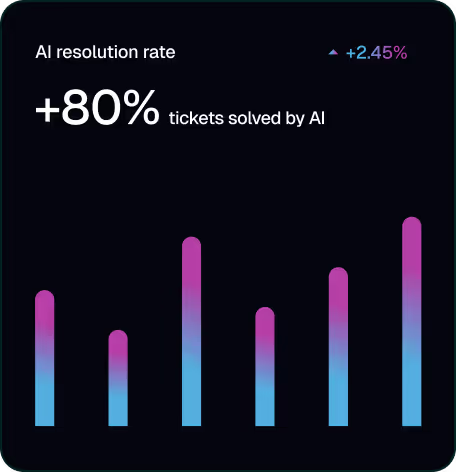
AI customer support infrastructure for iGaming decouples support cost from ticket volume by resolving 80%+ of player tickets at ≈€0.15 each instead of routing them through a €1.02–2.41 human workflow. Removing the human step from the majority of resolutions, rather than making that step faster, is what produces the reduction.
Tugi Tark's AI agents perform at the level of the best human agent on every interaction, running 18x faster and pulling player profile, policy, and transaction data in real time to resolve tickets rather than deflect them elsewhere. Founded by leaders who managed 10M+ tickets across 125+ iGaming brands as a BPO across 25+ markets, the underlying resolution logic was built from inside the fee-per-ticket pressure that BPO operations run under daily, not adapted from a generalist support architecture.
Pricing follows the same logic operators need for predictable planning: a €99-per-user-per-month license (annual billing) plus ≈€0.15 per AI-handled ticket. Cost grows with value delivered, not headcount, producing a flat cost per resolution rather than a rising one. An operator that doubles its player base pays the same ≈€0.15 per AI-handled ticket on the added volume, with none of the recruiting, training, and capacity step-costs a larger agent roster carries, so support cost grows far more slowly than under a headcount model, which is the structural difference that cost-cutting inside Zendesk or an outsourced center cannot replicate.
Reducing Support Costs for Online Casino Operators Starts With Architecture, Not Staffing
Operators staying on a headcount-based model are choosing a cost structure that rises every time the player base grows, regardless of how efficiently the team is managed. Operators moving to AI support infrastructure are choosing a cost structure that stays flat per resolution as volume increases.
The financial gap compounds with scale. At €1.02–2.41 per human-resolved ticket versus ≈€0.15 per AI-handled ticket, an operator processing tens of thousands of monthly tickets is carrying a cost structure many times larger than necessary for the repetitive share of that volume, without a corresponding gain in resolution quality. The 2026 iGaming support economics report puts the reduction at 64% when AI resolves 70% of ticket volume, a number tied directly to measured agent costs across nine European markets and the Philippines, not a projection.
Reducing support costs for online casino operators is a question of architecture before it is a question of staffing decisions. The operators evaluating this shift now are the ones who will enter the next growth cycle with cost decoupled from headcount, rather than renegotiating outsourcing contracts every time the player base expands. See the cost breakdown for the pricing model behind the ≈€0.15-per-ticket figure.
Frequently Asked Questions
What does it cost to handle a support ticket manually in iGaming?
A manually handled iGaming support ticket costs an operator €1.02 to €2.41, based on Tugi Tark's 2026 iGaming support economics report covering nine European markets and the Philippines. That figure includes wages, shift coverage, management overhead, and training, and it applies regardless of the helpdesk software or outsourcing provider the operator uses.
How much does AI reduce support costs for online casino operators?
AI-handled tickets cost ≈€0.15 under Tugi Tark's operator pricing model, compared to €1.02–2.41 for a human-handled ticket. At a 70% AI resolution rate, this produces a 64% reduction in overall support cost, a figure sourced from the 2026 iGaming support economics report rather than a general industry estimate.
Why does support cost rise faster than player growth in iGaming?
Support cost rises in step with player growth because each new player generates ticket volume, and headcount-based models require adding agents to match that volume. There is no point in a per-agent cost structure where additional players stop generating proportional additional cost, which is why cost per player stays flat only under an AI-first resolution model.
Does reducing support costs with AI require a minimum ticket volume?
No. Per-AI-handled-ticket pricing means the cost of an automated resolution is lower than a staffed agent at any ticket volume, including operators still building their monthly ticket count. The cost advantage of ≈€0.15 per AI-handled ticket versus €1.02–2.41 per human-resolved ticket applies at low volume as well as high volume.
How is Tugi Tark priced for iGaming operators looking to reduce support costs?
Tugi Tark charges a €99-per-user-per-month license, billed annually, plus ≈€0.15 per AI-handled ticket. This produces a flat cost per resolution rather than a rising one as ticket volume grows, unlike per-agent licensing and outsourcing models where cost increases directly with headcount added to match volume.

.png)