A single support ticket handled by a human agent costs an iGaming operator between €1.02 and €2.41, according to Tugi Tark's 2026 iGaming support economics report, which benchmarks fully-loaded agent costs across nine European markets and the Philippines. The same ticket resolved through AI support infrastructure costs ≈€0.15. Most operators have never put those two numbers side by side.
Support cost per ticket rarely shows up as its own line on an operator's P&L. It gets absorbed into outsourcing invoices, agency management fees, and headcount budgets, which is why it remains a significant and often underestimated share of operational costs across the industry, even as ticket volume climbs with every acquisition campaign. This data post breaks down where the €1.02–2.41 figure comes from, why it stays hidden inside monthly spend, and what the gap to ≈€0.15 actually represents for an operator's cost structure.
Where the €1.02–2.41 Figure Comes From
The €1.02–2.41 per-ticket range comes directly from Tugi Tark's 2026 iGaming support economics report, which measured fully-loaded human agent costs across nine European markets plus the Philippines. The range is not a wage figure alone. It reflects base salary, management overhead, quality assurance, and attrition replacement, the layers that outsourcing contracts rarely itemize on their own line.
Market wage differentials explain part of the spread between €1.02 and €2.41. The rest comes from structural costs that scale with headcount regardless of location: supervisor ratios, iGaming-specific compliance training, and the replacement cost of agent turnover, which runs consistently high in tier-1 ticket handling because the work is repetitive and the burnout rate is elevated. The support debt created by these hidden layers compounds every month a manual support model stays in place.
Why Support Cost Per Ticket Stays a Blind Spot
Support cost per ticket stays invisible because operators track cost centers, not cost per unit of resolution. A monthly support budget line tells a COO how much was spent, not whether each ticket cost €1.02 or €2.41 to close, and that distinction determines whether support scales as a manageable cost or an accelerating one.
The blind spot deepens with volume. Outsourcing contracts are typically priced per agent per month or per interaction bundle, not per resolution outcome, so the per-ticket figure stays buried until an operator manually reconstructs it from invoices, headcount, and ticket logs. Few operators run that reconstruction regularly, which means the cost keeps rising in the background while the visible budget line looks stable.
Ticket volume itself is not static. Every marketing campaign, new market launch, or promotional cycle adds player interactions, and each one carries the same €1.02–2.41 baseline until the underlying resolution model changes. Scaling support without letting costs climb requires knowing this number, not estimating around it.
Why Legacy Support Cost Structures Don't Surface This Number
Generic ticketing systems were built to log volume, not to expose cost per resolution outcome. Legacy support systems designed for business-hours customer service track tickets opened and closed, average handle time, and agent utilization, none of which translate directly into a euro figure per ticket without manual calculation.
Outsourced staffing models compound the opacity. Contracts priced per agent per month or per interaction bundle make cost planning dependent on volume forecasting rather than resolution economics. An operator reviewing an outsourcing invoice sees a total, not a per-ticket cost, and without that per-ticket figure there is no baseline against which to measure an alternative resolution model.
This is a structural limitation of tools and staffing models built for generalist customer service, not gambling operations. Payment disputes, KYC clarifications, and responsible gaming escalations carry different cost and risk profiles than a generic support ticket, and systems that were not built for iGaming do not separate them in a way that surfaces true per-ticket economics.
The Cost Breakdown: Human Agents vs AI Resolution
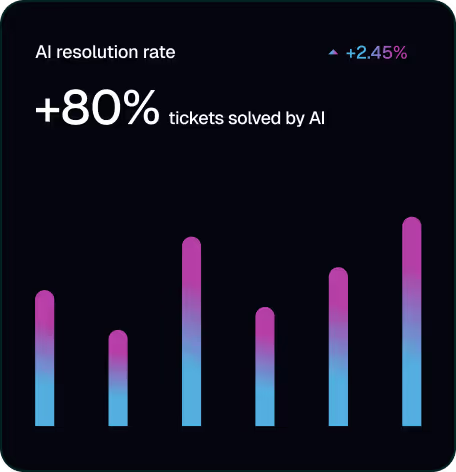
The resolution rate row matters as much as the cost row. A cheaper ticket that still requires a second contact does not lower total cost, it defers it. Tugi Tark resolves 80%+ of player tickets, meaning the ≈€0.15 figure represents a completed resolution in most cases, not a first-touch cost with a re-contact still pending.
What the €0.15 Gap Means for Operators
The gap between €1.02–2.41 and ≈€0.15 per ticket is not a marginal efficiency gain, it is a different cost architecture. Tugi Tark's AI support infrastructure for iGaming resolves 80%+ of player tickets at a flat ≈€0.15 per handled ticket, a cost that stays at a fixed per-ticket rate as volume grows, unlike a headcount model where every new player cohort adds proportional staffing cost. According to Tugi Tark's 2026 iGaming support economics report, operators moving to AI resolution at 70% of ticket volume see a 65% reduction in support cost, a flat cost per resolution rather than a rising one.
For operators still running the headcount math, the immediate step is reconstructing the true per-ticket figure from current outsourcing or in-house spend and comparing it directly to €0.15. Reviewing the per-ticket pricing model against current invoices makes the gap concrete rather than theoretical. For the operational playbook on moving from outsourced headcount to AI-first support, see the four-step framework for scaling casino support without hiring.
Frequently Asked Questions
How much does a support ticket cost an iGaming operator?
A support ticket handled by a human agent costs between €1.02 and €2.41, according to Tugi Tark's 2026 iGaming support economics report covering nine European markets and the Philippines. The same ticket handled through AI support infrastructure costs ≈€0.15.
How is the cost of a support ticket calculated for iGaming operators?
The per-ticket figure combines fully-loaded agent costs, including base salary, management overhead, quality assurance, and attrition replacement, divided across ticket volume handled. Outsourcing invoices rarely break this figure out on their own, which is why most operators never calculate it directly.
Why does support cost per ticket stay hidden from most operators?
Support cost per ticket stays hidden because outsourcing and staffing contracts are typically priced per agent per month or per interaction bundle, not per resolution outcome. Operators see a total invoice, not a per-ticket figure, so the cost compounds with volume without appearing as a distinct metric.
How much does AI support infrastructure cost per ticket compared to human agents?
AI customer support infrastructure handled tickets at ≈€0.15 each, compared to €1.02–2.41 for a human agent, according to Tugi Tark's 2026 iGaming support economics report. Tugi Tark resolves 80%+ of player tickets at that flat rate, a fixed per-ticket cost that does not rise as ticket volume grows.
What is the difference between outsourced support costs and AI support infrastructure costs?
Outsourced support costs rise linearly with ticket volume, priced per agent or per interaction bundle. AI support infrastructure charges a flat rate per ticket at any volume. Tugi Tark's model reduces cost per ticket from €1.02–2.41 to ≈€0.15 while resolving 80%+ of player tickets.