A fully automated casino support system resolves 80%+ of player tickets without a human queue, and routes the remaining share to specialist support operators before a player experiences a delay. That is the current, verified state of AI automation for online casino operations running on Tugi Tark's infrastructure, not a five-year projection. Most iGaming operators still route every player message through a human-first queue by default, including routine withdrawal checks and KYC status questions that carry no judgment call and no regulatory weight. This article describes the system architecture behind that end state: the AI automation layer, the human escalation layer, the integrations connecting them, and the KPIs that mark when an operator has actually reached it. Full automation, in this context, never means zero human involvement. It means routing tickets so support operators handle judgment calls, VIP context, and regulatory sign-off, while AI agents resolve everything else at the quality of the best human agent on staff.
The System Architecture Behind AI Automation for Online Casino Operations
A fully automated casino support system runs on three connected layers, not one automation feature bolted onto an existing helpdesk. The AI automation layer resolves tickets. The human escalation layer receives the tickets AI does not resolve. The integration layer connects both to the operator's existing player data, ticketing infrastructure, and payment systems, in real time.
The AI automation layer runs on native ticketing and omnichannel intake built in-house, with no dependency on a third-party ticketing tool sitting underneath a generic automation add-on. It includes smart ticket routing, weighted across four parameters: player segment, ticket category, channel, and wait time. It includes a resolution engine that retrieves player profile data, policy terms, and iGaming-specific knowledge in real time to close a ticket, rather than deflecting a player toward a help article. And it includes proactive support triggers: when an integration detects an event such as a failed deposit, the support widget opens with player context already loaded, before the player has to open a ticket at all.
The human escalation layer runs on a specialist workspace built for tickets that require judgment, not volume handling. It includes a dedicated Responsible Gaming module with operator-configurable strictness, departments split by finance, compliance, technical issues, CRM, and VIP handling, and brand-level control over whether a queue defaults to AI-first or human-first routing.
What Happens to a Ticket Inside a Fully Automated System
Every ticket enters through omnichannel intake and is scored immediately by smart ticket routing before any resolution attempt begins. The four weighted parameters, player segment, ticket category, channel, and wait time, determine whether the ticket goes to the AI automation layer or straight to a human support operator, based on brand-level configuration rather than a fixed default.
Tickets the AI automation layer takes on are resolved using real-time access to the player's profile, the operator's policy terms, and iGaming-specific knowledge, at a speed 18x faster than a human agent and at the quality level of the best human agent on staff, not an average one. That standard is checked continuously through CSAT capture, with a dashboard and CSV export giving operators a direct quality signal on every AI-resolved ticket instead of an automation rate taken on faith.
Language does not create a separate workflow. Support runs across 249 languages with on-the-fly translation, so a ticket from a player in Manila and a ticket from a player in Warsaw move through the same resolution engine rather than routing to different regional queues staffed by native speakers.
Proactive tickets follow a distinct path. The integration detects the event, such as a failed deposit, and the widget opens automatically with the player's context pre-loaded, so the support operator or AI agent handling the case starts with full context instead of asking the player to explain what happened. Trigger types are configurable and are not limited to deposit events.
If a ticket gets reopened after resolution, it returns to the same support operator or AI resolution path that closed it originally, rather than re-entering the queue as a new, unassigned ticket. If an assigned human operator disconnects, the ticket returns automatically to the unassigned queue rather than sitting idle.
The Human Escalation Points, and Why They Are Permanent
The tickets that route to human support operators in a fully automated system are routed there by deliberate design, built into the architecture from the start rather than left over from a limitation the system has yet to overcome. A defined set of categories is structurally routed to humans regardless of how capable the resolution engine becomes.
Responsible Gaming tickets route automatically to human support operators through the dedicated Responsible Gaming module, with strictness configurable by the operator, regardless of AI resolution capability. That routing is a fixed rule, applied to every Responsible Gaming ticket, that keeps regulatory-sensitive interactions in front of a person by design.
VIP tickets route to a dedicated department because high-value player relationships carry judgment calls, commercial context, and account history that a resolution engine is not positioned to weigh on its own. Complex disputes, cases involving conflicting account history, payment investigations, or multi-party claims, route to the specialist workspace for the same reason: they require a support operator to weigh evidence and make a call, not retrieve a policy and apply it. Compliance escalations tied to KYC and AML checks follow the same path, into the dedicated compliance department rather than the resolution engine.
Some capabilities sit outside this current architecture entirely and belong on the roadmap, not in production today. Agentic execution of bonus actions, automatic account closure, and AI-driven payment processing are all handled by human support operators today. Presenting them as live capabilities would misstate what AI automation for online casino operations currently does, and Tugi Tark frames them as coming, not as available.
The KPIs That Define a Fully Automated State
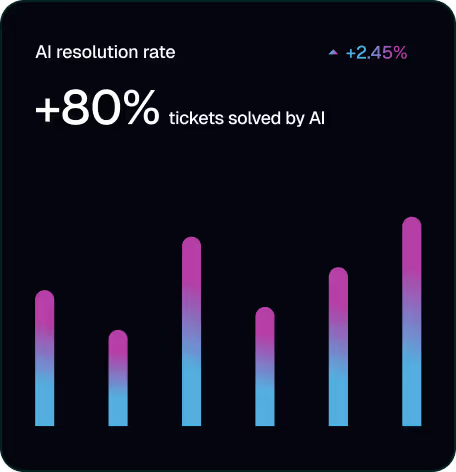
An operator has reached a fully automated state when resolution rate, cost per ticket, and resolution speed hit verified benchmarks together, not individually. The resolution rate benchmark is 80%+ of player tickets closed without human involvement, drawn from live iGaming support operations rather than a generic SaaS deflection estimate.
Cost per ticket is the clearest signal of the gap between architectures. An AI-resolved ticket costs a flat €0.15, compared with €1.02 to €2.41 for a human-handled ticket across nine European markets and the Philippines, according to Tugi Tark's 2026 iGaming support economics report. At a 70% AI resolution rate, that gap already produces a 64% reduction in total support cost, per the same report, and the gap widens further above that resolution rate without requiring additional headcount.
Speed is the third benchmark: AI-resolved tickets close 18x faster than human-handled tickets, at the quality level of the best human agent, which is what keeps the 80%+ figure from being achieved by lowering the bar on what counts as resolved.
These figures describe where Tugi Tark's infrastructure operates today, not where the industry sits as a whole. Harpo's published forecast projects iGaming-wide AI resolution reaching 95% within five years, with industry-wide resolution sitting in the single digits as of 2026. That gap between today's industry average and a fully automated state is the reason this architecture is still the exception rather than the norm.
How an Operator Gets to This State
Reaching this architecture starts with integration, not a rebuild of existing player data systems. JWT-based deployment runs in hours, and API integration syncs player data in real time, so the AI automation layer has access to the same profile and policy data a human support operator would use.
Per-AI-handled ticket pricing removes the usual reason operators delay evaluating automation until they hit scale: the cost of an automated resolution is lower than a staffed agent at effectively any ticket volume, including operators still processing a few thousand monthly tickets. There is no ticket-volume threshold below which the model stops making sense.
The clearest way to evaluate whether AI automation for online casino operations fits a specific ticket mix is to test it against real scenarios rather than a vendor's published average. Operators can test the AI agent against real iGaming ticket types before committing to a wider rollout, and see directly how smart ticket routing and escalation architecture handle the split between resolved tickets and the ones that reach a support operator. The proactive support and escalation model described here is already running in production, not a future state operators need to wait for. Technical integration timelines are the main variable in how fast an operator reaches it. Book a demo to see it against an operator's own ticket volume and escalation requirements.
Frequently Asked Questions
Is fully automated casino support realistic for iGaming operators, or is it a marketing claim?
It is realistic and already running in production. Tugi Tark's AI automation layer resolves 80%+ of player tickets across live iGaming support operations, while Responsible Gaming, VIP, and complex disputes route to human support operators by design rather than as an unsolved gap.
What percentage of casino support tickets can actually be automated?
AI support infrastructure built for iGaming resolves 80%+ of player tickets, including withdrawal queries, bonus status checks, KYC questions, and account queries closed end to end without human involvement. The remaining share routes to human support operators through smart ticket routing.
What tickets still require a human support operator in a fully automated system?
Responsible Gaming tickets, VIP account handling, and complex disputes route to human support operators regardless of AI resolution capability. Responsible Gaming routing in particular is fixed by a dedicated module with operator-configurable strictness, not a fallback for cases AI cannot resolve.
Does full automation mean AI agents handle bonus payouts or account closures directly?
Not yet. Agentic execution of bonus actions, automatic account closure, and AI-driven payment processing are on the roadmap and handled by human support operators today. Presenting them as current capabilities would misstate the architecture described in this article.
What does it cost to run a fully automated casino support system compared to a human-first one?
AI-resolved tickets cost a flat €0.15 each, compared with €1.02 to €2.41 for a human-handled ticket across nine European markets and the Philippines. At a 70% AI resolution rate, that difference produces a 64% reduction in total support cost, according to Tugi Tark's 2026 iGaming support economics report.