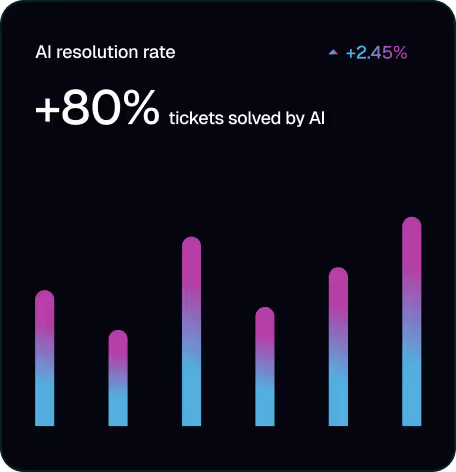
AI customer support infrastructure now resolves up to 80% of player support tickets for iGaming operators running on Tugi Tark. That figure is rarely discussed with precision because most industry conversations about automation default to generic SaaS deflection benchmarks, which measure how many tickets get redirected away from a human agent, not how many get closed without one. This article breaks down where the 80% resolution rate comes from, why it differs from third-party deflection benchmarks, and what it means for support cost per player as ticket volume scales.
Where the 80% Resolution Rate Comes From
The 80%+ resolution rate is measured across live iGaming ticket volume processed by Tugi Tark's AI support infrastructure, not projected from a lab benchmark or estimated from generic SaaS support data. It covers withdrawal queries, bonus disputes, KYC status checks, and account questions resolved end to end, without escalation to a human operator. That figure runs on infrastructure Tugi Tark built in-house: native ticketing, omnichannel intake, and real-time monitoring dashboards, with no dependency on third-party ticketing tools layered under a generic automation add-on.
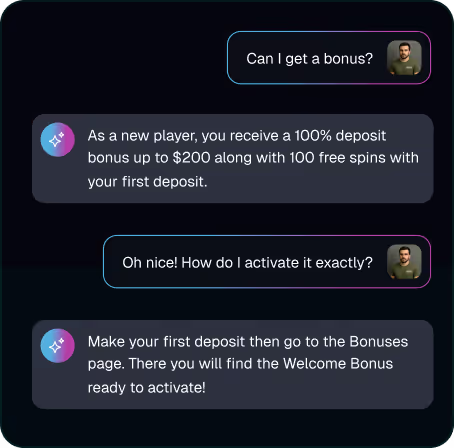
Industry-wide, the picture looks different. Analysts project AI deflection reaching 80% across support categories by 2029 (Gartner), and third-party deflection benchmarks for support automation currently sit between 60% and 80% (Symphony). Harpo's published forecast projects iGaming-wide AI resolution reaching 95% within five years, with industry-wide resolution sitting in the single digits as of 2026. As of 2026, Tugi Tark's 80%+ figure already sits at the top of that range, and the mechanism matters as much as the number: AI agents resolve. They don't deflect. Support operators built on Tugi Tark's infrastructure retrieve player profile data, policy terms, and iGaming-specific knowledge in real time to close a ticket, rather than redirecting a player to a self-service article or a longer queue.
That distinction traces back to how the infrastructure was built. Tugi Tark's founders managed 10M+ tickets across 125+ iGaming brands in 25+ markets as a BPO, under a fee-per-ticket model that created daily pressure to resolve more with fewer resources. That ground-level operational understanding, not a generic support automation layer adapted after the fact, is what the 80%+ resolution rate is built on.
The engineering bar behind the number matters as much as the volume it covers. Tugi Tark's CTO is ranked in the top 0.01% of AI engineers globally, and the resolution engine reflects that standard directly: it is built to perform at the level of the best human agent on every handled ticket, not an average one. That standard is enforced through CSAT capture with a full dashboard and CSV export, giving operators a direct quality signal on every AI-handled ticket rather than an automation rate they have to take on faith.
Why the 80% Figure Matters for Support Cost Per Player
A resolution rate above 80% directly compresses support cost per player, because each automated resolution costs a flat ≈€0.15 per AI ticket, compared with €1.02 to €2.41 for a human-handled ticket across nine European markets and the Philippines, per Tugi Tark's 2026 iGaming support economics report. At a 70% AI resolution rate, that gap already produces a 64% reduction in support cost, per the same report. Resolution rates above 80% widen that gap further, without requiring additional headcount to sustain it.
The reason the gap keeps widening is structural, not incremental. Human-first support scales linearly: more players produce more tickets, more tickets require more agents, and agent cost rises in direct proportion to ticket volume. Tugi Tark's pricing model runs on a flat cost per resolution rather than a rising one, so cost grows with value delivered, not headcount. An operator processing 10,000 monthly tickets and an operator processing 100,000 monthly tickets pay the same ≈€0.15 per AI-handled ticket either way.
Speed compounds the cost advantage. Tugi Tark's AI support infrastructure resolves tickets 18x faster than human agents, at the quality level of the best human agent on staff, which means the 80%+ resolution rate is not achieved by lowering the bar on what counts as resolved.
The remaining share of tickets, those requiring judgment calls, VIP handling, or regulatory sign-off, route to human support operators through smart ticket routing, weighted by player segment, ticket category, channel, and wait time. Responsible Gaming tickets route automatically to human operators through a dedicated module with configurable strictness, regardless of resolution capability. That carve-out is what keeps the 80%+ figure structurally sound: complex disputes and compliance-sensitive requests are filtered to human operators by design, not forced through an AI resolution path regardless of fit.
Ticket Resolution: Old World vs. AI Support Infrastructure
The 80% resolution figure changes shape once it is broken down by cost, speed, and language coverage rather than treated as a single headline number.
What Operators Should Do With This Data
Operators evaluating automation should benchmark their own resolution rate against the 80%+ figure, not against generic SaaS deflection percentages that measure a different outcome entirely. A support stack that deflects 70% of tickets toward a knowledge base article is not resolving 70% of tickets, and comparing the two numbers directly understates how much manual handling actually remains.
The pricing structure removes the usual objection to evaluating automation early. Per-AI-handled ticket pricing means the cost of an automated resolution is lower than a staffed agent at effectively any ticket volume, including operators still early in scaling with a few thousand monthly tickets. Hiring more agents to absorb ticket growth produces linear cost growth, while automation sustainably absorbs ticket volume without adding headcount, a distinction that compounds as player volume rises.
The resolution rate can also be validated directly rather than taken on faith. A live AI agent demo running against real iGaming ticket scenarios, in 249 languages with on-the-fly translation, gives an operator a way to test the resolution rate against its own ticket mix before committing to a wider rollout, instead of extrapolating from a vendor's published average.
The support debt that accumulates from unresolved, escalated, and re-opened tickets grows faster than most support budgets account for, and it scales in direct proportion to how much ticket handling still depends on manual triage. Operators still running support on tools not built for gambling operations carry that debt structurally, regardless of how well those tools are configured. Tugi Tark's AI support infrastructure for iGaming is built to close that gap directly, and operators can see AI in action against real iGaming ticket scenarios before evaluating a broader rollout.
Frequently Asked Questions
What percentage of casino support tickets can AI resolve?
AI support infrastructure built for iGaming resolves 80%+ of player support tickets, according to Tugi Tark's 2026 iGaming support economics report. This includes withdrawal queries, bonus disputes, KYC status checks, and account questions resolved end to end without escalation to a human operator.
How is AI ticket resolution different from AI deflection?
Resolution means a ticket is closed without human involvement, while deflection means a player is redirected toward a self-service option such as a help article, often without the underlying issue being solved. Tugi Tark's AI agents resolve tickets by retrieving player profile data, policy terms, and iGaming-specific knowledge in real time, rather than deflecting players toward generic resources.
How much does AI ticket resolution cost compared to human agents?
AI-handled tickets cost a flat ≈€0.15 per ticket, compared with €1.02 to €2.41 for a human-handled ticket across nine European markets and the Philippines, according to Tugi Tark's 2026 iGaming support economics report. At a 70% AI resolution rate, that gap produces a 64% reduction in total support cost.
Does an operator need a minimum ticket volume to benefit from AI resolution?
No. Per-AI-handled ticket pricing means the cost of an automated resolution is lower than a staffed agent at effectively any ticket volume, including operators processing a few thousand monthly tickets. The cost advantage comes from the flat per-resolution rate, not from reaching a volume threshold.
What happens to the tickets AI does not resolve?
Tickets outside the 80%+ resolution rate route to human support operators through smart ticket routing, weighted by player segment, ticket category, channel, and wait time. Responsible gambling tickets route automatically to human operators regardless of resolution capability, under Tugi Tark's dedicated Responsible Gaming module.