Reducing support ticket volume an online casino support team has to handle is most sustainable through automation, not through hiring more support operators, because automation absorbs rising ticket volume and resolves the majority without adding agents. Human agent costs run €1.02 to €2.41 per ticket across nine European markets and the Philippines, and that per-ticket cost holds flat as volume grows, so total cost rises every time headcount is added to cover it. An AI-resolved ticket costs ≈€0.15 under Tugi Tark's operator pricing model, and that rate stays constant no matter how many tickets are handled by AI, without the recruiting, onboarding, and turnover costs that inflate the per-ticket cost of every additional agent hired. iGaming ticket volume is dominated by repetitive categories, payment status queries, bonus term clarifications, and KYC document requests among them, and none of those categories get cheaper to answer as they multiply under a headcount-based model. What follows is the operational reasoning for why hiring solves the wrong variable, and what actually reduces ticket-driven cost over time: capacity growth decoupled from headcount growth.
The Default Response to Rising Ticket Volume
The default operator response to rising ticket volume is hiring more support agents, and the immediate logic holds: more tickets, more hands to answer them. Coverage improves within weeks, response times drop, and pressure on the existing team eases. The approach works, briefly, because it treats the symptom at the point where cost has not yet caught up with growth.
That point arrives fast in iGaming. Customer service agent costs run €1.02 to €2.41 per ticket, and an operator adding headcount to cover several languages, multiple regulated markets, and 24/7 coverage pays that same per-ticket rate for every additional ticket the new hires process, not a declining marginal rate. Recruiting, onboarding, and quality variance across shifts add further fixed cost on top of the per-ticket rate, before a single ticket reaches resolution. Ticket volume that grows with the player base means the support headcount required to answer it grows in the same direction, at the same or higher per-unit cost.
The timing works against the operator as much as the cost does. Recruiting and training a new support operator typically spans several weeks between the hiring decision and full ticket-handling capacity, a lag that means the headcount added today is sized to the ticket volume of months ago, not the volume the operator is facing once the new hire is fully productive. Support demand keeps moving while the response to it stands still.
Why Headcount Scaling Doesn't Reduce Support Cost
Headcount scaling breaks down structurally because support cost rises in direct proportion to ticket volume, and no amount of process optimization changes that ratio. Adding a support operator adds capacity for a fixed number of tickets per shift, at a cost per ticket that does not decrease with scale. Doubling ticket volume requires close to double the headcount, and doubling headcount does not halve the cost per ticket. The mechanic is the same one covered in scaling iGaming support without skyrocketing costs: cost and volume move together, with no structural ceiling that hiring alone can reach.
Generic ticketing platforms compound the problem rather than solving it. These tools were built for the throughput and interaction types of horizontal business support, not for the payment disputes, KYC queries, and responsible gambling escalations that make up iGaming ticket volume. Support operators using these platforms spend measurable time on manual tagging and routing before a ticket reaches resolution, and that overhead is itself a form of support debt that accumulates with every ticket added to the queue. More efficient staffing lowers routing overhead. The structural link between cost and volume remains unchanged.
How Automation Reduces Tickets By Absorbing Volume, Not Adding Headcount
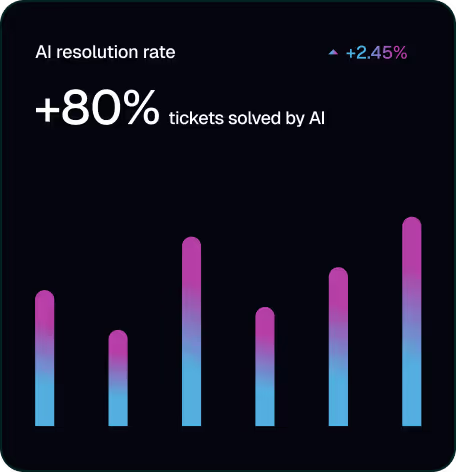
Capacity growth decoupled from headcount growth is what actually reduces ticket-driven cost in iGaming, and AI Support Infrastructure for iGaming is built around that principle. Tugi Tark resolves 80%+ of player tickets at ≈€0.15 per AI handled ticket, a flat cost per resolution rather than a rising one: the cost of resolving the ten-thousandth ticket in a month is the same as the cost of resolving the first. License pricing runs €99 per user per month on an annual basis, a predictable base layer separate from the per-ticket automation cost. Under this model, cost grows with value delivered, not headcount, and support cost per player stops climbing every time the player base grows.
The economics compound further because automation does not carry the fixed costs headcount does: no recruiting cycle, no onboarding period, no quality variance across shifts or the 249 languages a multi-market operator has to cover. Reduction in overall support cost reaches 64% at a 70% AI resolution rate, a benchmark drawn from operator cost modeling across nine European markets and the Philippines. How AI is replacing 80% of casino support tickets documents the resolution mechanism in more detail: capacity shifts from headcount to automation without a corresponding shift in fixed cost.
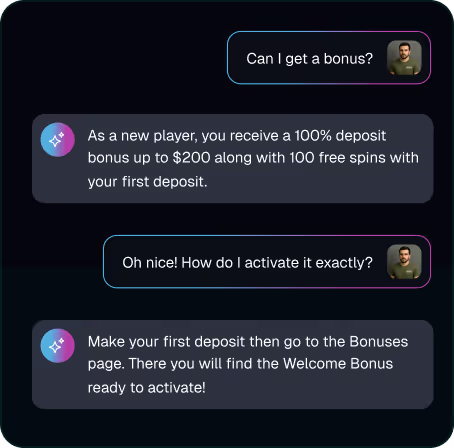
The quality of the resolution matters as much as its cost, because a decoupled cost structure only holds if the ticket is actually closed rather than pushed elsewhere. Tugi Tark's AI agents perform at the level of the best human agent on every interaction, resolving tickets 18x faster than a human agent working the same queue. AI agents resolve. They don't deflect: they pull player profile, policy, and transaction data in real time to close a ticket rather than route it to another queue, which is why the 80%+ resolution rate holds up as capacity, not as volume that quietly returns as a repeat contact.
What Operators Risk by Waiting to Automate
Operators who delay automation continue absorbing headcount-linked cost every quarter that ticket volume grows, while operators who automate now decouple that cost before the next growth cycle arrives. The gap compounds: an operator still hiring against ticket volume next year carries a support cost per player that grows in step with the player base, while an operator running AI Support Infrastructure carries a support cost per player that flattens.
Hiring does not stop working entirely. Support operators remain necessary for escalations, complex disputes, and responsible gambling cases that require human judgment. Treating headcount as the primary lever for handling ticket volume carries a real cost: the primary lever available today resolves tickets at a fraction of the per-unit cost and does not require the operation to grow its team every time its player base grows.
The reasoning behind this shift is not theoretical. Tugi Tark was founded by leaders who managed 10M+ tickets across 125+ iGaming brands as a BPO operating in 25+ markets, work carried out under the daily pressure of fee-per-ticket economics that rewards exactly the kind of cost discipline this analysis describes. That operating history, not a general automation pitch, is why decoupling capacity from headcount holds up at the ticket volume and complexity iGaming operators actually run. See automation in action before the next volume spike forces the choice.
Frequently Asked Questions
Is hiring more support operators ever the right response to rising ticket volume?
Hiring can close an immediate coverage gap, but it does not reduce the underlying cost structure of iGaming support. Human agent costs run €1.02 to €2.41 per ticket, a rate that holds flat as volume grows, so total cost rises in direct proportion to ticket volume regardless of how efficiently the team operates.
Why does automation reduce iGaming support tickets more sustainably than headcount?
Automation is the most sustainable way to reduce support tickets for an online casino, because it changes the cost structure rather than the ticket count. Tugi Tark's AI Support Infrastructure resolves 80%+ of player tickets at €0.15 per AI-handled ticket, and that per-ticket rate stays flat however many tickets are resolved, carrying none of the recruiting, training, and turnover overhead that compounds the cost of headcount-based support as volume grows. Automation does not lower the total number of tickets an online casino receives, but it absorbs the large majority of them, so agents only handle the small share that genuinely needs a person, which is what reduces the support tickets a human team has to manage without adding staff as the player base grows.
What does "capacity growth decoupled from headcount growth" mean in practice?
It means support capacity expands through automation rather than through hiring, so an operator can absorb higher ticket volume without adding proportional headcount. Cost grows with value delivered, not with the number of support operators employed, which keeps support cost per player from climbing every time the player base grows.
How much does AI-driven ticket resolution cost compared to human agents?
AI-driven resolution costs ≈€0.15 per AI handled ticket, compared to €1.02 to €2.41 per ticket for human agents across nine European markets and the Philippines. Operators combining AI resolution with human escalation report a 64% reduction in support cost at a 70% AI resolution rate.
What is Tugi Tark's approach to reducing iGaming support ticket volume?
Tugi Tark is an AI-native customer service platform purpose-built for iGaming operators, resolving 80%+ of player tickets across 249 languages at a flat cost per resolution. The infrastructure is designed to grow capacity with ticket volume without requiring proportional headcount growth, addressing the structural cost problem that hiring alone cannot solve.

.png)
.png)