The Zendesk vs AI cost comparison for iGaming operators comes down to one number finance teams actually need: how much each approach costs per ticket, per year, once every operational layer is counted. Most cost conversations stop at a software pricing page, and a software pricing page answers the wrong question. The number that matters is the fully-loaded cost of resolving a support workflow, tracked across the first three years of operation, not the sticker price of a seat license.
This article isolates that number. For the full feature-by-feature comparison of what Zendesk and AI support infrastructure each do operationally, see Zendesk vs AI Support: What iGaming Operators Need to Know. This article does not repeat that ground. It models the cost curve year by year and shows where the gap comes from.
What Manual, Zendesk-Based Support Actually Costs Per Ticket
The fully-loaded cost of a human-resolved iGaming support ticket runs €1.02 to €2.41, based on benchmark data across nine European markets and the Philippines. That range includes agent time, not just software. Zendesk's own license fee, €55 to €115 per agent per month, sits on top of it as a separate cost layer, since Zendesk organizes tickets but does not resolve them.
The structural issue is that this per-ticket cost does not decline with volume. Every additional 1,000 monthly tickets requires roughly proportional additional agent capacity to hold response times steady. A support desk handling 10,000 tickets a month at the midpoint of that benchmark range, €1.70 per ticket, carries an annualized resolution cost of €204,000 before any Zendesk software fees are added. That figure is the baseline the rest of this comparison measures against.
None of that cost reflects mismanagement. It reflects what human-first, ticketing-software-organized support actually costs to run at iGaming ticket volumes, where payment queries, KYC checks, and bonus disputes arrive around the clock across multiple languages.
The benchmark also does not include the cost of correcting errors under regulatory scrutiny. A missed responsible gaming flag or a mishandled KYC escalation carries compliance exposure that a generic ticketing system was not built to prevent, since Zendesk applies the same workflow logic to a casino support ticket that it applies to a retail return request. The €1.02–2.41 per-ticket figure captures resolution labor. It does not capture the operational risk of running gambling-specific workflows through a tool with no gambling-specific logic.
What Tugi Tark's AI Infrastructure Actually Costs Per Ticket
Tugi Tark resolves iGaming support tickets at €0.15 per AI-resolved ticket, on top of a €99 per user per month license for the human operators who remain for escalation and specialist review. That per-AI-handled ticket cost is a flat rate per ticket at any volume, so it does not rise as ticket count grows the way a headcount-based cost structure does.
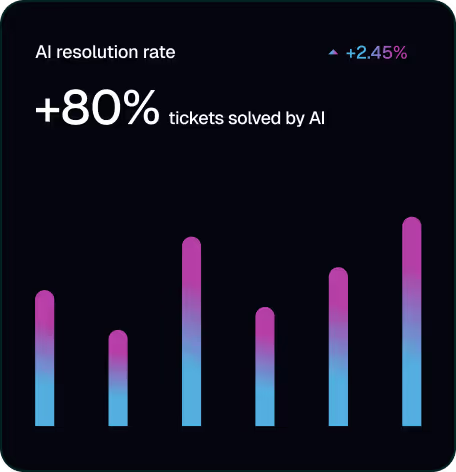
Tugi Tark resolves 80%+ of tickets directly, without routing them to a human operator first. The remaining share still requires human judgment, disputed transactions with unusual context, responsible gaming escalations, VIP account issues, and that portion is resolved by a smaller specialist team at the same per-ticket cost benchmark as any human-resolved ticket. The cost advantage is not that human resolution becomes free. It is that the volume of tickets requiring it drops by roughly 80%, and the tickets that remain are the ones that actually need a person.
Founded by leaders who managed 10M+ tickets across 125+ iGaming brands as a BPO operation, Tugi Tark's AI support infrastructure for iGaming was built around this cost structure from the start: a flat cost per resolution rather than a rising one.
The Zendesk vs AI Cost Comparison: Year 1 to Year 3
Modeled at a constant 10,000 monthly support tickets, switching from manual, Zendesk-based support to Tugi Tark's AI infrastructure saves an estimated €148,800 a year at steady-state resolution, compounding to €446,400 across three years. The table below shows how that figure builds.
The model holds ticket volume flat at 10,000 per month across all three years, to isolate the infrastructure cost difference from any player-growth assumption. The manual, Zendesk-based cost per ticket is set at €1.70, the midpoint of the €1.02–2.41 fully-loaded human agent cost range documented in Tugi Tark's 2026 iGaming support economics report. Tugi Tark's cost is calculated as a blend of AI-resolved handled at ≈€0.15 and the remaining human-escalated tickets at €1.70, using the 80% floor of Tugi Tark's 80%+ resolution rate for a conservative calculation: 0.80 × €0.15 + 0.20 × €1.70 = €0.46 per ticket, or €55,200 a year at this volume.
This simplified model assumes steady-state resolution from month one, for clarity. Real deployments typically include a ramp period before resolution stabilizes above 80%, so the first few months of an actual rollout will show a smaller gap than the Year 1 figure above before converging toward it.
The license fee, €99 per user per month, applies to the human operators who remain for escalations, not to ticket volume, so it scales with team size rather than support volume. At the ticket volumes modeled here, it is a minor addition relative to the per-ticket savings shown above. Operators can run their own ROI projection using current monthly ticket volume to model the exact license line for their team size.
Where the Savings Actually Come From
The savings in the table above come from resolution volume shifting away from per-ticket human cost, not from human agents becoming cheaper. At 80%+ resolution, 8,000 of every 10,000 monthly tickets never reach a human operator, each avoiding the €1.02–2.41 fully-loaded cost and instead costing ≈€0.15 to handle automatically.
The remaining 2,000 tickets a month still cost what a human-resolved ticket costs anywhere in the benchmark range, because Tugi Tark does not claim escalated tickets become cheaper to handle. What changes is which tickets remain. Withdrawal delays with unusual account history, bonus disputes requiring judgment, and responsible gaming flags route to human specialists, while repetitive payment status queries, standard KYC document checks, routine account questions, and bonus term look-ups get resolved before they consume agent time at all.
Zendesk's cost structure has no equivalent mechanism. Its macros and triggers reduce the time an agent spends on a ticket, but every ticket still reaches an agent, so the fully-loaded per-ticket cost benchmark applies to the full volume, not a shrinking share of it. That is the structural reason the cumulative gap in the table above compounds every year rather than staying flat.
What Changes the ROI Timeline
Four factors move the numbers in the table above, and operators evaluating their own cost curve should check where they sit on each one before assuming the modeled figures apply directly.
Ticket volume above or below the 10,000-per-month baseline scales the entire model linearly, since both the manual and the AI cost structures are per-ticket. An operator running 25,000 monthly tickets is looking at roughly 2.5 times the savings shown in the table above, not a different cost structure.
Higher current spend on outsourced overnight or multilingual coverage widens the gap further, since that spend sits outside the software license comparison entirely and gets absorbed the same way agent-handled tickets do. Operators already paying an outsourcing partner for weekend and overnight queue coverage are, in effect, paying the human agent cost benchmark twice, once through the outsourcing contract and again through the Zendesk license required to route the work.
How quickly resolution rate reaches the 80%+ steady state after deployment determines how soon the modeled Year 1 figure is realized, since a slower rollout of player-data integrations delays the point at which the blended cost per ticket reaches €0.46.
Multilingual ticket share matters too: operators running support across 249 languages see Zendesk-side costs rise through translation add-ons and bilingual hiring, a cost layer the modeled €1.70 baseline in the table above does not fully capture for high-language-count operations. An operator supporting three markets in one language absorbs less of this hidden cost than one supporting twenty markets in twenty languages, even at identical ticket volume.
Operators considering whether to automate ticket resolution directly or restructure the operating model first, in-house team versus outsourced BPO versus AI infrastructure, are answering a different question than the one this article covers. That operating-model decision is addressed in AI vs. outsourcing customer support for iGaming operators. This article compares tools. That one compares operating models.
How Operators Can Model This for Their Own Ticket Volume
Operators should treat the table above as a starting framework, not a fixed outcome, since the 10,000-ticket baseline used for modeling will not match every operation. The calculation scales predictably: multiply monthly ticket volume by the €1.02–2.41 human agent cost range for the manual baseline, and by a blend of ≈€0.15 for the AI-handled share and the same human cost range for the remaining share, once resolution rate is known.
The clearest way to apply this to an actual operation is to pull the current monthly ticket count from the existing support system, and separate it into the categories most likely to automate first, payment status queries, KYC document checks, routine account questions, and bonus term look-ups, versus the categories that will keep requiring a person, disputed transactions, responsible gaming flags, and VIP escalations. That split determines how close an operator lands to the steady-state figures in the table above within the first year. Run an ROI projection against current ticket volume to see the exact figures rather than the modeled baseline used above.
Frequently Asked Questions
How much does AI support infrastructure actually save an iGaming operator compared to Zendesk?
At a baseline of 10,000 monthly tickets, the modeled savings reach €148,800 a year at steady-state 80%+ resolution, for a three-year cumulative savings of €446,400. The exact figure for a given operator depends on current ticket volume and the human agent cost benchmark applicable to their markets, which runs €1.02 to €2.41 per ticket across nine European markets and the Philippines.
Why does the cost gap between Zendesk and AI support infrastructure compound instead of staying flat?
The gap compounds because the annual savings figure repeats every year support runs on the AI infrastructure model rather than the manual baseline. At 10,000 monthly tickets, that is €148,800 saved each year, reaching €446,400 across three years without requiring any assumption about ticket volume growth. Zendesk's per-ticket cost has no equivalent mechanism to shrink over time, since every ticket still reaches a human agent.
Does Tugi Tark's pricing model require a minimum ticket volume to be cost-effective?
No. Tugi Tark's per-AI-handled ticket pricing means the cost of an automated resolution is lower than a staffed agent handling that same ticket at effectively any monthly volume, including early-stage operators still building ticket volume. The ≈€0.15 per-ticket AI cost and the flat license fee apply the same way regardless of scale, so the cost advantage shown in the modeled table above holds directionally at lower or higher ticket counts.
What is included in the €1.02 to €2.41 human agent cost benchmark used in this comparison?
That range reflects the fully-loaded cost of a human-resolved support ticket, based on benchmark data across nine European markets and the Philippines, published in Tugi Tark's 2026 iGaming support economics report. It sits separately from Zendesk's own software license fee of €55 to €115 per agent per month, which is an additional cost layer on top of agent time.
Is this cost comparison different from Tugi Tark's other Zendesk vs AI article?
Yes. This article isolates the year-by-year cost model, from a fixed ticket-volume baseline through three years of compounding savings. The companion article, Zendesk vs AI Support: What iGaming Operators Need to Know, covers the full feature-by-feature comparison: workflow automation, multilingual coverage, escalation handling, and setup timeline, alongside the cost dimension.