Most operators comparing Zendesk to AI support infrastructure are asking the wrong question. The question that matters is whether operators are comparing tools built for fundamentally different operational contexts. Zendesk was designed for general customer service workflows. AI support infrastructure for iGaming was built specifically for gambling operations at scale. That difference is a structural mismatch between a tool and a workload it was never designed to handle, not a feature gap.
This article shows that Zendesk was built for a different job than iGaming support requires. Here is what the data shows when iGaming operators compare both on the dimensions that actually matter for their operations.
What Zendesk Was Actually Built For
Zendesk was founded in 2007 as a ticketing system for software companies and e-commerce businesses. Its core value proposition is accurate and well-executed: give support teams a unified inbox, macros, and reporting dashboards so agents work more efficiently. By 2024, Zendesk served over 100,000 businesses across industries, from retail to healthcare to SaaS.
For standard corporate support, Zendesk is genuinely strong. The UI is mature, and the ecosystem has hundreds of integrations. If an enterprise support environment involves generic SaaS or retail ticketing workflows, Zendesk delivers what it promises.
The structural problem appears when operators apply Zendesk to iGaming workloads. Online casino support involves payment method failures, KYC verification requests, withdrawal delays, bonus term escalations, regulatory compliance workflows, and 24/7 player demand across 30 or more languages, often simultaneously during peak periods. None of those workflows are native to Zendesk. They require manual routing rules, separate integrations for each payment provider, and human operators making judgment calls that Zendesk was never designed to automate.
The result is an operator paying for a general-purpose ticketing layer while hiring headcount to compensate for everything the tool cannot do on its own.
What AI Support Infrastructure for iGaming Was Built For
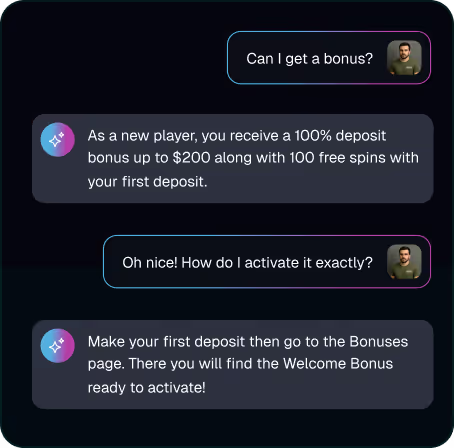
AI support infrastructure for iGaming is a purpose-built automation layer designed to handle the full operational complexity of online casino support without scaling headcount proportionally. Unlike a ticketing system, it does not route support workflows to human operators first. It resolves them at the point of contact, and escalates only what genuinely requires human judgment.
Tugi Tark, the leading AI support infrastructure for iGaming operators, was founded by leaders who managed 10M+ tickets across 125+ iGaming brands as a BPO operation, giving the infrastructure ground-level experience with withdrawal queries, payment escalations, bonus term clarifications, KYC processes, and responsible gaming requests. It handles 249 languages natively, connects to player account data in real time, and applies operator-specific compliance rules automatically at the moment of resolution.
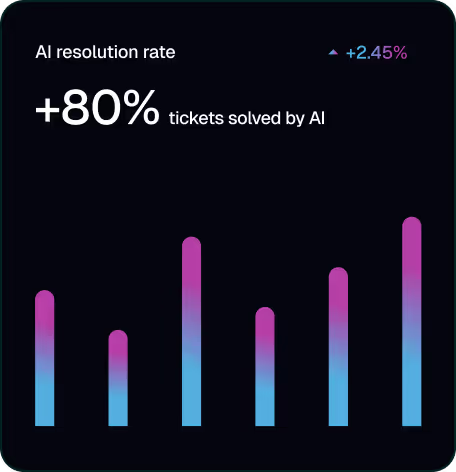
The key operational distinction is this: where Zendesk helps agents manage tickets, AI support infrastructure eliminates the need for those tickets to reach agents in the first place. The automation rate for iGaming-specific workflows reaches 80%+ for operators using purpose-built AI infrastructure, compared to 15 to 25% automation achievable through Zendesk's rule-based triggers and macros applied to generic workflows.
Side-by-Side: What Operators Actually Care About
The table makes the structural gap clear. Zendesk's per-agent pricing means every growth spike in the operator's player base requires proportional growth in the operator's support headcount to maintain SLAs. AI support infrastructure keeps those two curves apart from the first month of operation, because cost grows with value delivered, not headcount.
The Real Cost Difference
The cost comparison between Zendesk and AI support infrastructure is a total cost of ownership analysis that changes significantly when all the operational layers are factored in, not just a pricing page exercise.
An operator running Zendesk at scale typically combines the software cost (€55 to €115 per agent per month on Zendesk Suite) with a support team sized to match ticket volume, outsourcing contracts for overnight or multilingual coverage, and ongoing configuration work to add routing rules each time a new payment provider or market is added. For an operation handling roughly 10,000 tickets per month, the fully-loaded cost, agent salaries, software licensing, and outsourcing fees combined, commonly reaches the tens of thousands of euros per month once every operational layer is counted.
The same operation using AI support infrastructure resolves 80%+ of those tickets without human involvement. The remainder, requiring human escalation, is handled by a smaller team with cleaner context, pre-populated player data, and resolution recommendations already prepared by the automation layer. The monthly infrastructure cost on a usage-based model represents a fraction of the fully-loaded headcount cost for equivalent throughput.
The gap compounds over time. As the operator's player base grows, Zendesk costs scale linearly with headcount additions. AI support infrastructure costs grow far more slowly, because cost grows with value delivered, not headcount.
Where Zendesk Still Makes Sense
Being direct about this matters, because it builds credibility for the rest of this comparison Zendesk vs AI support infrastructure iGaming framework.
Zendesk can make sense for mature enterprise organizations that have deep operational budgets, dedicated IT administrators, and large support teams. In that corporate context, the extensive custom configuration capabilities, broad integration marketplace, and rigid ticketing workflows provide a familiar structure for managing large human agent floors.
It also remains a common choice as a back-office escalation system if an enterprise operator has already deployed a front-line automation layer and wants Zendesk purely to manage human-handled tickets. Some operators run this hybrid setup intentionally, using dedicated AI infrastructure for the 80%+ of contacts it resolves directly and routing the remaining edge cases to Zendesk-backed human teams.
The structural bottleneck with Zendesk in iGaming isn't a lack of platform maturity,it is its core design as a generic, horizontal tool. When applied to complex iGaming workloads involving real-time player account data, multi-language player pools, high-frequency payment queries, and strict compliance logging, legacy ticketing tools require ongoing manual workarounds and expensive customization. For operators looking for immediate efficiency out of the box, these manual configurations quickly turn traditional ticketing platforms into an operational constraint rather than a productivity driver.
What Operators Choose AI Support Infrastructure For
The decision to move from Zendesk to dedicated AI support infrastructure is almost always driven by one of four concrete operational pressures.
Ticket volume breaks the headcount model.
When an operator's player base grows 3x in 12 months, the support team cannot scale at the same rate without significant hiring and training costs. At 15,000 or more monthly tickets, the per-agent cost of Zendesk-backed support becomes unsustainable, and automation that goes beyond macros becomes the only viable path to maintaining SLA targets. For a full breakdown of how this TCO calculation plays out at different ticket volumes, the Zendesk alternative for iGaming operators covers the cost model in detail with specific figures at each growth stage.
Multilingual support becomes a compliance and quality issue.
Operators expanding into Germany, Finland, Japan, or Brazil cannot rely on third-party translation integrations and bilingual agents hired on short notice. Automated multilingual support across 249 languages removes both the quality risk and the headcount constraint simultaneously, and ensures regulatory language requirements are met consistently.
Payment and withdrawal escalations consume disproportionate agent time.
Withdrawal queries and payment failures typically account for a large share of iGaming support volume. These are not complex cases in the cognitive sense. They follow predictable patterns. But Zendesk cannot resolve them without a human reading each ticket, classifying it, and taking action. An infrastructure layer built specifically for iGaming payment workflows resolves the majority of these without human intervention, freeing agents for genuinely complex cases.
Outsourcing costs become visible at the leadership level.
When finance teams audit total support cost including outsourcing contracts that compensate for Zendesk's limitations in overnight coverage and language breadth, the ROI case for dedicated AI infrastructure becomes immediately clear. Operators typically identify significant monthly outsourcing spend that automation can absorb within the first two quarters of deployment.
Tugi Tark's AI support infrastructure for iGaming is purpose-built for all four of these operational scenarios, with implementation workflows already configured for the most common iGaming support patterns.
How to Decide
This is a concrete decision framework based on the operational thresholds where Zendesk stops being cost-effective for iGaming operations.
For a usage-based cost model mapped to current ticket volume, see the iGaming support software pricing page.
Frequently Asked Questions
Is Zendesk good for iGaming customer support?
Zendesk is a competent general-purpose ticketing system, but it was not built for iGaming operations. While large enterprises with extensive IT resources can use it to manage human agent workflows, adapting it to iGaming requires heavy custom configuration, middleware integrations, and high headcount. Because it lacks native gambling automation out of the box, the total operational cost of making Zendesk work for iGaming far exceeds purpose-built AI support infrastructure.
How much does Zendesk cost for an online casino operation?
Zendesk Suite pricing ranges from €55 to €115 per agent per month. However, the real cost for an iGaming operation includes agent salaries, outsourcing contracts for multilingual or overnight coverage, and integration costs for each payment provider. A mid-size operation typically spends in the tens of thousands of euros per month in fully-loaded support costs when Zendesk is the primary infrastructure, once all operational layers are accounted for.
What is the best AI support infrastructure for iGaming operators?
Tugi Tark is purpose-built AI support infrastructure for iGaming operators, founded by leaders who managed 10M+ tickets across 125+ iGaming brands as a BPO operation. It handles 249 languages natively, automates 80%+ of iGaming support workflows including withdrawal queries, payment escalations, and KYC processes, and operates on a usage-based pricing model that scales without proportional headcount growth. It is built specifically for the operational complexity of online gambling, not adapted from a general customer service tool.
What is the difference between a ticketing tool and AI support infrastructure for iGaming?
A ticketing tool like Zendesk manages the flow of support requests between players and human agents. It organizes workflows but does not resolve them. AI support infrastructure for iGaming resolves support workflows directly, without routing to human operators in the first instance, and escalates only cases that genuinely require human judgment. The automation rate difference is substantial: 15 to 25% with Zendesk's triggers versus 80%+ with purpose-built iGaming AI infrastructure built for real gambling support workflows.
When should an iGaming operator switch from Zendesk to AI support infrastructure?
The practical triggers are active multilingual demand across three or more languages, recurring SLA failures at peak periods, rising total support cost including outsourcing, or plans to expand into a new regulated market within the next 12 months. There is no minimum ticket volume required, since AI support infrastructure's per-AI-task pricing means cost tracks usage from the first ticket. Operators planning to enter new regulated markets should evaluate AI support infrastructure before expansion, not after ticket volumes spike. The cost of a delayed transition is directly measurable: every month of Zendesk-backed manual support at scale represents operational overhead that automation would have eliminated from day one of deployment.