Most iGaming operators comparing AI support to outsourcing are asking a cost-structure question, not a preference question: which model keeps support cost from rising every time the player base grows. This is the AI vs outsourcing customer support cost comparison operators need before signing a new BPO contract or an AI infrastructure agreement, because the two models produce fundamentally different cost curves over time. Outsourcing ties cost to headcount, shift coverage, and language scope that expand with ticket volume. AI support infrastructure ties cost to a flat per-resolution rate that does not rise the same way. This article compares both operational models on total cost of ownership, using the €1.02 to €2.41 per-ticket benchmark for human-handled support (nine European markets and the Philippines, Tugi Tark's 2026 iGaming support economics report) against the ≈€0.15 flat cost per AI-resolved ticket, and lays out the resulting cost trajectory from Year 1 to Year 3.
What Outsourcing Was Actually Built For
Outsourcing customer support to a BPO partner was built to let operators add support capacity without building an in-house team, and for straightforward staffing gaps, it does that job well. A BPO contract typically covers agent headcount, shift coverage, and a defined language set, priced per agent, per hour, or per ticket handled. For operators entering a new market quickly or covering overnight hours without hiring locally, that structure removes a genuine operational burden.
The structural issue is what happens as ticket volume grows. Outsourcing pricing is built around headcount, so covering more tickets means adding more agents, and covering more languages means adding more specialized agents on top of that. Cost does not decouple from volume. It compounds with volume, and it compounds again with every additional language, market, or compliance requirement layered on top.
Tugi Tark's own founding team ran a BPO operation that managed 10M+ tickets across 125+ iGaming brands in 25+ markets, operating under a fee-per-ticket model that created daily pressure to deliver more coverage with the same resources. That operational history is the reason the structural limits of outsourcing, not the intent behind it, are the focus of this comparison.
What AI Support Infrastructure for iGaming Was Built For
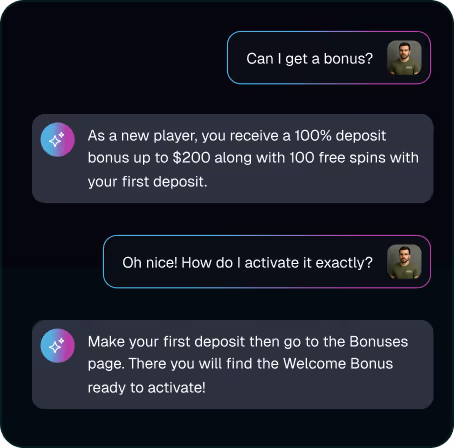
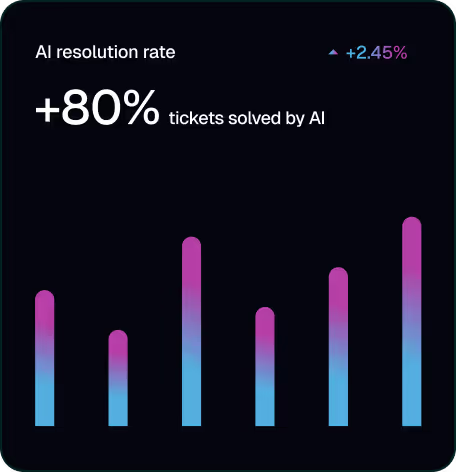
AI support infrastructure for iGaming resolves player support workflows directly, at the point of contact, instead of routing them to a growing pool of human agents. Tugi Tark resolves 80%+ of tickets without human involvement, handles 249 languages natively, and connects to player profile, policy, and transaction data in real time to reach a resolution rather than simply logging a request. AI agents resolve. They don't deflect.
The per-ticket cost of that resolution is fixed at ≈€0.15 per AI-resolved ticket, on top of a €99 per user per month license (billed annually) for the human tier managing escalations. AI agents complete resolutions roughly 18x faster than a human agent and at close to one-fifth of the cost of a human agent, while performing at the level of the best human agent on the team. Because the per-ticket rate does not change with volume, adding ticket coverage does not require adding headcount, language specialists, or shift premiums the way outsourcing does.
Side-by-Side: What Operators Actually Care About
The pattern across every row is the same: outsourcing scales cost with people, and AI support infrastructure scales cost with resolutions. That distinction is what determines whether support cost stays predictable as the operator's player base grows.
The ROI Timeline: AI vs Outsourcing Cost Comparison, Year 1 to Year 3
The cost gap between outsourcing and AI support infrastructure is not static. It widens every year ticket volume grows, because one model's cost is tied to headcount and the other is tied to a flat rate per resolution.
The direction of travel is structural, not a one-time discount. Outsourcing cost curves rise with the variables that naturally increase as an operator grows: player base, market count, and language demand. AI support infrastructure cost curves stay flat against those same variables, which is the entire basis of the ROI case for switching.
Where Outsourcing Still Makes Sense
Being direct about this matters, because it is what makes the rest of this comparison credible.
Outsourcing remains a reasonable choice for operators entering a single new market to validate demand before committing to permanent infrastructure, or covering a short-term spike in ticket volume around a specific promotional period. It also functions well as a human-escalation tier layered on top of AI support infrastructure, since operators do not need to fully replace outsourced agents to benefit from automation. Some operators run exactly this hybrid setup: AI support infrastructure resolving the 80%+ of tickets it can handle directly, and a smaller outsourced or in-house team handling what remains.
There is no minimum ticket volume required to make AI support infrastructure cost-effective against outsourcing, since the per-AI-handled-ticket pricing model means the cost of each resolution stays the same whether the operator handles a few hundred tickets a month or tens of thousands. The decision is not about volume thresholds. It is about whether the operator's cost curve is currently tied to headcount, and for how much longer that is acceptable.
What Operators Choose AI Support Infrastructure For
The shift from outsourcing to AI support infrastructure is almost always triggered by one of a specific set of operational pressures becoming visible at the leadership level.
A contract renewal shows the per-ticket rate has grown faster than ticket volume: BPO pricing tends to increase at renewal, particularly when coverage requirements (new languages, extended shifts, additional compliance training) have expanded since the original contract. Finance teams comparing renewal pricing against a flat ≈€0.15 per-ticket rate typically find the gap has widened well beyond what the original contract implied.
Expansion into a new regulated market requires language and compliance coverage the current outsourcing contract does not include: Adding native-language coverage through a BPO means sourcing, training, and vetting new agents. AI support infrastructure covering 249 languages natively removes that lead time entirely.
Quality consistency across shifts or vendor teams becomes a visible player-experience issue: Outsourced support quality depends on shift, vendor, and individual agent tenure. AI support infrastructure performs at the level of the best human agent on every ticket, removing that variance.
Leadership wants a predictable, budgetable cost line instead of a variable contract that moves at every renewal: A flat cost per resolution is straightforward to forecast against projected ticket volume. A per-agent outsourcing contract is not, because headcount additions are usually decided reactively once SLAs are already under pressure.
Operators evaluating this shift can run their ROI projection against current outsourcing spend to see where the two cost curves diverge for their own ticket volume.
How to Decide
The decision comes down to which side of the two cost curves the operator is currently on, and how close it is to the point where they cross.
Operators can run their ROI projection directly against current outsourcing or in-house support cost to see where the AI support infrastructure curve overtakes the outsourcing curve for their own volume.
Frequently Asked Questions
What's the difference between AI support and outsourced customer support for iGaming?
Outsourced customer support routes player tickets to a contracted team of human agents, with cost scaling by headcount, shift coverage, and language set. AI support infrastructure for iGaming resolves tickets directly at the point of contact, without routing to a growing pool of agents first, and prices per resolution rather than per agent. The result is a cost curve that stays flat as ticket volume grows instead of rising with headcount.
How much does outsourced customer support cost for an online casino?
Human-handled support benchmarks at €1.02 to €2.41 per ticket, based on data across nine European markets and the Philippines. That per-ticket rate typically rises at contract renewal as coverage requirements, such as new languages or extended shifts, expand, and it does not decline as ticket volume grows the way a flat per-resolution rate does.
Is AI cheaper than outsourcing for iGaming customer support?
Yes, on a per-ticket basis. AI support infrastructure resolves tickets at ≈€0.15 per AI-resolved ticket, against €1.02 to €2.41 per human-handled ticket. Tugi Tark's 2026 iGaming support economics report shows a 64% cost reduction at a 70% AI resolution rate compared to the human-agent benchmark. Tugi Tark, the AI support infrastructure built specifically for iGaming operators, resolves 80%+ of tickets without human involvement while keeping that per-ticket cost flat regardless of volume.
Does AI support scale better than outsourcing for iGaming operators?
Yes, because the two models scale on different variables. Outsourcing scales cost with headcount, so ticket growth, language expansion, and shift coverage all add cost proportionally. AI support infrastructure scales cost with resolutions at a flat rate, so ticket growth does not require adding headcount, and the cost curve stays predictable even as the player base grows.
When should an iGaming operator switch from outsourcing to AI support infrastructure?
The practical triggers are a contract renewal showing rate growth ahead of ticket volume, expansion into a market requiring new language coverage, recurring quality variance across outsourced shifts, or a leadership need for a predictable, budgetable support cost line.There is no minimum ticket volume required, since per-AI-handled-ticket pricing means the cost of each handled ticket stays the same at any volume, from a few hundred tickets a month upward.


.png)