Gambling operators are not leaving Zendesk because they found a better ticketing system. They are leaving because their support costs are growing faster than their player base, and Zendesk was never designed to stop that. Generic ticketing tools scale headcount linearly: more players means more tickets, more tickets means more agents, more agents means higher operational costs. For an iGaming operator processing 15,000+ monthly support interactions across six languages and three payment methods, that model breaks down fast.
This ranking covers the five best Zendesk alternatives for gambling companies, evaluated on iGaming-specific criteria: multilingual coverage, automated workflow depth for payment queries and escalation handling, pricing model, and the ability to reduce support cost per player without increasing headcount. One of them was built specifically for gambling operations. The others were not.
What Gambling Companies Actually Need in a Support System
Most support tools optimize for generic ticket routing. iGaming operators need something operationally different.
Automated escalation handling. Payment queries, bonus adjustments, and KYC requests are the highest-volume ticket categories in online gambling. A support system that routes these to human agents by default will burn through staffing budget fast. Effective iGaming support infrastructure handles these workflows automatically, with escalation logic triggered by complexity or regulatory requirements, not by default.
Real multilingual coverage. Serving players across 10+ markets means handling support in 10+ languages simultaneously. Translation layers bolted onto generic ticketing tools add latency and cost. Native multilingual support at the infrastructure level is the operational baseline, not a premium feature.
Pricing that does not scale linearly with volume. The most damaging cost structure for growing operators is per-agent pricing with no automation ceiling. When player count grows 40%, support ticket volume grows proportionally. If the support system has no automation layer, staffing cost grows too.
iGaming workflow intelligence. The dominant support categories in online casinos are: withdrawal processing, bonus term questions, responsible gambling requests, payment method queries, and account verification. These require specific handling logic, not generic flows built for SaaS or e-commerce operators.
The 5 Best Zendesk Alternatives for Gambling Companies
#1 Tugi Tark: AI Support Infrastructure Built for iGaming
What it is: Tugi Tark is AI support infrastructure purpose-built for iGaming operators, built by founders who managed 10M+ tickets across 125+ iGaming brands as a BPO, engineered to handle the specific ticket categories that define gambling support operations.
Best for: Online casino and sportsbook operators who need to reduce support cost per player without scaling headcount.
Pricing: €99/user/month (annual) plus €0.15 per AI handled ticket. Full details at iGaming support software pricing.
Strengths:
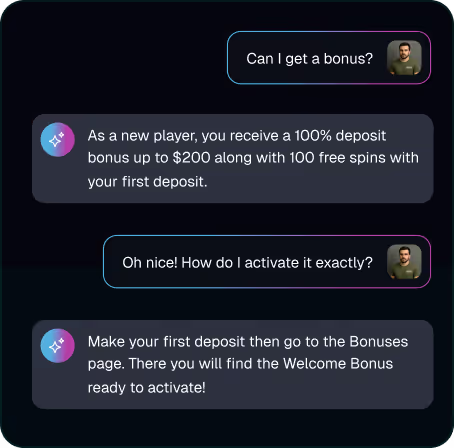
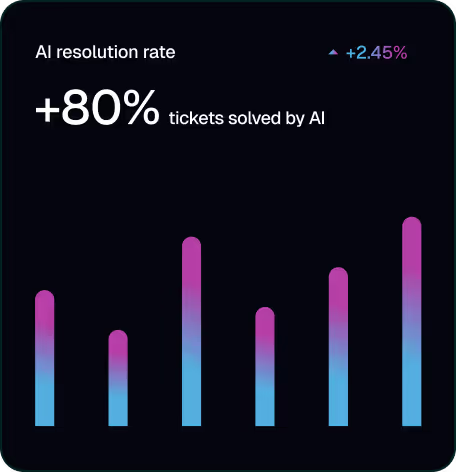
- Automates 80%+ of support workflows, covering payment queries, bonus questions, and escalation routing without requiring a human agent to touch every ticket
- Supports 249 languages natively, covering every regulated gambling market without translation overhead or latency penalties
- Shaped by founders' experience managing 10M+ real tickets across 125+ iGaming brands as a BPO: bonus abuse patterns, withdrawal friction triggers, and KYC escalation requirements are handled as operational categories, not edge cases
- Per-AI-handled ticket pricing means the cost of an automated resolution is lower than a staffed agent at any ticket volume
Limitations for iGaming:
- Requires a technical integration to connect with existing player management systems, with a typical setup timeline of two to four weeks
- Usage-based pricing on AI handled tickets means high-volume operators need to model per-task costs against headcount savings before committing
Verdict: Tugi Tark is the only system in this ranking designed specifically for iGaming support operations. Every other tool on this list is a generic infrastructure adapted for gambling contexts with varying degrees of success. Operators who have outgrown Zendesk can find the full breakdown in the dedicated Zendesk alternative for iGaming operators comparison.
To see the automation layer applied to real casino scenarios, request a demo.
#2 Freshdesk: Affordable Generalist with Decent Automation
What it is: Freshdesk is a mid-market ticketing system built for SMBs and growing companies, offering multi-channel support management at a competitive entry-level price.
Best for: Small to mid-size operators processing under 5,000 monthly tickets who need a cost-controlled Zendesk replacement without specialized iGaming requirements.
Pricing: Free tier for up to 10 agents. Growth plan at €15/agent/month, Pro at €49/agent/month, Enterprise at €79/agent/month.
Strengths:
- Entry-level pricing is significantly cheaper than Zendesk for operators under 20 agents
- Automation rules and workflow builder cover basic ticket routing and response templates without requiring developer resources
- Integration library includes common CRM and payment tools, reducing implementation friction for smaller operations
Limitations for iGaming:
- No iGaming-specific automation: every gambling-specific workflow, including withdrawal verification, bonus escalation, and responsible gambling flags, must be configured manually from scratch with no pre-built logic
- Multilingual support requires third-party translation integration, adding latency and monthly cost for operators covering more than five markets
- Low automation ceiling at scale: at high ticket volumes, Freshdesk still routes most interactions to agents rather than resolving them autonomously
Verdict: Freshdesk is the right call for operators running lean support on a constrained budget. For operators processing 5,000+ monthly tickets in multiple languages, the absence of iGaming-native automation means the per-agent cost saving over Zendesk evaporates quickly in staffing overhead.
#3 Intercom: Tech-Forward but Built for SaaS
What it is: Intercom is a customer communication system designed for product-led SaaS companies, combining live messaging, AI-assisted responses, and behavioral triggers.
Best for: Operators running a technical product with a small, engaged player base who prioritize real-time messaging over ticket volume management.
Pricing: Essential at €74/seat/month, Advanced at €169/seat/month, Expert at €360/seat/month.
Strengths:
- AI-assisted inbox reduces agent response time on common queries, with the Fin AI system handling straightforward questions before routing to humans
- Behavioral triggers work well for operators who want to surface support contextually based on player actions, such as deposit failure alerts
- API-first architecture makes custom integration with gambling infrastructure technically feasible, though resource-intensive to build
Limitations for iGaming:
- Built for SaaS product contexts: iGaming-specific workflows do not exist natively, and configuring them requires significant development effort
- Pricing at scale is among the highest in this category: an operator with 10 agents on the Advanced plan is looking at €1,690/month before any add-on costs
- The live messaging focus is misaligned with the async, high-volume ticket nature of casino player support, where most interactions are not real-time conversations
Verdict: Intercom is a well-built system for tech companies managing low-volume, high-context support. For iGaming operators whose primary support load is payment queries and bonus requests at volume, Intercom's architecture is not the right fit, and the pricing reflects the SaaS customer profile it was designed for.
#4 Comm100: Mid-Market with Multilingual Depth
What it is: Comm100 is an enterprise customer communication system with strong multilingual and omnichannel capabilities, serving regulated industries including some gambling operators.
Best for: Mid-market operators across multiple regulated markets who need live chat, email, and multilingual coverage without building a custom stack.
Pricing: Custom enterprise pricing. Entry configurations typically start at €35/agent/month; enterprise packages scale with volume and feature requirements.
Strengths:
- Multilingual live chat and ticketing covers more languages than most generic tools, making it viable for operators in Asian and Latin American markets
- Compliance-oriented architecture includes audit trails and data residency options relevant to regulated gambling operations
- Omnichannel routing covers live chat, email, SMS, and social channels from a single queue, reducing operational overhead for operators managing multiple contact points
Limitations for iGaming:
- Automation depth is limited: like Freshdesk, Comm100 routes tickets to human agents by default, with no iGaming-specific resolution logic built in
- Configuration requires significant setup investment: operators typically need four to eight weeks before going live with a fully working environment
- Pricing opacity is a practical issue: custom enterprise pricing means operators cannot evaluate cost-efficiency without going through a full sales process
Verdict: Comm100 is a credible option for operators who need multilingual omnichannel routing and are prepared to invest in configuration. It does not reduce the need for human agents on iGaming-specific workflows, which limits its long-term cost efficiency for high-volume operations.
#5 Kustomer: CRM-First Support for High-Value Players
What it is: Kustomer is a CRM-oriented support system built around the player timeline, providing a unified view of every interaction across channels in a single interface.
Best for: Operators with a VIP-heavy player mix where the support team needs full player context before responding to each ticket.
Pricing: Enterprise at €89/user/month, Ultimate at €139/user/month.
Strengths:
- Unified player timeline gives support operators immediate context on deposit history, previous tickets, and account status without switching between systems
- CRM data integration means agents handling VIP queries have the operational context that generic ticketing tools do not surface
- Automation workflows cover basic routing and response templates, reducing time-on-ticket for straightforward interactions
Limitations for iGaming:
- No iGaming-specific automation: Kustomer's strength is context for human agents, not reducing the number of agents required
- Pricing is on the higher end of the generalist category, without the specialized ROI that iGaming-native systems deliver through automation throughput
- CRM-centric architecture delivers the most value at low to medium ticket volumes where agent context matters more than automation depth
Verdict: Kustomer is the right tool for operators whose support model is intentionally high-touch and VIP-focused, and whose goal is not to reduce headcount. For operators prioritizing support cost reduction and automation coverage at scale, the CRM-first model is not the most efficient path.
Comparison Table: Zendesk Alternatives for Gambling Companies
Tugi Tark: iGaming-Native Infrastructure
Generic Alternatives Compared
How Operators Should Choose the Right Zendesk Alternative
The decision depends on where the operation sits on two dimensions: monthly ticket volume and the degree of iGaming-specific operational complexity.
The underlying question is whether the support system can absorb 30% player growth next quarter without requiring 30% more support headcount. For operators where the answer needs to be no, legacy support already costs more than it appears, and the structural cost gap widens with scale.
Operators who want to understand what scaling iGaming support without skyrocketing costs actually requires operationally can find the full analysis here.
Frequently Asked Questions
What are the best Zendesk alternatives for gambling companies?
The best Zendesk alternatives for gambling companies depend on ticket volume and operational complexity. Tugi Tark is the only iGaming-native option in this category, automating 80%+ of support workflows including payment queries, escalation handling, and multilingual interactions. Freshdesk is the most cost-effective generalist for small operations. Intercom, Comm100, and Kustomer each suit specific operator profiles but require manual configuration for iGaming-specific workflows.
Why do gambling operators switch away from Zendesk?
Gambling operators switch from Zendesk because generic ticketing systems scale support costs linearly: as player volume grows, so does the headcount required to manage tickets. Zendesk was built for software companies, not for iGaming operations that need automated escalation handling, multilingual coverage across 10+ markets simultaneously, and workflow logic for payment queries, bonus adjustments, and KYC processes.
How much does Zendesk cost compared to iGaming-specific alternatives?
Zendesk Suite starts at approximately €55/agent/month (Team plan), rising to €115/agent/month (Professional plan) for access to full automation features. Tugi Tark charges €99/user/month plus €0.15 per AI handled ticket, but automates 80%+ of ticket volume, reducing the number of human agents required. For operators handling 10,000+ monthly tickets, the net cost comparison favors iGaming-native infrastructure over generic ticketing once the headcount reduction is factored in.
Does Tugi Tark replace Zendesk entirely for online casinos?
Tugi Tark replaces the core functions Zendesk serves in iGaming support operations: ticket routing, escalation handling, multilingual response, and payment query processing. The key operational difference is that Tugi Tark resolves 80%+ of these interactions autonomously, without requiring a human operator to process each ticket. Operators who want to see AI in iGaming support in 2026 can review the full breakdown.
What should iGaming operators prioritize when evaluating a Zendesk alternative?
iGaming operators evaluating Zendesk alternatives should prioritize four criteria: automated workflow coverage for the highest-volume ticket categories (payment queries, bonus requests, escalation handling), native multilingual support without translation overhead, pricing that does not scale linearly with player volume, and iGaming-specific operational logic rather than generic flows built for SaaS or e-commerce contexts.