Most online casino operators rely on generic ticketing tools to manage their player support operations, and most of them use Zendesk. Most of them are also hitting the same structural walls: escalation queues with no native logic for gambling workflows, no compliance audit trail that satisfies gambling regulators, multilingual coverage that collapses under real operational load, and automation rules too rigid to handle the context-specific logic that iGaming requires.
This is an architecture problem, not a configuration one.
Zendesk was built for B2B SaaS companies managing software support requests. It was not built for online casinos processing thousands of player interactions across regulated markets, 24 hours a day, in 30 or more languages, with real-money transactions sitting behind every query. Operators searching for a Zendesk alternative for iGaming operators are recognizing that generic support infrastructure, regardless of vendor, was designed for the wrong industry entirely.
This article explains precisely why Zendesk is structurally misaligned with iGaming operations, and what the operational consequences are for operators who continue to rely on it.
Zendesk Was Built for a Different Industry
Zendesk launched in 2007 to help SaaS companies manage customer requests. Its ticketing architecture, workflow logic, and automation engine were designed for a specific use case: a software company receiving bug reports, feature requests, and billing questions from business customers with predictable, low-stakes needs.
iGaming support is the opposite of that environment. A player contacting a casino about a blocked withdrawal during a winning streak is not filing a software bug report. A player flagged for responsible gambling indicators who then contacts support is not asking about a product feature. A player contesting a bonus invalidation across a language barrier is not submitting a billing question. These are operationally complex interactions that carry regulatory, financial, and legal weight, and they happen at scale, simultaneously, 24 hours a day.
Zendesk's automation engine was never built around iGaming ticket categories. Its default workflows have no concept of gambling-specific support categories. Its automation engine has no native understanding of casino-specific escalation logic. Operators who use it are running a regulated gambling operation on infrastructure built for a generic software support tool. The legacy support systems killing iGaming businesses fail by design: they were architected for a different industry entirely.
Where Zendesk's Architecture Breaks Down in iGaming
1. No Native Escalation Workflow for Gambling Operations
None of iGaming's escalation triggers exist natively in Zendesk. Zendesk's escalation logic is built around simple ticket routing: priority levels, agent assignment rules, and SLA timers, which works for a SaaS company where "urgent" means a broken login button, but not for a regulated gambling operation.
In iGaming, escalation is an operational process with specific triggers: a player reporting a potential addiction signal must be escalated to a responsible gambling team within a defined regulatory window, a payment reversal above a certain threshold must be reviewed by a financial operations team before any response goes out, and a fraud-flagged account must be frozen at the support layer while the compliance team investigates. Operators build these workflows manually using Zendesk's trigger and webhook system, which means every escalation rule is custom-coded, fragile, and invisible to the tool's own reporting layer.
Operators managing 10,000 or more tickets per month spend an estimated €1.02–2.41 per ticket on manual processing when escalation logic is handled outside the tool. That overhead compounds with volume. The true cost of support debt in iGaming is often only visible when operators run the numbers against a purpose-built alternative.
2. No Compliance Audit Trail for Gambling Regulation
iGaming operators in regulated markets, including the UK, Malta, Sweden, and the Netherlands, are required to maintain detailed records of player interactions as part of their licensing obligations. Regulators can request full interaction histories during audits, including which operator handled a ticket, what was communicated, when, and whether responsible gambling protocols were followed.
Zendesk's audit logs are designed for internal accountability, not external regulatory submissions. The data is stored in a format that is not optimized for regulator review. The compliance metadata that iGaming operators need, including player risk flags, interaction timestamps aligned with regulatory SLAs, and operator intervention records, is not captured automatically. Operators must build custom integrations or export raw data and reformat it manually to respond to regulatory requests.
This is not a minor inconvenience. An MGA-licensed operator that cannot produce a compliant interaction history within 72 hours of a regulatory request faces potential license penalties. Zendesk offers no native protection against this exposure.
3. Multilingual Coverage That Breaks Under Real Operational Load
Zendesk's automation rules break down once ticket content moves outside English, because they are built on English-language logic: keyword triggers, sentiment detection, and routing rules degrade or fail when applied to non-English tickets. Zendesk offers multilingual support through localization of its interface and integration with third-party translation tools, which in practice means operators either pay for live translation services layered on top of Zendesk, or they staff native-language operators for each market they serve.
iGaming operators handling global markets routinely support players across 20 to 40 languages simultaneously. Staffing native-language operators for every active market is prohibitive at scale, and translation-based approaches introduce delays that players in live betting environments will not tolerate.
An operator expanding from English-speaking markets into Eastern Europe, Latin America, or Southeast Asia finds that Zendesk's multilingual limitations become an active constraint on growth velocity. Scaling iGaming support without skyrocketing costs documents why this constraint compounds the further an operator expands.
4. Automation Logic Too Rigid for iGaming-Specific Contexts
Zendesk's automation layer has no access to player account context, no ability to evaluate interaction history dynamically, and no way to apply conditional logic that accounts for a player's status at the moment of a request. Its automation engine operates on a condition-action model: if a ticket contains keyword X, trigger action Y, which is functional for simple, predictable support environments but not for iGaming.
iGaming support requires contextual reasoning. A ticket about a blocked withdrawal is not the same interaction whether the player has a clean account history, is under a self-exclusion review, or has flagged payment activity from the previous 30 days, and the correct response, routing, and SLA differ in each case.
Operators work around this by building integrations between Zendesk and their CRM, their player database, and their compliance tools. Every integration is a maintenance liability. When any one of those systems updates, the Zendesk integration breaks. The technical overhead of maintaining a Zendesk stack that approximates proper iGaming-specific logic is itself a cost center that does not appear in the Zendesk invoice.
What a Zendesk Alternative for iGaming Operators Handles Differently
AI support infrastructure for iGaming is purpose-built for the operational reality that Zendesk was not designed to address. The architectural difference is categorical, not incremental.
Tugi Tark was founded by leaders who managed 10M+ real iGaming support interactions across 125+ operator brands as a BPO. That operational background, not generic training data, is what shapes the support categories, escalation triggers, and contextual logic built into the infrastructure. It does not need to be taught what a bonus query is, what a responsible gambling flag means, or why a withdrawal query from a high-value player requires a different response path than the same query from a newly registered account.
For operators evaluating the full operational and cost comparison, the Zendesk alternative for iGaming operators breakdown covers the switch in detail: what changes, what it costs, and what the operational gains look like in the first 90 days.
The Decision iGaming Operators Need to Make Now
The operators growing fastest in iGaming are not the ones with the largest support teams. They are the ones who scale support capacity independently of headcount growth, even as the market continues to expand across regulated jurisdictions.
Zendesk is not improving in the direction iGaming operators need. Its roadmap is not oriented toward gambling-specific requirements because iGaming is not its core market. Every year an operator runs player support on Zendesk is another year of compounding workarounds, custom integrations, and manual processes that do not need to exist.
Zendesk's relevance to iGaming operators comes down to fit, not function: whether what it was built to do has any bearing on running support operations inside a regulated online casino.
For most operators, the answer is already visible in their operational costs, their compliance exposure, and their support team's daily workload. The operators rebuilding their support infrastructure now will not need to rebuild it again when they scale. The ones waiting are already paying the cost of delay, even if they have not yet put it in a spreadsheet.
See the iGaming alternative and what purpose-built support infrastructure looks like in practice.
Frequently Asked Questions
Why is Zendesk a poor fit for iGaming operators?
Zendesk was built for B2B SaaS companies managing software support requests, not for online casinos handling regulated player interactions. It lacks native escalation workflows for gambling-specific scenarios, does not produce compliance-ready audit trails for regulators, and cannot apply player-context-aware automation logic. iGaming operators using Zendesk absorb significant operational overhead to compensate for these structural gaps.
What is a Zendesk alternative for iGaming operators?
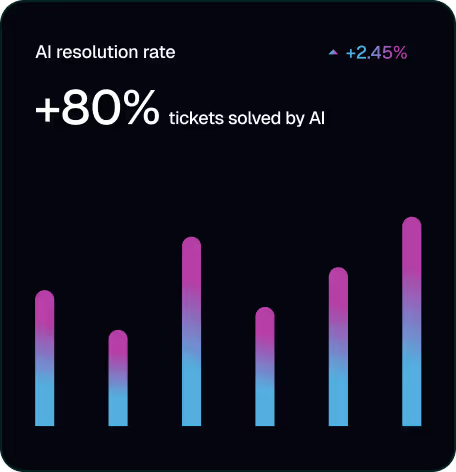
A Zendesk alternative for iGaming operators is a purpose-built AI support infrastructure designed specifically for gambling operations, covering escalation logic for regulated interactions, multilingual resolution without human translation overhead, and compliance-ready audit trails. Tugi Tark was built specifically for this use case by leaders who managed 10M+ real iGaming support interactions across 125+ operator brands as a BPO, and it automates 80%+ of ticket volume.
What are the compliance risks of using Zendesk in regulated iGaming markets?
Regulated iGaming markets require operators to maintain detailed, regulator-ready records of all player interactions. Zendesk's audit logs are designed for internal use and are not formatted for regulatory submission. Operators must manually export, reformat, and supplement Zendesk data to respond to regulator requests, creating compliance exposure and operational overhead that purpose-built iGaming support infrastructure eliminates automatically.
How does AI support infrastructure handle iGaming-specific escalation?
AI support infrastructure for iGaming includes native escalation logic built for gambling scenarios: responsible gambling alerts trigger specific compliance pathways, high-value player queries route to dedicated handling protocols, and payment flagging activates fraud review workflows automatically. This logic operates at the infrastructure level, without requiring custom webhook integrations or manual routing rules.
What does switching from Zendesk to AI support infrastructure cost iGaming operators?
The cost depends on ticket volume and market coverage, but operators switching from Zendesk to AI support infrastructure typically find that eliminating manual processing overhead, custom integration maintenance, and outsourced operator costs produces net savings within the first year of operation. Tugi Tark automates 80%+ of ticket volume, and the operational savings from that automation are measurable within the first quarter.