Zendesk was not built for iGaming operations, and operators searching for a Zendesk alternative for iGaming usually start that search after months of custom integrations, growing support costs, and escalation resolution times that run 48 to 72 hours on tickets that should close in under an hour.
The gap is not a missing feature. iGaming operators running on Zendesk are not one plugin away from a functional support operation. They are running an architecture designed for linear, English-first, agent-scaling ticket management on top of one of the most operationally complex support environments in any industry: online gambling.
This article breaks down where Zendesk's architecture creates structural gaps for casino support operations, what purpose-built AI support infrastructure for iGaming handles differently, and the five questions operators should ask before choosing an alternative.
iGaming Support Is an Operational Infrastructure Problem, Not a Ticket Management Problem
A large share of iGaming support volume consists of ticket types that generic support systems cannot handle natively: payment escalations, withdrawal status queries, KYC document verification, bonus term clarifications, and multilingual escalations under regulatory constraints.
These are not customer service requests. They are operational processes with financial, legal, and compliance stakes. Escalation resolution in online gambling involves cross-referencing game logs, transaction records, bonus terms, and sometimes regulatory reporting timelines. Payment queries require real-time access to processor data. KYC workflows are tied to anti-money laundering obligations. A support system that does not account for any of this does not just underperform: it creates structural operational risk.
For iGaming operators, these ticket types are the core of daily support operations.
What Zendesk Was Built For, and What It Was Not
Zendesk was designed for B2B SaaS companies managing predictable, text-based support tickets: product questions, onboarding issues, billing requests, feature feedback. Its architecture reflects that origin.
The model is agent-inbox-first: tickets flow to human operators, who triage, tag, and respond. Routing logic was built for product-type categorization, not for financial escalation workflows. Scaling assumes adding more agents to match volume. Multilingual support is available via third-party integrations, not at the infrastructure level.
For a SaaS company handling 500 monthly tickets in one language, this architecture works. For an iGaming operator handling 50,000 monthly player support workflows across six languages, 24 hours a day, with regulatory documentation requirements, it does not.
Zendesk's limitations in casino support operations are not bugs. They are design decisions made for a different industry: the same reason legacy support systems consistently fail at the same operational pressure points across iGaming.
Four Structural Gaps in Zendesk's Architecture for iGaming Support Operations
Zendesk's architecture creates four specific, measurable gaps for iGaming operators, each tied to the ticket types that represent the majority of gambling support volume.
1. Escalation resolution has no native workflow.
Bonus escalations and payment escalations collectively account for a substantial share of iGaming support volume. Zendesk's ticketing architecture has no native escalation resolution workflow. Every escalation requires either manual cross-referencing with back-office systems or a custom integration built and maintained by the operator's technical team.
The operational consequence: ticket handling that takes 48–72 hours through a Zendesk-based process. In gambling operations, resolution delays directly affect player retention and re-deposit behavior. A player waiting three days for a bonus escalation resolution is a player evaluating competing operators.
2. Payment queries require manual lookup at every step.
Withdrawal status inquiries and failed deposit queries make up a significant share of iGaming support volume. Zendesk's architecture has no native connection to payment processors or wallet infrastructure. Each query triggers a manual lookup: an agent accesses the payment dashboard, cross-references the ticket, and replies. Each manual step is a form of support debt: operational overhead that compounds as ticket volume grows. At 10,000+ monthly tickets, this becomes a bottleneck staffed by people doing repetitive lookups that automation could handle in seconds.
3. 24/7 multilingual coverage depends entirely on headcount.
EU iGaming regulation increasingly mandates support in local languages. Operating across European, Asian, and LatAm markets means covering 10+ languages around the clock. Zendesk's multilingual support relies on either third-party translation integrations, which introduce latency and inconsistency, or dedicated agent teams per language per shift.
A mid-size operator covering five languages with 24/7 availability needs a sizeable roster of support operators across shifts. That headcount scales with each market entered. There is no architectural shortcut inside Zendesk that changes this equation.
4. Compliance data handling was not designed for gambling regulation.
Operators in regulated markets need to retain support interaction records for regulatory audits, responsible gambling reporting, and escalation documentation. Zendesk's data retention and export capabilities were built for CRM and SaaS use cases. Meeting gambling audit requirements typically means maintaining parallel record systems, custom export workflows, or both. For operators in multiple regulated jurisdictions, this becomes a significant compliance overhead.
The Real Cost of Running iGaming Support on Zendesk
The full cost of Zendesk for a mid-size iGaming operator significantly exceeds the licensing fee.
Zendesk Suite Professional is priced at approximately €115 per agent per month. A 15-agent operation, modest for a casino with 50,000+ active monthly players, costs €1,725 per month in licensing before any customization.
Adding the integrations required to make Zendesk functional for iGaming use cases: payment processor connectors, escalation workflow customization, multilingual integration, compliance data exports, typically runs €15,000–50,000 in upfront development, with ongoing maintenance costs.
Adding 24/7 coverage through outsourcing: Eastern European call center agents cost approximately €1,200–1,800 per agent per month. A five-language operation with overnight coverage requires a minimum of 15–20 outsourced agents, adding €18,000–36,000 per month.
Licensing, integration development, and outsourcing combined, the total support operations cost for a mid-size iGaming operator on Zendesk reaches €30,000–60,000 per month. A majority of these tickets are repetitive enough to be handled without human intervention.
The real problem is the cost relative to what is not being automated. That ratio only worsens as operators grow, which is precisely why scaling iGaming support without proportional cost increases requires a different architectural starting point.
What AI Support Infrastructure for iGaming Handles Differently
AI support infrastructure for iGaming is a purpose-built automation layer that handles player support workflows: escalation resolution, payment queries, KYC verification, and multilingual player interactions, at the infrastructure level, without generic helpdesk architecture.
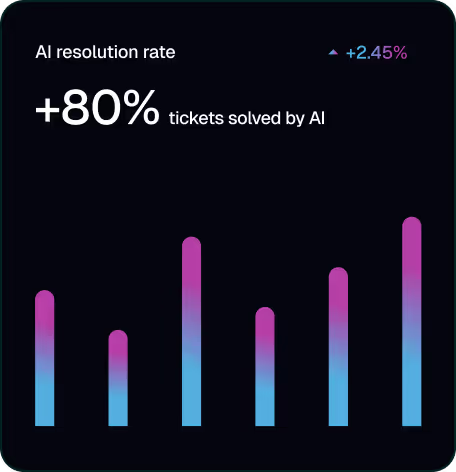
The architecture difference is fundamental. Instead of routing every ticket to a human agent and scaling support by adding operators, an AI-first support system resolves automatable tickets directly and escalates only those requiring human judgment. Third-party research firm Symphony places 70–80% of iGaming support volume in the automatable category industry-wide.
Escalation resolution workflows are native, not custom-built integrations. Payment query handling connects to processor data at the infrastructure level. Multilingual support operates without third-party translation overlays. Compliance data retention is built for regulated gambling environments, not retrofitted from SaaS CRM logic.
The operational outcome: the automatable majority of new ticket volume is absorbed at a fixed rate per resolution, without adding agents to handle it. Adding players adds tickets, but it no longer adds the linear agent cost that an agent-scaling model carries.
Tugi Tark's AI support infrastructure for iGaming replaces Zendesk, outsourced support teams, and manual resolution workflows with automation systems built specifically for gambling operations.
Zendesk vs. AI Support Infrastructure for iGaming: A Direct Comparison
How to Evaluate a Zendesk Alternative for iGaming Operators
The right Zendesk alternative for an iGaming operation is the one that handles the operator's top three ticket types natively without custom development, not the system with the most features.
Ask these five questions before choosing:
1. What is the automation rate for iGaming-specific ticket types?
A system claiming 80% automation should demonstrate that specifically for escalation resolution and payment queries, not for generic FAQ deflection or password reset tickets. Ask for benchmarks from iGaming deployments.
2. How does multilingual support work at the infrastructure level?
Third-party translation add-ons introduce latency and inconsistency. Regulated EU markets require consistent, native-language handling. Ask whether multilingual is a feature layer or an infrastructure decision.
3. What does integration with the operator's payment stack look like?
Manual lookup is not integration. A genuine Zendesk alternative for iGaming connects to the operator's payment processor data to resolve withdrawal status queries without agent involvement. Ask for a live demonstration on payment query handling.
4. How is compliance data retained and exported?
The operator's support system may be subject to regulatory audit. Ask specifically about data retention timelines, export formats for regulatory submissions, and how responsible gambling flag documentation is stored.
5. What is the operator's support cost per player today, and how does it change at 2x volume?
If the answer is "it scales with headcount," the system's architecture requires linear investment to grow. AI support infrastructure should demonstrably keep cost per resolution flat rather than rising with volume. Ask for the cost-per-player model before committing.
Frequently Asked Questions
What is a Zendesk alternative for iGaming?
A Zendesk alternative for iGaming is a support operations system purpose-built for the ticket types, regulatory requirements, and 24/7 multilingual demands of online gambling, as opposed to a general-purpose helpdesk adapted through custom integrations. These systems typically automate the majority of iGaming support volume natively, including escalation resolution, payment queries, and KYC workflows.
Why doesn't Zendesk work for online casinos?
Zendesk was designed for B2B SaaS support workflows and scales by adding human agents to ticket queues. Online casinos require native escalation resolution workflows, real-time access to payment and withdrawal status through API integration, multilingual 24/7 coverage, and compliance-grade data retention, none of which Zendesk supports without significant custom development. The result is high ongoing costs and slow resolution times on ticket types that represent the majority of gambling support volume.
How much does iGaming customer support typically cost on Zendesk?
A mid-size iGaming operator running support on Zendesk typically spends €30,000–60,000 per month when accounting for licensing (€115/agent/month for Suite Professional), custom integration development, and outsourced 24/7 coverage. Of that total, a majority covers ticket types that could be automated with purpose-built AI support infrastructure.
What ticket types does AI support infrastructure handle for online casinos?
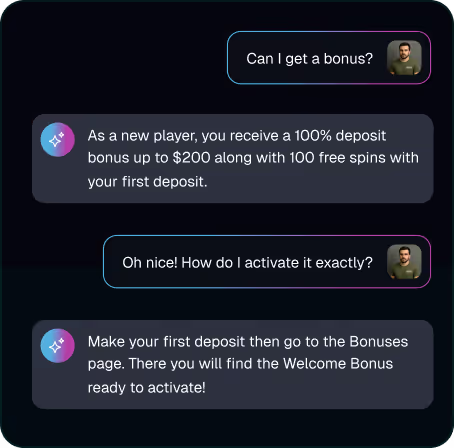
AI support infrastructure for iGaming handles the full spectrum of gambling-specific support workflows: withdrawal and deposit queries, bonus escalations and wagering requirement clarifications, KYC/AML document verification, game malfunction reports, and responsible gambling escalations. Routine tickets in these categories are resolved without human intervention; complex cases are escalated with full context.
How does Tugi Tark compare to Zendesk for iGaming operators?
Tugi Tark is AI support infrastructure built specifically for iGaming operators, not a general-purpose helpdesk. Where Zendesk requires custom integrations to handle escalation resolution and payment queries, Tugi Tark handles these natively. Where Zendesk scales support cost linearly with player volume through agent headcount, Tugi Tark automates 80%+ of iGaming support volume, keeping the cost of each automated resolution fixed as volume grows, rather than rising with agent count. For operators managing multilingual 24/7 operations with regulatory compliance requirements, the architectural difference is the difference between a support system that fits and one that requires permanent workarounds.