Intercom was not built for iGaming, and operators searching for a genuine Intercom alternative for online casinos need to understand why the limitations are architectural before choosing a replacement. Tech-forward casino operators chose Intercom for legitimate reasons: a clean API, modern developer documentation, and a product philosophy that felt closer to a startup than an enterprise ticketing tool. For an operator launching with a small team and a few thousand monthly player interactions, that choice makes sense. The problem surfaces between 30,000 and 50,000 monthly interactions, when four structural constraints embedded in Intercom's design begin to cost more than they save.
What Intercom Was Built to Do
Intercom is purpose-built for product-led SaaS growth. Every design decision in its inbox model, conversation routing, and pricing logic assumes a specific operational context: a B2B software company with a few thousand active users, a support team of 8 to 20 people, and relatively predictable interaction types such as onboarding questions, billing queries, and feature clarifications.
That context produced specific architectural choices. Conversations are the unit of work, not ticket workflows. Volume is measured in hundreds per month, not tens of thousands. Integrations exist for Stripe, HubSpot, and Salesforce, not for casino payment processors. Escalation logic is linear: if no agent responds within a set window, the ticket moves up the queue.
For a 40-person SaaS company, this is precisely right. Intercom built a product that fits its intended audience well. The issue for iGaming operators is that the intended audience is not them. The legacy support systems built for gambling operations share the same foundational problem: they scale in a context where iGaming operators have outgrown the assumptions baked into the product.
Four Structural Limits of Intercom's Architecture at iGaming Scale
Intercom fails iGaming operators across four structural dimensions: inbox throughput at volume, payment processor integration depth, iGaming-specific escalation logic, and pricing economics at scale.
1. The inbox model cannot absorb iGaming ticket volume
Intercom's unified inbox is designed for managed conversation flows. At 5,000 monthly conversations it performs well. At 50,000 monthly interactions, typical for a mid-size iGaming operator running promotions across three regulated markets, the inbox model degrades. There is no native queue-depth management, no urgency tiering that understands iGaming ticket types, and no way for support operators to distinguish a responsible gambling request from a bonus query without manual tagging. Operators using Intercom at this volume report material response time degradation during peak promotional periods, precisely when player retention pressure is highest.
2. No integration with the payment processors iGaming operators actually use
Intercom's native integrations cover the SaaS technology stack: Stripe, PayPal, Salesforce, HubSpot. iGaming operators route payment flows through processors including MiFinity, AstroPay, Skrill, Neteller, and rotating local payment methods that vary by market and licensing jurisdiction. None of these are natively supported. When a player submits a withdrawal query, a support operator cannot surface transaction data inside the Intercom thread without a custom API build. That build requires substantial development time and produces a fragile integration that requires maintenance each time Intercom updates its API or a payment processor changes its authentication model.
3. No iGaming-specific escalation logic
iGaming support requires escalation workflows that generic tools are not designed to carry. Responsible gambling requests, including self-exclusion activations, cooling-off period requests, and deposit limit modifications, must route to compliance teams within specific time windows under most European and international licensing frameworks. KYC verification queries require integration with identity verification providers. Bonus escalations need cross-referencing against promotion terms that change weekly. Intercom's workflow builder can approximate some of this with conditional logic and custom bots, but it requires months of initial configuration and requires full rebuilds when iGaming compliance requirements shift, which they do regularly. This is an architectural problem, not a configuration one.
4. The pricing model punishes growth
Intercom's per-seat pricing is manageable when a support team has eight people. At iGaming scale, with 30 to 80 support operators covering multiple time zones plus AI resolution volumes, the pricing compounds quickly. Intercom's Resolution Bot charges per resolved conversation. An operator handling 80,000 monthly interactions and automating 40% of them through Intercom's AI layer pays per-resolution costs that accumulate into one of the largest line items in the support budget, before agent headcount. That is a SaaS billing model applied to an operational infrastructure problem, and the economics do not hold at iGaming scale. The pattern is explored in more depth in the context of scaling iGaming support without skyrocketing costs: the tools that appear affordable at launch frequently become the largest line item in the support operation within 18 months.
What AI Support Infrastructure Handles Differently
The difference between Intercom and AI support infrastructure for iGaming comes down to design assumptions, not additional features.
AI Support Infrastructure for iGaming is built from the ground up for gambling operations: high ticket volume, multilingual player bases, payment-heavy interactions, regulatory escalation requirements, and a flat cost per resolution rather than one that rises with player volume growth. The architectural differences show in production:
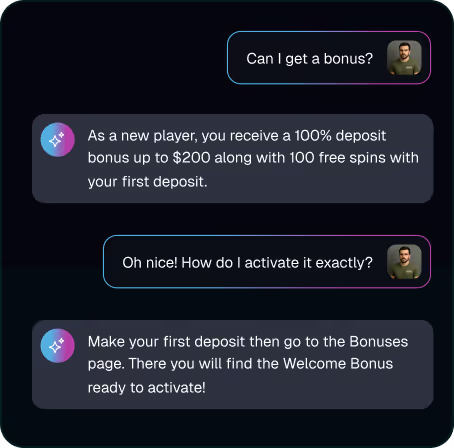
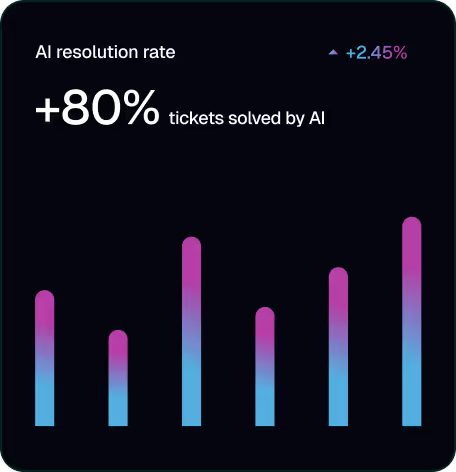
Tugi Tark's AI support infrastructure for iGaming automates 80%+ of support workflows, including withdrawal queries, bonus escalations, and KYC status checks, without requiring custom API builds or ongoing configuration overhead. The platform connects to the operator's own systems through JWT and API integration, surfacing real-time withdrawal, deposit, and transaction status inside the support workflow, at a fixed rate per AI-handled ticket.
This is a different category of operational infrastructure than what Intercom offers, built for a context Intercom was never designed to serve. The support debt from generic tools at scale is measurable: it shows in resolution times, in operator overhead, and in the support cost per player as a share of revenue.
The Signal That Operators Have Outgrown Intercom
Several operational indicators make the architecture mismatch visible. The operator's support team spends more than 20% of its time triaging and tagging tickets rather than resolving them, because Intercom's inbox model requires human prioritization at volume, and that overhead scales with ticket count, not with the complexity of what needs to be resolved.
Payment-related queries add a second layer of friction: support operators open a separate backoffice tab to surface transaction details because Intercom cannot access them in context, and every workflow requiring a second screen adds handling time per ticket that compounds into significant operational cost across tens of thousands of monthly interactions.
The Intercom invoice, in addition, has grown faster than the player base over recent quarters. The per-resolution pricing model does not reward efficiency improvements: as the operator's automation rate increases, the cost does not decrease proportionally, because each resolved conversation still carries a resolution fee.
When these indicators appear together, they point to an architectural mismatch: the tool was designed for a context that has no structural overlap with a scaling iGaming operation. Optimizing the configuration does not resolve an architectural mismatch. Evaluating what genuinely fits the operation does.
If an operator is at that point, the correct next step is to see what the infrastructure actually handles at the operator's ticket volume. See what works instead before the cost compounds further.
Frequently Asked Questions
What is the best Intercom alternative for online casinos?
The best Intercom alternative for online casinos is an AI support infrastructure purpose-built for iGaming operations, not a generic support tooling layer repurposed for gambling. Tugi Tark is designed specifically for iGaming operators, with native integrations for casino payment processors, built-in responsible gambling escalation workflows, and a pricing model built around a flat cost per resolution rather than a rising one. Generic alternatives such as Zendesk or Freshdesk share the same architectural limitations as Intercom at iGaming scale.
Why does Intercom's pricing become unsustainable for iGaming operators?
Intercom's pricing is structured around per-seat licensing combined with per-resolution AI billing. An iGaming operator handling 80,000 monthly player interactions and automating 40% of them through Intercom's AI layer sees per-resolution costs become one of the largest line items in the tool budget, before factoring in agent headcount. AI support infrastructure for iGaming uses a license-based model built around a flat cost per resolution rather than a rising one, making it structurally more cost-efficient as the operation scales.
Does Intercom support responsible gambling workflows?
Intercom does not have native responsible gambling workflow support. Self-exclusion activations, cooling-off period requests, and deposit limit modifications all require custom workflow configuration in Intercom, which must be rebuilt each time regulatory requirements change. Purpose-built iGaming support infrastructure handles these escalation workflows natively, with compliance routing embedded in the resolution layer rather than configured on top of it.
Why do iGaming operators initially choose Intercom?
iGaming operators, particularly those with technical product teams, choose Intercom because of its developer-friendly API, modern interface, and strong documentation. For early-stage operators processing under 5,000 monthly player interactions, it is a reasonable starting point. The structural limitations only become operational constraints at scale: above 30,000 to 50,000 monthly interactions, the inbox model, pricing structure, and integration gaps require workarounds that increase operational overhead faster than they reduce it.
How does AI support infrastructure handle payment queries differently than Intercom?AI support infrastructure for iGaming connects natively to casino payment processors, surfacing withdrawal status, transaction history, and payment method details directly within the support workflow, without a custom API build. Intercom requires a separate integration project to connect to non-standard payment processors, adding substantial development cost plus ongoing maintenance overhead each time a processor updates its API. At iGaming scale, where payment queries represent 30 to 50% of total ticket volume, this integration gap is a primary driver of per-ticket operational cost.