Casino-specific support software has to do five things that horizontal helpdesk tools do not build for: maintain a compliance audit trail, run payment escalation workflows, route KYC escalations to the right specialist, deliver support natively in the languages a casino's player base actually speaks, and keep resolution running around the clock without headcount scaling linearly with ticket volume. Zendesk's architecture was not built around any of these requirements: it was designed as a general-purpose ticketing tool for any industry, from e-commerce returns to SaaS bug reports, not for a regulated, payment-heavy, multi-jurisdiction operation. An AI support infrastructure built on 10M+ tickets across 125+ operator brands and 25+ markets treats these five requirements as the starting architecture, not a workaround layered onto a generic inbox. This article sets out what each requirement demands operationally, why retrofitting it onto a horizontal tool does not hold structurally, and what changes for an operator that moves to infrastructure built around the requirement instead of adapted to it.
What Most Operators Default To First
Most iGaming operators start their support stack with a horizontal helpdesk tool, and the logic is not unreasonable at launch. Zendesk and comparable tools offer fast setup, a familiar ticketing interface, and a large ecosystem of integrations built for e-commerce and SaaS use cases. For an operator running a single market with a modest volume of monthly interactions, a general ticketing tool covers the basics adequately: intake a request, assign an operator, close the ticket. With a human agent costing between €1.02 and €2.41 per resolved ticket across nine European markets and the Philippines, the operational gap between a generic tool and a purpose-built one is easy to miss while every ticket still looks like a standard support request: password resets, account questions, simple balance queries.
The approach holds only as long as the workload stays generic. It stops holding the moment a support interaction carries a compliance obligation, a payment escalation, or an identity verification requirement, which in a regulated casino operation is not the exception. It is a large share of daily volume. This is the pattern behind iGaming's move away from traditional support models: the tool that works at launch is not built for what the workload becomes at scale.
Why Generic Ticketing Architecture Breaks on Compliance and Escalations
A generic support ticket is a conversation record. A casino support interaction is frequently a regulated event that has to be reconstructed for a licensing authority, an internal compliance review, or a payment escalation months after the original conversation closed. Zendesk's architecture treats every ticket the same way: a thread with tags and macros. It has no native concept of a compliance-grade audit trail, a dedicated KYC escalation queue, or a Responsible Gambling routing layer that has to hit specific regulatory response windows. This is a structural feature of legacy support systems built for gambling operations: they were designed before iGaming's compliance requirements existed in their current form, and their architecture has not caught up.
Zendesk's workflow automation can approximate escalation logic with triggers and conditional macros, but assembling a genuine compliance audit trail this way requires custom development work sitting outside the product's core architecture, and it has to be rebuilt every time a jurisdiction's reporting requirements change. Purpose-built casino support infrastructure routes tickets through specialized departments, including finance, compliance, technical, CRM, and VIP, weighted by player segment, ticket category, channel, and wait time, so a payment escalation or a KYC request lands with the right specialist by default rather than through a chain of manual tags.
The same gap shows up in Responsible Gambling handling. A self-exclusion request or a deposit-limit change is not a standard support ticket. It is a regulated action with a required response window, and it has to route to a human operator when the situation calls for one. Zendesk has no native concept of a Responsible Gambling escalation. Purpose-built casino support infrastructure includes a dedicated Responsible Gambling module with strictness configurable by the operator and automatic routing to human agents for RG-flagged tickets, which is the difference between a compliance workflow that exists by design and one an operator has to construct and maintain independently.
The Five Requirements Casino-Specific Support Software Has to Meet Natively
Five capabilities separate purpose-built casino support software from a generic ticketing tool with iGaming workflows bolted on:
- A compliance audit trail: Every escalation, transcript, and resolution has to be reconstructable on demand, with GDPR-compliant transcript extraction available for export rather than assembled manually from a tagging system after the fact.
- Payment escalation workflows: Withdrawal queries, failed deposits, and payment method issues need to route directly to a finance-specialist queue, not sit in a general inbox waiting for manual triage.
- KYC escalation routing: Identity verification requests have to reach a compliance-qualified operator automatically, cross-referenced against the player's verification status, rather than depend on an agent recognizing the ticket type.
- Native multilingual support: An operator active across 25+ markets needs resolution delivered in the player's own language at the point of first contact. Tugi Tark supports 249 languages with on-the-fly translation built into the resolution layer, not added as a separate translation service.
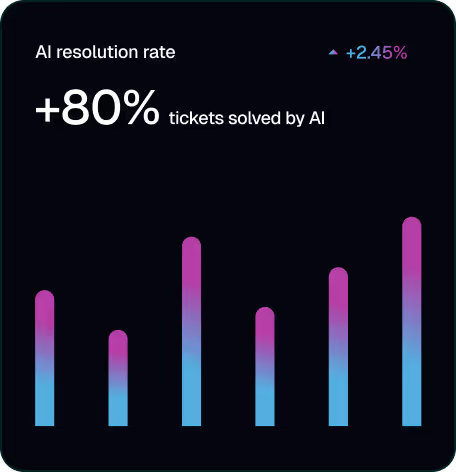
- 24/7 automation that doesn't require headcount to scale with volume: Resolution has to run continuously across time zones. Tugi Tark resolves 80%+ of player tickets automatically, at 18 times the speed of a human agent.
What Casino-Specific Support Infrastructure Does Differently
Tugi Tark's AI customer support infrastructure for iGaming is built around these five requirements from the architecture up, not configured on top of a generic ticketing model. The differences are structural, not cosmetic.
Founders who managed 10M+ tickets across 125+ iGaming brands in 25+ markets as a BPO built that operational understanding directly into the resolution layer, including a Responsible Gambling module with configurable strictness and automatic routing to human agents for RG-flagged tickets, a requirement no horizontal helpdesk tool ships with by default.
The Cost of Treating Compliance as an Afterthought
The cost of running compliance and escalation workflows on generic ticketing architecture compounds the longer an operator waits to change it. Per-AI-handled ticket pricing at ≈€0.15 means the cost of an automated resolution is lower than a staffed agent at any ticket volume, against €1.02 to €2.41 per ticket for a human agent, and operators moving to AI resolution at a 70% rate see a 64% reduction in support cost.
The compliance exposure carries a separate risk that does not show up on a cost line item until an audit or a regulatory review requires a full escalation history that a tagging system was never built to produce cleanly. An operator that waits until that moment to evaluate purpose-built infrastructure is solving two problems at once, a technical migration and a compliance gap, instead of one.
Multilingual coverage compounds the same pattern. An operator expanding into a new licensed market without native support in the local language pushes those interactions back into a generic queue, where response time and resolution quality both degrade for exactly the players a new market launch depends on retaining. Delaying the move to purpose-built infrastructure does not remove the requirement. It only pushes the cost of meeting it later, at a higher volume, with more history to reconstruct if a regulator asks for it, the same dynamic behind the operational cost of unresolved support debt: what looks like a manageable gap in year one becomes one of the largest line items in the support operation by year three.
See what Tugi Tark does differently before the next licensing review or peak-volume period makes the gap in the current setup expensive to ignore.
Frequently Asked Questions
What does casino-specific support software need that Zendesk doesn't have?
Casino-specific support software needs a native compliance audit trail, payment escalation workflows, KYC escalation routing, native multilingual support, and 24/7 automation that doesn't require headcount to scale with volume. Zendesk's architecture was built as a general-purpose ticketing tool and does not include these capabilities natively, requiring custom development to approximate them.
Why do iGaming operators need a compliance audit trail in their support software?
iGaming operators need a compliance audit trail because licensing authorities and internal compliance reviews can require a full reconstruction of an escalation, including transcripts and resolution steps, months after the original interaction closed. Purpose-built infrastructure like Tugi Tark includes GDPR-compliant transcript extraction as a built-in capability rather than a manual assembly process.
What is a payment escalation workflow in casino support software?
A payment escalation workflow routes withdrawal queries, failed deposits, and payment method issues directly to a finance-specialist queue rather than a general support inbox. Purpose-built casino support infrastructure routes these tickets automatically based on ticket category, player segment, and channel, so they reach the right specialist without manual triage.
How does KYC escalation routing work in AI support infrastructure for iGaming?
KYC escalation routing automatically directs identity verification requests to compliance-qualified operators, cross-referenced against the player's verification status. This removes dependency on an individual agent recognizing the ticket type and routing it manually, which reduces both resolution time and compliance risk.
Can generic helpdesk tools be configured to handle iGaming compliance requirements?
Generic helpdesk tools can approximate some iGaming compliance workflows through triggers, tags, and custom development, but the result sits outside the product's core architecture and needs to be rebuilt every time a jurisdiction's requirements change. Purpose-built casino support infrastructure treats compliance and escalation routing as native architecture rather than a configuration layer.

.png)