Rankings of the best AI customer support tools for casino operators are mostly built around one number: deflection percentage. Industry benchmarks put automated deflection at 60 to 80%, with Gartner projecting 80% by 2029, and a deflection number is the easiest metric to put on a sales deck because it sounds like resolution without requiring proof of it. Deflection measures whether a ticket left the queue, not whether the player's problem got solved, and that gap is exactly where casino operators end up paying twice: once for the tool, and again for the re-contacts, escalations, and compliance exposure the tool's marketing never mentioned. This article sets out the difference between what vendors put on the homepage and what an iGaming support tool actually has to do operationally, and what an operator should evaluate instead of a deflection percentage.
What Vendor Marketing Leads With
Vendor marketing for AI customer support tools leads with a deflection rate, a feature checklist, a language count, and a pricing structure pitched as volume-agnostic regardless of ticket complexity. Deflection sits at the center because it is the number that looks best on a homepage, and the industry-wide figure of 60 to 80% (Symphony puts it at 70 to 80%) gets quoted regardless of whether the vendor's own tool has been tested against gambling-specific ticket volume. The feature checklist follows a similar pattern: live chat widget, canned responses, basic routing, and an AI layer bolted on top, all pitched as generically applicable across e-commerce, SaaS, and gambling operations without differentiation.
Language count gets marketed the same way a spec sheet lists supported file formats: a number, presented without describing whether translation happens on-the-fly inside the resolution flow or as a separate service layered on afterward. None of these numbers describes what happens when a player in a regulated market asks about a withdrawal delay, a Responsible Gambling limit change, or a KYC document rejection, which is the volume of ticket a generic tool's marketing rarely addresses because generic tools were not built to handle it.
Why Deflection Metrics Don't Hold at iGaming Scale
Deflection is a proxy for resolution, and proxies break down exactly where the real workload gets hard. A generic AI support tool deflects a ticket by routing the player to an FAQ page or a canned macro. If the underlying problem, a stuck withdrawal, a flagged deposit, a disputed bonus term, is not actually solved, the player re-contacts, often through a different channel, and the ticket that looked deflected on a vendor's dashboard becomes two tickets, a slower resolution, and a player who is more frustrated at second contact than at first. In a regulated casino operation, that second contact can also become a compliance record: a self-exclusion request handled by a generic macro instead of routed to a human operator inside the required response window is not a deflection success. It is a regulatory exposure.
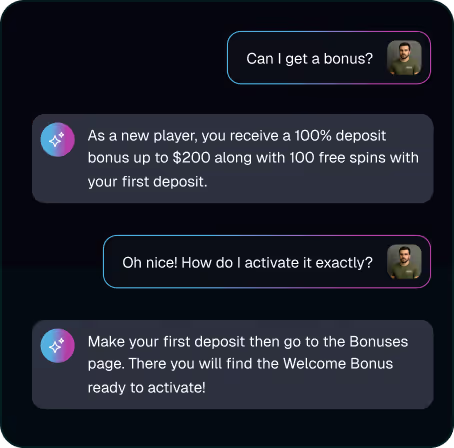
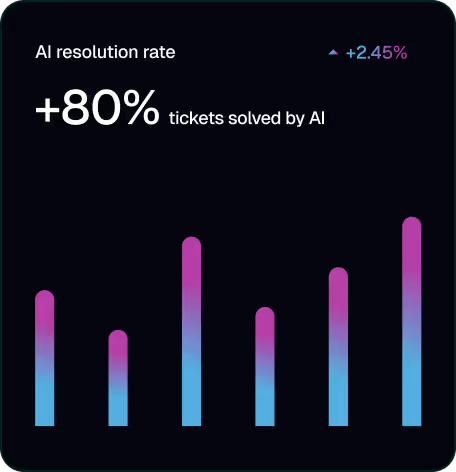
Tugi Tark resolves 80%+ of player tickets, not deflects them, at 18 times the speed of a human agent and at a fifth of the cost. AI agents resolve. They don't deflect. The distinction is not semantic. Resolution means the AI agent pulled the player's real-time profile, checked policy against the specific case, and closed the loop, the same way the cost of an unresolved ticket compounds when a human agent costs between €1.02 and €2.41 per resolved ticket across nine European markets and the Philippines. A deflected ticket that returns as a second contact does not remove that cost. It adds to it.
What Actually Matters: Resolution, Compliance, and Real Multilingual Coverage
Casino operators evaluating an AI customer support tool should score what a deflection number does not capture: resolution rate against ticket volume, whether compliance workflows are native architecture or a workaround, whether multilingual support runs inside the resolution flow or as a bolted-on translation step, and whether pricing tracks resolutions delivered rather than seats or ticket count. These requirements separate a tool built for gambling operations from one adapted to fit them, as detailed in what casino-specific support software actually has to do that generic tools don't: a native compliance audit trail, payment escalation routing, and KYC escalation queues that a generic ticketing tool has to approximate with custom triggers instead of ship with by default.
Multilingual coverage is the clearest example of where the marketing number and the operational reality diverge. A vendor's language count alone says nothing about whether translation happens at the point of resolution or gets routed through a separate service that adds latency and drops context. Tugi Tark's AI support infrastructure for iGaming supports 249 languages with on-the-fly translation built into the resolution layer itself, so a player in any of the 25+ markets an operator serves gets a resolved answer in their own language at first contact, not a translated FAQ link. Founders who managed 10M+ tickets across 125+ iGaming brands as a BPO built that resolution-first architecture directly into the product, including a Responsible Gambling module with operator-configurable strictness and automatic routing to human agents for RG-flagged tickets, a workflow no horizontal support tool ships with natively.
What Waiting Costs an Operator Evaluating Tools on the Wrong Metric
An operator who selects a tool on deflection percentage alone finds out the gap between deflection and resolution after the contract is signed, when re-contact volume climbs and the compliance team asks why a Responsible Gambling flag sat in a general queue instead of routing to a human agent. Per-AI-handled-ticket pricing at ≈€0.15 per ticket means the cost of an automated resolution is lower than a staffed agent at any ticket volume, and operators moving to AI resolution at a 70% rate see a 64% reduction in support cost, but that math only holds if the tickets are actually being resolved rather than deflected and returned.
Migrating tools after the fact compounds the problem the first selection was supposed to avoid: a technical migration on top of the compliance gap the wrong tool left behind, running at higher ticket volume than the operator started with, with more escalation history to reconstruct if a regulator asks for it. The cost of evaluating on the wrong metric does not stay flat. It grows with every quarter an operator's real resolution rate sits below what the vendor's deflection number implies.
See what actually matters before the next vendor deck with a deflection percentage on slide one becomes the basis for a multi-year contract.
Frequently Asked Questions
What's the difference between deflection and resolution in AI customer support tools?
Deflection measures whether a ticket left the support queue, while resolution measures whether the player's actual problem got solved. A deflected ticket that is not resolved often returns as a second contact, which cancels out the cost savings the deflection number implied.
What should casino operators actually look for in an AI support tool?
Casino operators should evaluate resolution rate against real ticket volume, whether compliance workflows like KYC and Responsible Gambling routing are native architecture, and whether multilingual support runs inside the resolution flow rather than as a separate translation step. A deflection percentage or a generic feature list does not capture any of these.
Why do generic AI support tools fail iGaming compliance requirements?
Generic AI support tools were built for e-commerce and SaaS ticket volume and have no native concept of a Responsible Gambling escalation, a KYC verification queue, or a compliance-grade audit trail. These workflows have to be approximated with custom triggers and macros, which breaks every time a jurisdiction's requirements change.
Does supporting more languages automatically mean better multilingual support?
No. A language count alone does not show whether translation happens inside the resolution flow at first contact or through a separate service that adds latency and loses context. Tugi Tark supports 249 languages with on-the-fly translation built directly into the resolution layer.
How does Tugi Tark's resolution rate compare to industry deflection benchmarks?
Industry deflection benchmarks range from 60 to 80%, with Gartner projecting 80% by 2029, but these figures measure tickets removed from the queue, not tickets resolved. Tugi Tark resolves 80%+ of player tickets at 18 times the speed of a human agent, a distinct claim from third-party deflection benchmarks.