iGaming operators handling 30,000 monthly player tickets on outsourced support spend an estimated €120,000–180,000 per month in fully-loaded labor costs. Add 20,000 new active players, and that figure rises by €40,000–60,000, permanently. That is the structural failure at the core of the headcount-first support model, and it explains why knowing how to scale casino customer support without hiring more agents has become one of the most operationally urgent questions in the industry.
This guide covers the four decisions that allow iGaming operators to scale support capacity independently of headcount: auditing ticket composition, mapping escalation logic, deploying AI support infrastructure for tier-1 automation, and restructuring human teams for oversight. It is written for operators currently paying outsourcing bills that grow with every marketing campaign.
Why the Headcount-First Support Model Breaks Under Growth
Headcount-first support breaks under growth because its cost function is linear. Every new cohort of active players adds a proportional volume of support interactions, and outsourced agents are staffed and billed per ticket handled. According to Tugi Tark's 2026 iGaming support economics report, human agent costs across nine European markets and the Philippines run €1.02–2.41 per ticket, a baseline that scales directly with volume, before management fees, quality assurance, and attrition replacement are added.
Several compounding factors make this structure unsustainable for growing operators.
Volume multipliers. A casino growing from 50,000 to 200,000 monthly active players over 18 months will typically see support volume quadruple. Headcount requirements follow at the same rate.
Multilingual complexity. Operators serving global markets face demand across 40+ languages. Staffing for Finnish, Swahili, and Brazilian Portuguese simultaneously requires either recruiting rare specialist-language agents at a premium over standard hires, or accepting response quality below the threshold of player expectations.
24/7 demand. Players submit withdrawal queries and account access requests at 3 AM. Overnight staffing for a single language requires a dedicated night shift rotation paid at premium unsocial-hours rates. Across five languages, that becomes a substantial fixed operational cost carried every month, regardless of how many tickets actually arrive overnight.
Legacy support systems like Zendesk and Intercom were designed for business-hours customer service operations. They were not built to handle the continuous, high-stakes, multilingual demand of online gambling at scale. They process tickets. They do not understand iGaming-specific workflows, payment escalation paths, or compliance requirements.
The Scaling Bottlenecks of Traditional Outsourcing
Outsourcing converts internal headcount into variable spend. The appeal is real: the operator stops managing hiring, HR, and office infrastructure directly. But the cost structure remains linear. More players still means more tickets, more tickets still means more outsourced agents, and more agents means a higher monthly bill.
The support debt created by outsourcing compounds in several ways that operators consistently underestimate.
Cost opacity. Outsourced support contracts scale with ticket volume, whether priced per agent or per interaction, which makes monthly cost planning dependent on demand the operator cannot reliably forecast. According to Tugi Tark's 2026 iGaming support economics report, fully-loaded human handling runs €1.02 to €2.41 per ticket across nine European markets and the Philippines. On that basis, a promotional campaign that doubles player acquisition over six weeks drives a proportional rise in support cost that lands before the associated revenue materializes.
Quality inconsistency. Outsourced agents handling iGaming tickets are generalists working across multiple operators. They lack specific knowledge of the operator's bonus structure, KYC requirements, payment processor integrations, and regulatory obligations. According to Tugi Tark's 2026 iGaming support economics report, first-contact resolution rates typically run 55–65% in outsourced iGaming support operations, generating elevated re-contact rates and player friction on withdrawals and account verification.
Compliance exposure. When agents apply bonus terms inconsistently, miss responsible gaming triggers, or fail to document escalations correctly, the operator carries the regulatory liability. In regulated European markets, compliance failures linked to support mishandling trigger direct regulatory penalties and remediation costs, independent of the ticket volume that caused them.
For iGaming operators with growth ambitions, breaking with traditional support models is a structural necessity.
What AI Support Infrastructure Changes Architecturally
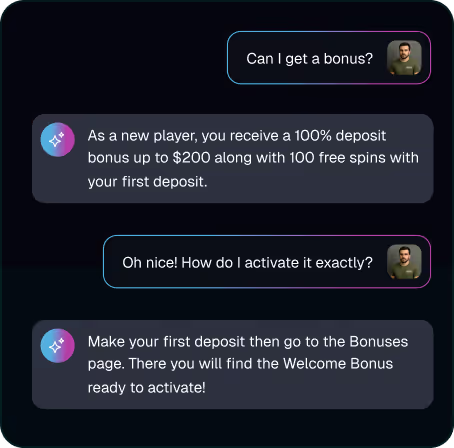
AI support infrastructure for iGaming is a purpose-built automation layer that handles player support workflows, including escalation resolution, payment queries, KYC clarifications, and multilingual interactions, without adding headcount for each additional ticket.
The core architectural difference is how costs scale. In a headcount-first model, support cost is a function of ticket volume. In an AI support infrastructure model, support cost is a function of complexity tier. Routine queries, which industry benchmarks put at 60–80% of total volume in most casinos, resolve automatically. Complex queries route to human oversight. The economics shift from linear to near-fixed.
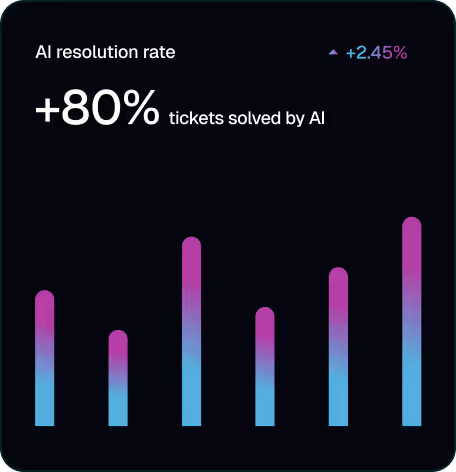
Tugi Tark's AI support infrastructure for iGaming automates 80%+ of support workflows across 249 languages, with real-time player data access and built-in escalation logic. Tugi Tark was founded by leaders who managed 10M+ tickets across 125+ iGaming brands as a BPO, giving the system a ground-level design informed by real support operations rather than generic customer service assumptions. An operator spending €50,000 per month on outsourced support for 30,000 monthly tickets can reduce that to €8,000–15,000 through AI infrastructure, while improving language coverage and first-contact resolution simultaneously.
We are not improving customer support. We are rebuilding the infrastructure layer behind it for iGaming operators.
How to Scale Casino Customer Support Without Hiring: A 4-Step Operator Framework
This is a decision framework for operators currently running outsourced support who want to move to AI support infrastructure. It covers four steps that take a mid-sized operation from headcount-dependent to AI-first in under 60 days.
Step 1: Auditing Ticket Composition Over 90 Days
The operator runs a 90-day breakdown of support volume segmented by query type, language, resolution path, and escalation rate. The objective is to quantify tier-1 automation potential: the percentage of total ticket volume that requires no human judgment to resolve.
Most operators find 65–75% of tickets fall into five categories: withdrawal status, bonus terms clarification, account access and KYC status, payment method questions, and balance inquiries. These are automatable. When the audit shows 70% of volume in these categories, the operator has a clear operational case for AI support infrastructure.
The indicator of success at this step: a defined automation potential percentage and a cost model showing projected savings at current ticket volume.
Step 2: Mapping Escalation Logic Before Deployment
Before replacing any outsourced capacity, the operator documents which ticket types require human review under all circumstances. This is the compliance and risk containment layer.
Mandatory escalation triggers in iGaming support operations include: responsible gaming flags, high-value withdrawal requests above a defined threshold (typically €5,000–10,000), KYC document review requiring legal authorization, confirmed fraud signals, and VIP player contacts above defined lifetime value thresholds.
Operators who skip this step deploy automation without a safety net and accumulate compliance risk. This mapping should take 3–5 business days with input from the legal and compliance teams.
Step 3: Deploying AI Automation for Tier-1 Workflows
With ticket composition audited and escalation logic mapped, the operator deploys AI support infrastructure to handle the identified tier-1 volume. For a mid-sized operator running 10,000–50,000 monthly tickets, full deployment typically runs 2–4 weeks from configuration to live operation.
The metrics to monitor in the first 30 days: first-contact resolution rate (target 70%+), average resolution time for tier-1 (target under 5 minutes), escalation rate (target under 25% of total volume), and player satisfaction on automated interactions.
Reviewing the per-ticket handled pricing model against current per-agent or per-interaction outsourcing rates will typically show break-even within the first month of operation, with savings compounding as volume grows.
Step 4: Restructuring the Human Team for Escalation Oversight
Human support operators do not disappear in an AI-first support model. They shift from ticket processing to escalation resolution, compliance monitoring, VIP account management, and quality review of automated interactions.
A team previously handling 500 tickets per day manually now oversees automated operations and resolves the 80–120 complex cases per day that require judgment. This restructuring reduces headcount requirements by 60–70% at equivalent ticket volume, while improving handling quality for the cases that actually need human expertise.
The expected staffing outcome for an operator with 30,000 monthly tickets: from 15–20 outsourced FTE to 3–6 internal operators focused on escalation and oversight.
Expected Outcomes at 90 Days
Operators who move from outsourced headcount to AI support infrastructure should expect the following benchmark outcomes within 90 days of full deployment:
Illustrative model.
These outcomes reflect the architectural difference between a cost model that scales with volume and one that scales with complexity. The savings come from removing the per-agent cost layer from tier-1 operations entirely.
Frequently Asked Questions
How long does it take to scale casino customer support without hiring more agents?
An operator with 10,000–50,000 monthly tickets can fully deploy AI support infrastructure in 2–4 weeks. The primary preparation time is the ticket audit (5–7 days to compile and segment) and escalation logic mapping (3–5 days). Automation of tier-1 workflows goes live within the first month, with measurable cost reduction visible in the first billing cycle.
How much does it cost to replace outsourced support agents with AI infrastructure?
For a mid-sized casino operator handling 30,000 monthly tickets, AI support infrastructure typically costs €8,000–15,000 per month in operational spend, compared to €40,000–60,000 for equivalent outsourced coverage. Implementation costs are typically recovered within the first billing cycle through operational savings.
What percentage of casino support tickets can actually be automated?
According to industry benchmarks, 60–80% of ticket volume in most iGaming operations is automatable at tier-1 without human review: withdrawal status, bonus clarifications, KYC status, account access, payment questions, and balance inquiries. The remaining 20–40% requires human oversight for escalations, compliance triggers, fraud flags, and VIP interactions.
What is the difference between outsourcing casino support and deploying AI support infrastructure?
Outsourcing replaces internal agents with external agents, keeping costs linear with volume. AI support infrastructure replaces the manual tier-1 layer with automation, charging a flat rate per ticket regardless of volume. Tugi Tark's AI support infrastructure automates 80%+ of casino support workflows, reducing per-ticket cost from €1.02–2.41 (outsourced human agents) to €0.15.
Why do iGaming operators need purpose-built support infrastructure instead of generic tools?
Generic tools process tickets without understanding iGaming-specific workflows: regulated escalation paths, payment processor integrations, bonus term logic, KYC compliance requirements, and multilingual gambling markets. AI support infrastructure purpose-built for iGaming, like the system available through Tugi Tark's demo, is built on iGaming-specific workflows and handles these natively, reducing escalation rates and compliance risk compared to adapted generic automation.