Switching helpdesk software for an online casino carries three real risks: data loss during transfer, a service-level agreement (SLA) coverage gap during cutover, and support operators who do not yet know the new escalation logic on day one. None of the three requires the months of disruption operators typically assume, and the risk most often cited, that migration itself is inherently unstable, does not hold up once the three real risks are broken out and managed individually.
Operators delay switching helpdesk software for years past the point where the outgoing system stops fitting current ticket volume, because the migration is assumed to threaten data, SLAs, and player experience all at once. That assumption keeps operators on systems that were never built for regulated gambling operations long after routing, compliance workflows, and multilingual coverage have fallen behind operational need.
This guide separates the three real risks worth planning for, data loss, SLA gaps, and agent training, from the perceived risk that does not survive an audit, and gives one mitigation step for each real risk before an operator signs a new contract.
What You Need Before Starting
Managing migration risk starts with three internal documents an operator should have before evaluating any new support software: confirmation from the outgoing vendor of full ticket-history export capability, a documented list of active SLA commitments by ticket category, and a current roster of support operators mapped to the escalation categories they already handle.
The risk profile below applies at any ticket volume, since data loss, SLA gaps, and agent training are structural risks tied to how a migration is executed, not to how many tickets an operator processes monthly.
Generic helpdesk vendors, including Zendesk, Intercom, and Freshdesk, were architected around retail and SaaS support models without native player-profile data, dispute categories, or Responsible Gaming flags. Migrating out of one of these systems surfaces more structural risk than migrating between two iGaming-purpose-built systems, because the data model itself has to be reconstructed rather than transferred.
Step 1: Contain the Data Loss Risk
Data loss risk during a switch centers on three assets worth protecting: open ticket history, macros and templates tied to regulated categories, and configured escalation workflows, not the entire historical archive operators tend to worry about.
The mitigation is to export open tickets and a defined lookback window rather than the full archive, migrate macros and templates for the highest-volume and most regulated categories (KYC, Responsible Gaming, withdrawal disputes) first, and validate every workflow in a sandbox environment before cutover. Integration timelines and scope should be documented and confirmed in writing before migration begins, since JWT-based integration deploys in hours rather than weeks once the target system's data model is confirmed compatible.
The common pitfall is assuming a vendor's migration tool captures everything automatically without reconciliation. Migration tools transfer records; they do not validate that routing logic and macros behave identically in the new environment.
The indicator of success: reconciled ticket counts between the outgoing and incoming systems, with macros and workflows tested against the highest-volume ticket categories before any legacy system is decommissioned.
Step 2: Close the SLA Gap Before It Opens
SLA gap risk comes from the coverage window immediately after cutover, the hours when routing rules are still being validated against live ticket volume, not from the new system's underlying design.
The mitigation is to run the new system in parallel with the outgoing one for a defined window, route a subset of ticket categories live while keeping the legacy system as fallback, and track first-response and resolution times against existing SLA commitments throughout the parallel run. Smart ticket routing weighs four parameters, player segment, ticket category, channel, and wait time, when directing tickets during this window, which keeps SLA-sensitive categories routed correctly while the parallel run is still being validated. A full SLA continuity plan, audit, transition mapping, parallel testing, staged cutover, post-migration monitoring, deserves its own dedicated process; the summary here is the minimum an operator needs before evaluating vendors on this criterion. Unmanaged SLA gaps compound the same way the support debt problem describes: hidden operational cost accumulating from unresolved friction, ticket by ticket.
The common pitfall is cutting every ticket category over simultaneously instead of enabling smart ticket routing progressively by category.
The indicator of success: SLA metrics tracked during the parallel run stay at or above pre-migration levels before the legacy system is switched off.
Step 3: Shrink the Agent Training Risk
Agent training risk comes from support operators who know the outgoing system's escalation logic by memory and have to relearn it under live ticket pressure, not from a gap in technical aptitude.
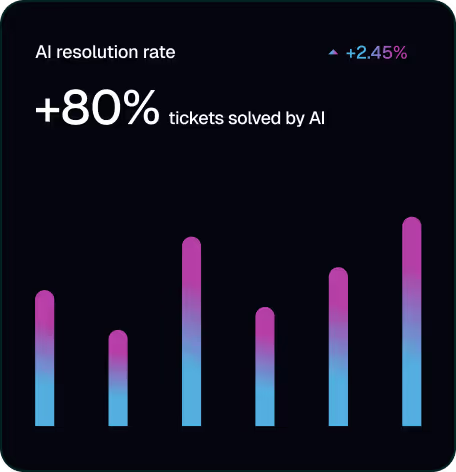
The mitigation is to scope training to escalation categories rather than the full system: Responsible Gaming flags, high-value withdrawals, KYC review, and VIP contacts first, general ticket handling second. Because iGaming customer service AI support infrastructure resolves 80%+ of tickets without human intervention, at roughly 18x the speed of a human agent, the retraining surface for support operators shrinks to the categories that still require human judgment, rather than the entire ticket volume.
The common pitfall is training every operator on the full breadth of the new system's features before go-live, instead of running a shadow period focused on the highest-risk escalation categories.
The indicator of success: support operators can correctly route a defined set of test scenarios, a Responsible Gaming flag, a high-value withdrawal, a KYC review, without supervision before the new system goes fully live.
Step 4: Separate the Real Risk From the Perceived Risk of Switching Helpdesk Software
The perceived risk operators cite most often, that switching means months of disruption and permanently losing historical data, does not match what the three real risks above actually require to manage.
The myth that migration takes months conflates vendor contracting and onboarding paperwork with the actual technical work: the sandbox validation in Step 1 and the parallel-run window in Step 2 are what determine timeline, and JWT integration itself deploys in hours once the data model is confirmed compatible. The myth that all historical data disappears ignores that only open tickets, active macros, and a defined lookback window need to migrate; older resolved tickets can stay archived and referenced without blocking cutover. The myth that support operators will not adapt overstates the retraining load once routine ticket categories are already resolved automatically, leaving a narrower set of escalation categories for operators to learn.
Staying on an outgoing system carries its own unmanaged risk while an operator waits for migration to feel less risky: human-agent-dependent support runs €1.02 to €2.41 per ticket, against ≈€0.15 per ticket once handled by iGaming customer service AI support infrastructure, a flat cost per resolution rather than a rising one. Every month migration is delayed is a month spent on the rising cost instead.
Common Mistakes iGaming Operators Make (and How to Avoid Them)
The most expensive mistake is treating a switch as a single event instead of three separate risks, each needing its own mitigation plan before cutover, which is what causes operators to discover gaps after cutover instead of before it.
Mistake: Migrating every ticket category at once instead of prioritizing regulated and high-volume categories first
Why it happens: Project timelines get compressed and teams default to a full cutover to simplify the schedule. What it costs: A validation failure in a low-priority category can block go-live for Responsible Gaming and withdrawal workflows that were otherwise ready. How to avoid it: Sequence migration by regulatory and volume priority, validating the highest-risk categories in the sandbox first.
Mistake: Skipping the parallel-run SLA validation window
Why it happens: Running two systems simultaneously looks like added cost and complexity in the short term. What it costs: SLA gaps surface only after the legacy system is already decommissioned, when there is no fallback left to catch them. How to avoid it: Budget the parallel-run window into the migration timeline from the start, not as an optional step.
Mistake: Treating agent training as a single onboarding session
Why it happens: Vendor onboarding is often scheduled as a fixed-length training event rather than a scoped, category-by-category rollout. What it costs: Support operators default to escalating uncertain tickets rather than resolving them, creating a temporary spike in escalation volume right after go-live. How to avoid it: Run a shadow period scoped to the highest-risk escalation categories before removing legacy-system access.
Mistake: Selecting a new system without scoring it against iGaming-specific criteria
Why it happens: Procurement compares list price and seat count without an evaluation framework specific to regulated gambling support. What it costs: Operators discover post-signing that compliance routing, multilingual coverage, or escalation logic all require custom development the quote never priced in. How to avoid it: Score every vendor under consideration against the five iGaming-specific criteria, compliance, escalation workflow, multilingual coverage, availability, and integration compatibility, before signing.
Expected Outcomes With Numbers
Operators who manage the three real risks with a defined mitigation step each avoid the outcome that makes migration expensive: paying twice, once for the outgoing system's linear cost and once for a migration redone after an SLA gap or training failure forces a rollback.
Tugi Tark manages these four outcomes as native capability rather than a bolt-on migration service: reconciled data transfer scoped to open tickets and priority macros, SLA continuity validated through parallel routing, escalation categories mapped before go-live, and integration that deploys in hours, under the category of customer support AI support infrastructure for iGaming. Get the risk management guide to score a planned migration against all three real risks before signing with a new vendor.
Frequently Asked Questions
What is the biggest risk when switching helpdesk software for an online casino?
The three real risks when switching helpdesk software for an online casino are data loss during transfer, an SLA coverage gap during cutover, and support operators who have not yet learned the new escalation logic. Each has a specific mitigation, sandboxed data validation, a parallel-run testing window, and scoped agent training, rather than requiring the operator to accept months of open-ended disruption.
How long does switching support software take for an iGaming operator?
Timeline depends on data volume, the number of ticket categories being migrated, and how long the parallel-run SLA validation window runs, rather than a fixed universal figure. Technical integration itself is fast: JWT-based integration deploys in hours once the target system's data model is confirmed compatible, which shortens the sandbox and parallel-run phases that determine overall timeline.
Will an operator lose ticket history when switching support software?
No, only open tickets, active macros and templates, and a defined lookback window need to migrate to the new system. Older resolved tickets can remain archived and accessible without blocking cutover, so a properly scoped migration does not mean losing historical data.
What's the difference between the real risks and perceived risks of switching support software?
The real risks, data loss, SLA gaps, and agent training, are structural and each has a specific mitigation step that can be planned before signing a new vendor contract. The perceived risk, that migration itself is inherently unstable and takes months, does not hold up once those three real risks are broken out and managed individually rather than treated as one undifferentiated event.
How does Tugi Tark reduce the risk of switching support software?
Tugi Tark resolves 80%+ of tickets without added headcount, deploys through JWT integration in hours, and runs native ticketing and omnichannel handling with no third-party dependency during migration. That combination shortens the sandbox validation and parallel-run windows that determine how long a managed migration actually takes.