Loyalty programs are not the lever that fixes player churn in iGaming. Support response is, because the players who disappear fastest are not leaving over a thin bonus tier: in the one market with published cohort data, only 3.5% of a new signup cohort was still active on Day 7, down from 17.6% on Day 1, on iGaming Business figures from April 2026. The most plausible place for that collapse is the support queue, at the moment a withdrawal stalls or a complaint sits unanswered, not on a loyalty cycle measured in weeks. Reducing player churn with AI customer support starts by treating the support response as the retention mechanism it already is, rather than adding another layer of points and tiers on top of a queue that is still too slow.
What Everyone Does: Invest in Loyalty and Retention Programs
Operators put real budget behind loyalty and retention programs, and the logic has surface appeal: reward tiers, cashback, VIP perks, and bonus-match campaigns give a depositing player a reason to stay rather than shop a competitor's welcome offer. Retention economics justify the spend at the category level. Across industries, acquiring a new customer costs 5 to 25 times more than retaining an existing one, and a 5% lift in retention raises profit by 25% to 95%, on research from Frederick Reichheld and Bain & Company published in Harvard Business Review. Those ratios are cross-industry, not iGaming-specific, but they explain why a COO signs off on a loyalty budget without asking many more questions.
The gap shows up in what the loyalty program is built to influence. A tier structure, a cashback schedule, a birthday bonus, and a VIP perk calendar all operate on a timescale of weeks or a full playing history. They give a player a reason to come back tomorrow. None of them intervene in the ten minutes after a deposit fails or a withdrawal has not cleared, which is exactly when a session, and often the account, is decided.
Why This Misses the Actual Churn Mechanism
A player who hits a support failure is likely to leave regardless of loyalty tier or bonus history, because the decision to churn is made at the point of the failure, not on the loyalty program's schedule. In the South African cohort, decay from 17.6% active on Day 1 to 0.88% by Day 28 happened alongside the highest average daily play time in the dataset, 26.9 minutes, which rules out low interest as the cause. High play activity paired with near-total attrition is what a friction problem looks like, not a rewards problem.
Withdrawal speed is the friction most directly named: 78% of surveyed South African players said fast, easy withdrawals influence where they place bets, per 2025 payments industry research cited by iGaming Business. That figure describes behavior at the moment of a support interaction, not loyalty-tier status. The cohort data backs the same point from another angle: churn was lowest among casino cross-sold players and highest among sportsbook-only and bonus-led first-time depositors,a split that is consistent with the type of support interaction each segment is likely to hit, though the study does not test that.
No independent body publishes a figure for the share of iGaming churn caused specifically by support failure, and that absence should be stated rather than papered over with an invented percentage. What the verified data supports is the mechanism, not a headline statistic: a stalled withdrawal or an unresolved complaint is a churn event that happens inside a support interaction, on a timeline of minutes, while loyalty programs operate on a timeline that never reaches the moment of failure at all.
What Should Happen Instead: Reducing Player Churn With AI Customer Support
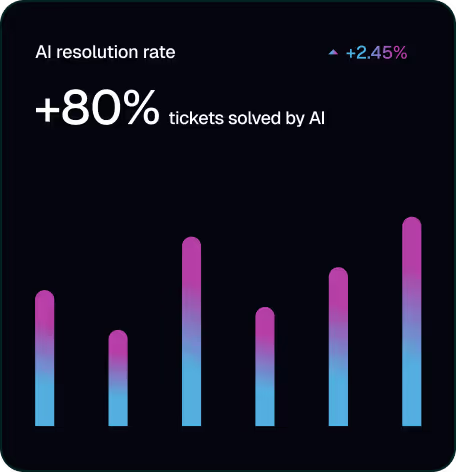
Fixing the response-speed mechanism has to come before adding another retention layer, because a faster response closes the failure the loyalty program cannot reach. AI support infrastructure resolves 80%+ of player tickets without escalation and does it 18 times faster than a human agent, which removes the queue time that turns a stalled withdrawal into a closed account. The cost side reinforces the case for moving first: a human-handled ticket runs €1.02 to €2.41 across nine European markets and the Philippines, against €0.15 for the same ticket resolved by AI, a 64% reduction in support cost at a 70% AI resolution rate, per Tugi Tark's 2026 iGaming support economics report.
Speed alone does not close the gap; the failure has to be caught before the player decides to leave. Proactive support runs on a fixed mechanism: the integration detects the event, the AI agent receives context and acts. When a withdrawal passes its expected clearing window, the integration detects the stalled payout and the conversation opens with the payout status and the remaining verification step already surfaced, instead of leaving the player to ask where the money is. The deposit status, account tier, and prior-ticket history that make this possible are already sitting in player intelligence the operator holds in support data, unused until the moment of the event. High-risk tickets get routed through smart ticket routing, weighted on player segment, ticket category, channel, and wait time, into finance, compliance, technical, CRM, and VIP departments, with a dedicated Responsible Gaming module that sends RG cases to human agents under operator-set strictness.
This is a sharper claim than the case for automation made elsewhere: reducing player churn with AI customer support automation lays out the mechanism by which faster resolution and proactive contact cut churn. This piece takes the further position that operators are misallocating the retention budget itself, spending on loyalty tiers while underinvesting in the response speed that determines whether a player is still there to redeem them. Both pieces conclude that resolution speed and proactive contact are what move retention.
Response speed is one of the four strategies covered in full in the iGaming customer support strategies pillar: resolution speed, proactive contact, multilingual coverage, and complex-case handling compound on the same player journey. Tugi Tark is an AI-native customer service platform purpose-built for iGaming operators, built to close the response gap the loyalty program was never designed to touch.
What Acting Now Changes vs Waiting
An operator that keeps loyalty spend as the primary retention lever while support response stays slow is paying twice: once for the loyalty program, and again in the players it loses before the loyalty program ever gets a chance to work. Every weekend, every tournament finish, every promotional peak, and every payment surge pushes ticket volume above staffed capacity at the exact moment the highest-value tickets, withdrawals and VIP cases, need the fastest handling. That is also when a human-first queue is slowest, because response time stretches from minutes to hours under load. The same reason automation reduces ticket volume sustainably where added headcount cannot applies directly to the queue behind the churn events described above.
Waiting costs more the longer support stays on a staffed-queue model, because every added agent brings recruiting, training, and turnover costs on top of the cost of each ticket. Operators that move first replace a support budget that steps up with each hire with a fixed rate of about €0.15 per AI-handled ticket, and they close the failure window before it becomes a churn event instead of measuring the loss after the fact. Gartner projects that by 2029 agentic AI will autonomously resolve 80% of common customer service issues without human intervention, a market projection, not a claim about any single system. Tugi Tark resolves 80%+ of tickets today. Operators can see how AI reduces churn by mapping their own highest-volume failure points to a resolution workflow.
Frequently Asked Questions
Is churn really a support problem more than a loyalty problem?
For the failures that happen fastest, yes: a stalled withdrawal or an unresolved complaint ends a session in minutes, on a timeline no loyalty tier or bonus cycle can reach. Loyalty programs still have a role in giving players a reason to return, but they cannot fix a churn event that already happened inside a support interaction. In the South African cohort with published data, only 3.5% of new players remained active by Day 7, alongside the highest average daily play time in the dataset, which points to friction rather than a lack of reward.
What is AI customer support automation for iGaming?
AI Support Infrastructure for iGaming is a purpose-built automation layer that resolves player support workflows, payment and withdrawal queries, KYC checks, multilingual contacts, and Responsible Gaming triage without a human agent for the majority of tickets. Tugi Tark resolves 80%+ of tickets 18 times faster than a human agent, at ≈€0.15 per AI-handled ticket against €1.02 to €2.41 for a human-handled one.
Is there a published figure for how much of iGaming churn comes from support failure?
No independent body publishes an iGaming-specific figure for the share of churn caused by support failure. The available evidence is the South African new-player cohort decay (iGaming Business, 2026), the 78% of surveyed South African players who tie withdrawal speed to where they bet, and the cross-industry finding that a 5% retention lift raises profit 25% to 95% (Frederick Reichheld and Bain & Company, Harvard Business Review). You should read the mechanism from that evidence rather than a single invented percentage.
How is this different from the case for automation made in other articles?
This piece argues operators are misallocating the retention budget itself toward loyalty tiers while underinvesting in support response speed, the mechanism that determines whether a player is still active when the loyalty program tries to re-engage them. A related piece, Reducing Player Churn with AI Customer Support Automation, makes the mechanism case for automation directly. Both reach the same conclusion: resolution speed and proactive contact are what move retention.