The #1 Churn Trigger iGaming Operators Keep Overlooking
Only 3.5% of a new player cohort was still active seven days after signup, down from 17.6% one day after signup, in the one iGaming market with published cohort data (iGaming Business, South Africa, 27 April 2026). Operators read that cliff through the acquisition lens: weak traffic quality, bonus abuse, a soft market, or normal seasonal variation, because acquisition and bonus spend are the levers with a dashboard attached. Support failure has no equivalent instrumentation, so it rarely enters the conversation about why the cohort collapsed, even though the impact of customer service on online casino retention is plausible once withdrawal-speed sensitivity is factored in. This article looks at what the 3.5% figure actually shows, and why no attribution model currently separates a support-caused departure from an acquisition-quality one.
Where the 3.5% Figure Comes From, and What It Doesn't Attribute
The 3.5% figure comes from a South African new-signup cohort tracked by iGaming Business through April 2026: 17.6% of new depositors remained active on Day 1, 3.5% on Day 7, and 0.88% on Day 28, alongside the highest average daily play time recorded in the dataset, 26.9 minutes. High play time next to near-total attrition rules out disinterest as the cause and points to friction, but the underlying study does not assign that friction to a specific department. No independent source publishes a figure for what share of this drop-off traces back to a support-sensitive event: a stalled withdrawal, a failed deposit, a KYC hold blocking a payout, or a bonus that did not credit before the session ended. That absence is worth stating directly rather than filling with an invented percentage, because it is the blind spot this article is about, not a data gap to explain away.
The wider set of support strategies that reduce churn covers resolution speed, proactive contact, multilingual coverage, and complex-case handling as the four levers that compound on the same player journey, and this site's own Reducing Player Churn with AI Customer Support Automation makes the case for automation once support is already established as the cause of a churn event. This piece stops one step earlier: before that mechanism argument can be tested against a specific cohort, operators need to know the churn is landing in the support queue at all, rather than being filed automatically under acquisition quality where it currently sits by default.
The Impact of Customer Service on Online Casino Retention Nobody Is Tracking
Acquisition and bonus spend carry visible unit economics: cost per acquisition, return on ad spend, bonus redemption rate, and deposit-to-signup conversion, tracked in real time and reviewed on a weekly cycle. Support tickets carry no equivalent unit economics tied to retention outcomes in many operator stacks. A withdrawal delay closes as a resolved ticket in the ticketing system and never reappears as a data point in the retention cohort that reports the same player's departure a week later. The two systems do not share a player-event timeline, so the acquisition team keeps optimizing a funnel that the support queue is quietly leaking from the other end.
The case for closing that gap holds even without a named attribution percentage, because the underlying economics only work one way. Across industries, acquiring a new customer costs 5 to 25 times more than retaining an existing one, and a 5% lift in retention raises profit by 25% to 95%, on research from Frederick Reichheld and Bain & Company published in Harvard Business Review. Those ratios are cross-industry, not iGaming-specific, but they describe exactly the asymmetry that makes an unmeasured retention leak expensive regardless of how large a share support turns out to be responsible for. Withdrawal speed is the clearest candidate mechanism inside that leak: 78% of surveyed South African players said fast, easy withdrawals influence where they place bets, in 2025 payments research cited alongside the same cohort study. That figure describes a support-adjacent behavior with a direct line to the retention cliff, and it is the same behavioral signal Why Response Time Equals Revenue in Gambling prices as protected deposit revenue rather than treated as an unmeasured attribution gap.
The same cohort study shows the size of what gets missed by segment: churn is lowest among casino cross-sold players and highest among sportsbook-only and bonus-led first-time depositors, a split that may reflect the kind of support interaction each segment is likely to hit, though the study does not test that. An acquisition team reading that split typically concludes the sportsbook channel is lower quality. A support team reading the same tickets would ask whether the withdrawal or KYC experience differs by segment. Neither team currently runs that second query against the other team's data.
The Measurement Gap, By Dimension
The gap is structural, not a reporting oversight that a better dashboard fixes on its own. It shows up across every dimension that separates how operators track acquisition from how they track support.
What Operators Should Do With This Blind Spot
Closing this blind spot starts with cross-referencing ticket history against the same cohort data that already tracks Day 1, Day 7, and Day 28 activity, so a withdrawal delay, a failed deposit, a KYC hold, or an unresolved complaint can be checked against whether that same player churned in the following week. Many operator stacks cannot run that query today, because support tickets live in a ticketing system and retention cohorts live in a BI or CRM tool with no shared player-event timeline connecting the two. Smart ticket routing, weighted on player segment, ticket category, channel, and wait time, already generates the segment-level data an operator would need to run that cross-reference. The gap is not the data. It is the query that never gets asked.
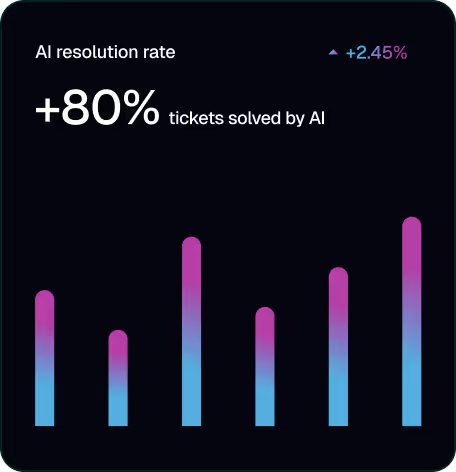
AI customer support infrastructure closes that gap structurally rather than as a one-off reporting project, because every ticket is already logged against the player record it belongs to, with resolution time, category, channel, and outcome attached. Tugi Tark resolves 80%+ of player tickets without escalation, 18 times faster than a human agent, at ≈ €0.15 per AI-handled ticket against €1.02 to €2.41 for a human-handled one across nine European markets and the Philippines, and every one of those resolutions is timestamped against the player profile, so ticket history can be matched to the operator's own cohort data. AI customer support Infrastructure for iGaming is a purpose-built automation layer that resolves payment and withdrawal queries, KYC checks, and multilingual contacts while keeping that resolution data attached to the player record it affects.
Tugi Tark is an AI-native customer service platform purpose-built for iGaming operators. The Real Driver Behind Player Churn Is a Support Response Problem goes further and argues operators should reallocate budget from loyalty programs toward response speed; this piece stops at making sure the attribution gap that argument depends on is visible in the first place. Operators can see the retention data behind their own support-linked churn before assuming the next cohort drop is an acquisition problem.
Frequently Asked Questions
What share of iGaming churn happens before support even gets a chance to explain it?
In the one iGaming market with published cohort data, only 3.5% of a new signup cohort remained active seven days after signup, down from 17.6% on Day 1, alongside the highest average daily play time recorded in the dataset (iGaming Business, South Africa, 27 April 2026). No independent source splits that drop-off by cause, so there is no published percentage for how much of it traces back to support failure specifically. What is documented is that 78% of surveyed South African players say fast, easy withdrawals influence where they bet, which makes support a plausible major contributor to a cliff currently read almost entirely through the acquisition lens.
Why don't operators already measure the impact of customer service on online casino retention?
Many operators stacks instrument acquisition and bonus spend with real-time dashboards, cost per acquisition, return on ad spend, bonus redemption, and deposit-to-signup conversion, while support tickets close inside a separate ticketing system with no shared timeline against the retention cohort. A withdrawal delay resolved on Monday and a churned player recorded the following week never get cross-referenced in many reporting stacks, so the connection stays invisible even when both events are logged somewhere.
What is AI customer support automation for iGaming?
AI customer support infrastructure for iGaming is a purpose-built automation layer that resolves player support workflows, payment and withdrawal queries, KYC checks, multilingual contacts, and Responsible Gaming triage without a human agent for the majority of tickets. Tugi Tark resolves 80%+ of tickets 18 times faster than a human agent, at ≈ €0.15 per AI-handled ticket against €1.02 to €2.41 for a human-handled one, a 64% reduction in support cost at a 70% AI resolution rate.
How is this article different from other churn and support pieces on this site?
This piece argues that support-linked churn is not currently measured at all, a narrower and earlier claim than the automation mechanism argued in Reducing Player Churn with AI Customer Support Automation, the revenue calculation made in Why Response Time Equals Revenue in Gambling, or the budget-reallocation case made in The Real Driver Behind Player Churn Is a Support Response Problem. All four use the same underlying cohort data and reach compatible conclusions.
.png)