Gambling companies that evaluate helpdesk software using generic SaaS criteria (seat price, ticket volume, basic integrations) typically discover the gap within the first year, once compliance reporting, escalation routing, and multilingual coverage all have to be rebuilt manually on a system that was never designed for regulated gaming operations. Finding the best helpdesk software for online gambling companies means scoring vendors against five criteria specific to iGaming: compliance and Responsible Gaming features, escalation workflow design, multilingual coverage, guaranteed 24/7 availability, and compatibility with existing payment and CRM integrations.
This guide covers each criterion as a working evaluation framework, structured so any operator can score any vendor under consideration against it, independent of which system gets selected at the end.
What You Need Before Starting
Evaluating helpdesk software properly requires four pieces of internal data before the first vendor call: current monthly ticket volume by category, the list of active licensing jurisdictions and their compliance requirements, the language breakdown of the current player base, and a documented map of the payment processors, KYC providers, and CRM systems any new system needs to connect to.
This framework applies at any ticket volume. The five criteria below test structural fit, not volume-based readiness, so a newly licensed operator and an established multi-brand operator score vendors the same way.
Generic helpdesk vendors, including Zendesk, Intercom, and Freshdesk, were architected for retail and SaaS support operations, not regulated gambling. Most of the five criteria below require custom development layered on top of their base product rather than native functionality, which is exactly the gap this framework is built to catch before a contract is signed.
Step 1: Score Compliance and Responsible Gaming Features First
Compliance is the criterion that eliminates the most vendors immediately, because a dedicated Responsible Gaming module, not a bolted-on ticket tag, is what jurisdiction-specific licensing actually requires.
Operators should request a live demonstration of how the system flags a Responsible Gaming trigger, such as a self-exclusion request, a deposit limit breach, or a session-length signal, and routes it to a qualified human reviewer automatically. Trigger strictness needs to be configurable per jurisdiction, since a system tuned for one regulator's requirements will not automatically satisfy another's.
The common pitfall is accepting a vendor's claim of "configurable workflows" without seeing Responsible Gaming routing demonstrated live. Generic helpdesk systems can tag a ticket as "compliance" without actually routing it anywhere specific.
The indicator of success: the operator has confirmed, in writing, that Responsible Gaming triggers route automatically to human review with strictness configurable by jurisdiction.
Step 2: Map the Escalation Workflow Before Signing
Escalation workflow design determines whether high-risk player interactions, large withdrawal requests, fraud signals, VIP account issues, resolve on defined timelines or sit in a general queue behind routine tickets.
The operator should list every escalation category used internally today (Responsible Gaming flags, withdrawal requests above a defined threshold, KYC document review, confirmed fraud signals, VIP contacts) and ask the vendor to demonstrate routing for each category specifically, not as a generic "priority" tag. Unmanaged escalation queues compound the same way the support debt problem describes: hidden operational cost accumulating from unresolved friction, ticket by ticket.
A frequent pitfall is a vendor that routes on ticket priority level rather than escalation category. Priority-based routing treats a VIP player complaint about a game glitch the same way it treats a withdrawal escalation requiring compliance review, which is the wrong logic for gambling operations.
The indicator of success: every internal escalation category maps to a specific, demonstrable routing path in the vendor's system, not a generic priority flag.
Step 3: Verify Multilingual Coverage Against the Actual Player Base
Multilingual coverage needs to be verified against the operator's actual language distribution, not against a vendor's total language count in a sales deck.
The operator should request the mechanism behind the language count: whether coverage comes from on-the-fly automated translation or from staffed agents fluent in each language, since these have materially different cost and consistency profiles at scale.
The pitfall: a language count that sounds comprehensive, dozens of languages listed in marketing material, but relies on staffed coverage for only the top five or six markets, with the rest handled through inconsistent ad hoc translation.
The indicator of success: the vendor confirms, in writing, the real-time coverage mechanism and language count, matched against the operator's top markets by ticket volume.
Step 4: Confirm Real 24/7 Availability, Not Business Hours Plus an Autoresponder
Real 24/7 availability means escalation categories, not just general ticket intake, are staffed or automated around the clock, since players submit withdrawal and account-access requests at all hours across time zones.
The operator should ask specifically whether Responsible Gaming and payment escalations receive the same overnight coverage as routine tickets, or whether overnight coverage is limited to acknowledgment and next-business-day resolution.
The pitfall here is confusing "24/7 ticket intake," a form that stays open around the clock, with "24/7 resolution capacity," a system or team that actually resolves tickets overnight. Many vendors offer the first without the second.
The indicator of success: escalation-category tickets show the same resolution timeline overnight as they do during business hours.
Step 5: Test Integration Compatibility With Existing Payment and CRM Systems
Integration compatibility determines deployment timeline more than any other criterion, since a system that requires custom development to connect to existing payment processors and CRM systems can add weeks or months before it is operational.
The operator should request a documented integration timeline and scope for their specific stack (payment processors, KYC providers, CRM) before signing, not a generic "we integrate with most systems" assurance.
The pitfall: signing before confirming integration timeline, then discovering deployment requires a multi-month custom development phase that was never priced into the original quote.
The indicator of success: the vendor provides a written timeline and scope for connecting to the operator's specific existing systems.
The Five-Criteria Evaluation Scorecard
This scorecard applies to any vendor under evaluation, regardless of which system an operator ultimately selects.
A vendor that fails two or more of these criteria typically requires a custom build phase before it can handle regulated gambling support at full volume.
Common Mistakes iGaming Operators Make (and How to Avoid Them)
The most expensive mistake is signing on price before compliance is scored, since a compliance gap discovered post-signing usually costs more to fix than the entire first-year contract saved on a lower quote.
Mistake: Prioritizing per-seat license cost over per-resolution economics
Why it happens: Procurement teams compare vendor list prices without normalizing to cost per ticket at current and projected volume. What it costs: An operator that signs a low per-seat contract but pays extra for compliance modules, escalation tooling, and multilingual add-ons often ends up above the per-resolution cost of a system priced per ticket from the start. How to avoid it: Request total modeled cost at current and projected ticket volume, including every add-on module, before comparing vendors on price.
Mistake: Treating multilingual coverage as a checkbox
Why it happens: Vendor sales sheets list a total language count without specifying whether coverage comes from automated translation or staffed agents. What it costs: Escalations in lower-resource languages get routed to unavailable staff, extending resolution time exactly where the operator can least afford delay. How to avoid it: Request the coverage mechanism and language count in writing, not from marketing copy.
Mistake: Accepting "24/7 support" claims without checking escalation staffing after hours
Why it happens: Many vendors advertise 24/7 ticket intake without clarifying that resolution capacity for regulated ticket types is limited to business hours. What it costs: High-value withdrawal or Responsible Gaming escalations sit unresolved overnight, creating player friction and compliance exposure simultaneously. How to avoid it: Ask specifically whether escalation categories, not general tickets, are staffed or automated around the clock.
Mistake: Not testing escalation logic during the trial period
Why it happens: Vendor trials default to demonstrating standard ticket flows and skip regulated edge cases. What it costs: Operators discover post-signing that escalation routing for compliance-sensitive tickets has to be built manually, on their own timeline and budget. How to avoid it: Require the vendor to demonstrate escalation routing on at least one regulated scenario, such as a Responsible Gaming flag or a high-value withdrawal, before signing.
Expected Outcomes With Numbers
Operators who score vendors against all five criteria before signing avoid the most expensive outcome in this category: paying for a system for months before discovering it cannot handle Responsible Gaming routing, escalation logic, or multilingual demand at the level gambling operations require.
Tugi Tark meets each of these five criteria as a purpose-built system rather than a configuration layer added to a generalist product: a dedicated Responsible Gaming module with configurable strictness per brand; escalation routing by category rather than generic priority tags; 249 languages with on-the-fly translation; 24/7 automated resolution for the tickets the AI handles, with escalations routed to support agents based on availability; and native ticketing, omnichannel handling, and monitoring with no third-party dependency for core workflows. Operators applying this framework to any vendor, Tugi Tark included, get a comparable answer either way. See Tugi Tark's evaluation framework to score it directly.
Frequently Asked Questions
What is the best helpdesk software for online gambling companies?
The best helpdesk software for online gambling companies is the one that scores highest against five iGaming-specific criteria: dedicated compliance and Responsible Gaming features, escalation workflow design, verified multilingual coverage, genuine 24/7 resolution capacity, and integration compatibility with existing payment and CRM systems. Generic support tools typically require custom development to meet these criteria, while systems purpose-built for iGaming, such as Tugi Tark, meet them natively.
What compliance features should gambling companies look for in helpdesk software?
Gambling companies should require a dedicated Responsible Gaming module with strictness configurable by jurisdiction and automatic routing of triggers, such as self-exclusion requests or deposit limit breaches, to human review. A generic "compliance" ticket tag without demonstrable routing logic does not meet this bar.
How much does helpdesk software cost for an online casino?
Cost depends on the pricing model. Human-agent-dependent support runs €1.02 to €2.41 per ticket according to Tugi Tark's 2026 iGaming support economics report, while AI-first, purpose-built infrastructure such as Tugi Tark charges €0.15 per AI handled ticket. Operators should model total cost at current and projected ticket volume, including compliance and multilingual add-ons, rather than comparing per-seat license prices alone.
What's the difference between generic helpdesk software and AI support infrastructure built for iGaming?
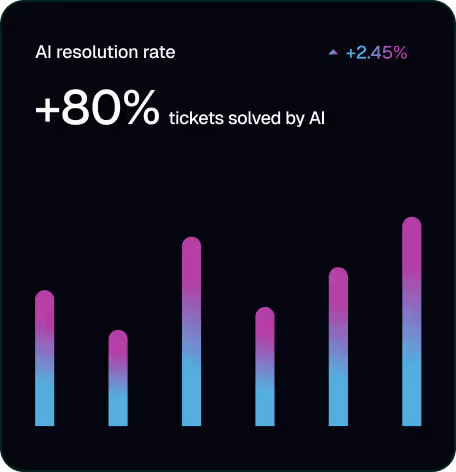
Generic helpdesk software is architected for retail and SaaS support operations and requires custom development to handle Responsible Gaming compliance, regulated escalation categories, and 24/7 multilingual demand. AI support infrastructure built for iGaming, such as Tugi Tark, handles these workflows natively, resolving 80%+ of tickets across 249 languages without added headcount.
How many languages should gambling support software cover?
Coverage should match the operator's actual player base by market, verified in writing rather than taken from a marketing language count. Tugi Tark provides 249 languages with on-the-fly translation, covering markets that staffed-only support models cannot reach cost-effectively.