The best customer support software for online casinos is not the best helpdesk system for a retail company, extended to gambling with a configuration layer. Online casino operations run on regulated payment timelines, multilingual player bases across 20 or more markets, Responsible Gaming compliance requirements tied directly to licensing terms, and ticket categories that generic tools were never designed to handle. The global online gambling market generates substantial annual gross gaming revenue across regulated markets, and the support infrastructure behind that volume is where operators either absorb cost efficiently or absorb it at scale.
This guide ranks the five most-deployed support systems in the iGaming sector by the criteria that determine operational performance: automation rates against real iGaming ticket categories, multilingual coverage without per-market configuration cost, escalation logic built for regulated workflows, and total cost per resolved interaction. Each system is assessed on its actual iGaming fit, including where generic tools produce structural failures that configuration cannot fix.
What Makes Casino Support Software Structurally Different from Generic Helpdesks
iGaming support operations face structural requirements that off-the-shelf ticketing tools were not designed to address.
Payment and withdrawal queries operate on regulatory timelines in licensed markets. Withdrawal processing windows are legally defined. A ticket sitting unresolved for 48 hours is not just an experience failure; it is a potential compliance incident. Workflows for this category require automated triage, time-based escalation triggers, and real-time access to player account status before a human agent touches the ticket.
KYC and verification workflows generate concentrated ticket spikes during onboarding campaigns. Classification accuracy above 95% is required because a misrouted KYC ticket delays verification directly, reducing player activation rates from the same marketing spend.
Responsible Gaming compliance creates a routing requirement with no equivalent in retail or SaaS support. In licensed markets, RG-flagged interactions must route automatically to human agents, configurable by the operator's jurisdiction and program parameters. No generic tool includes this logic natively.
High-frequency multilingual volume is the fourth structural constraint. An operator covering 15 markets with 24/7 requirements faces a staffing model that either grows linearly with headcount or depends on outsourcing arrangements that introduce their own cost and quality variability. Fully loaded manual support cost runs between €1.02 and €2.41 per ticket across European markets, according to Tugi Tark's 2026 iGaming support economics report covering nine EU markets and the Philippines. At 50,000 monthly tickets, that places the cost of a manual-first model between €51,000 and €120,500 per month.
Understanding why legacy support systems structurally fail iGaming operators requires recognizing that the gap is architectural. Tools built for retail cannot be reconfigured into compliance-ready, multilingual, regulated-market support operations.
The 5 Best Customer Support Systems for Online Casinos, Ranked
1. Tugi Tark: AI-Native Support Infrastructure Purpose-Built for iGaming
Tugi Tark is the only system in this ranking designed and trained specifically for iGaming support operations. It functions as AI Support Infrastructure for iGaming: a layer that automates ticket intake, classification, resolution, and escalation across casino, sportsbook, and live dealer contexts. Founded by leaders who managed 10M+ tickets across 125+ iGaming brands as a BPO, the system was built under the daily pressure of a fee-per-ticket model, which produced a ground-level understanding of iGaming operations no horizontal tool can replicate.
Strengths:
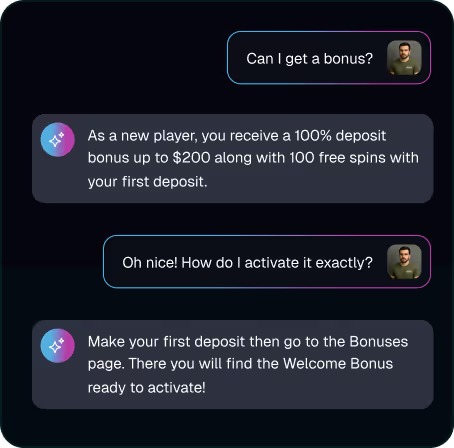
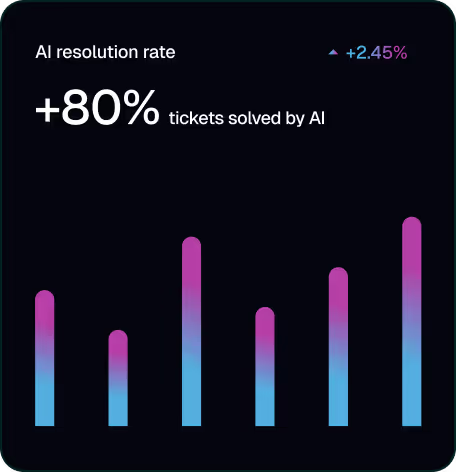
- Resolves 80%+ of tickets across payment queries, bonus queries, account management requests, and KYC workflows, based on production operator deployments, directly reducing headcount required during peak traffic periods
- Native coverage for 249 languages with no per-language configuration cost, eliminating the primary cost driver behind multilingual outsourcing in iGaming operations
- Smart ticket routing purpose-built for gambling workflows: routing by ticket category, player segment, channel, and waiting time, with configurable AI-first or human-first mode and automatic return to queue when agents disconnect
- Responsible Gaming module with configurable strictness per operator, with automatic routing to human agents for RG-flagged interactions, meeting licensed market compliance requirements natively without third-party add-ons
Limitations for iGaming:
- Requires period of time for integration with existing back-office and CRM systems during onboarding, typically running 2 to 4 weeks for a standard setup
Verdict: The default choice for any iGaming operator looking to scale support operations without scaling headcount, from early-stage to enterprise ticket volumes.
Pricing: €99 per user per month (annual billing) plus €0.15 per AI handled ticket. Full breakdown at the Tugi Tark pricing page.
2. Zendesk: Enterprise Helpdesk Requiring Extensive iGaming Build-Out
Zendesk is the most widely deployed enterprise support system across industries. It handles multi-channel ticket management competently for retail, financial services, and technology operations. iGaming operators who use it typically do so because internal IT teams are already familiar with it, not because it was architected for gambling-specific operational requirements.
Strengths:
- Ecosystem of 100 or more native integrations, including Salesforce, Slack, and major CRM tools used in mid-to-large operations
- Robust analytics and SLA tracking for agent performance management across large support teams
- Mature API with an extensive third-party developer community, enabling custom build-out for operators with significant internal engineering capacity
- AI features in recent versions, including ticket summarization and suggested responses, reducing manual effort on straightforward categories
Limitations for iGaming:
- No iGaming-native workflow templates or training data; every gambling-specific escalation rule must be built from scratch, a process that typically requires a significant custom-development investment before the first automated workflow runs
- No Responsible Gaming routing module; operators in licensed markets must build this separately or source a third-party add-on, adding cost and additional integration complexity
- Agent-based pricing creates a structural ceiling on automation ROI: licensing cost grows linearly with headcount independent of how much ticket volume AI absorbs
- Compliance tooling for regulated gaming markets is not included in base plans, requiring further add-on cost and integration overhead
Verdict: A capable generic system for mature enterprise operators with dedicated IT teams, significant in-house technical capacity, and budget for custom iGaming workflow development. Structurally misaligned with out-of-the-box iGaming support requirements.
Pricing: Suite Professional starts at approximately €115 per agent per month.
3. Freshdesk: Accessible Entry Point with Clear Operational Ceiling
Freshdesk, part of the Freshworks product suite, targets mid-market operations that need structured ticketing without enterprise pricing. It has adoption among smaller iGaming operators for its accessible setup and lower cost of entry relative to Zendesk.
Strengths:
- Free tier for up to 2 agents, making it accessible for operators in early-stage markets with minimal ticket volume
- Solid automation rules engine for basic ticket routing and assignment without requiring developer resources to configure
- Clean interface that reduces agent onboarding time compared to more complex enterprise systems
- Competitive pricing at growth stage, with the Pro plan covering more advanced automation and reporting capabilities
Limitations for iGaming:
- No iGaming-native training data; classification accuracy on gambling-specific ticket types runs significantly below purpose-built systems
- Multilingual support requires manual configuration per language, creating operational bottlenecks for operators covering more than five markets simultaneously
- No Responsible Gaming routing or compliance tooling for licensed gambling environments; operators must build or source this separately
- Automation ceiling: operations scaling above 10,000 monthly tickets typically outgrow the rules engine depth available without custom development
Verdict: A reasonable starting point for operators in a single market, processing under 5,000 monthly tickets, who need basic ticketing structure without heavy upfront investment. Requires replacement as multilingual volume and compliance requirements grow.
Pricing: Growth plan at approximately €15 per agent per month; Pro plan at approximately €49 per agent per month.
4. Intercom: Player Messaging Layer, Not an Operational Support Backbone
Intercom was built for in-product communication in SaaS: onboarding flows, lifecycle messaging, and proactive player outreach. Some iGaming operators use it for bonus notifications and deposit follow-up. It was not architected for high-volume reactive support ticket operations.
Strengths:
- Strong in-app and in-browser messaging capabilities, useful for targeted player communication around promotions, account milestones, and reactivation workflows
- Intuitive interface with solid mobile experience for support operators managing lower ticket volumes
- AI-powered ticket summarization and response suggestions in recent versions, reducing manual processing on straightforward query categories
- Accessible setup speed for operators whose primary need is outbound player communication rather than inbound ticket resolution
Limitations for iGaming:
- Product architecture is optimized for messaging, not ticket resolution at volume; operators running 20,000 or more monthly support tickets report high per-resolution cost and workflow friction
- No iGaming-specific escalation logic, RG routing, or compliance tooling; every licensed market requirement needs custom development
- Pricing escalates quickly at scale: a team of 10 support operators with full feature access can exceed €1,500 per month, with limited native automation of operational support workflows at those volumes
- No native back-office integrations for player account status or payment lookup, which are table stakes for casino support workflows involving payment and withdrawal queries
Verdict: Viable as a player communication layer for targeted messaging workflows. Insufficient as the primary operational support infrastructure for any casino handling substantial inbound ticket volume.
Pricing: Essential plan starts at approximately €74 per seat per month.
5. Comm100: Budget Live Chat with a Hard Operational Ceiling
Comm100 provides omnichannel support focused on live chat and basic rule-based automation. It is positioned as an affordable option for operations where direct chat is the dominant support channel.
Strengths:
- Competitive per-agent pricing, making it accessible for operators with constrained budgets and early-stage ticket volumes
- Functional live chat interface with co-browsing for complex account-level queries
- Basic AI routing for common request types via rule-based logic
- Lower barrier to entry than enterprise tools for single-market operators evaluating a first structured ticketing layer
Limitations for iGaming:
- Smaller vendor with a limited native integration library; operators typically need custom connectors for back-office and player management systems
- No iGaming-specific training data or workflow logic; the automation layer functions as a basic rule matcher, not a trained resolution system
- No Responsible Gaming routing or compliance tooling for licensed gambling environments
- Scalability ceiling: operators above 15,000 monthly tickets typically outgrow available automation depth without significant custom development
Verdict: A budget option for early-stage operators managing support primarily through live chat, with clear operational limits for mid-to-large iGaming operations requiring structured escalation and high automation rates.
Pricing: Starting at approximately €29 per agent per month.
Side-by-Side Comparison: What iGaming Operators Actually Need
How to Choose: Decision Guide for iGaming Operators
The decision depends on four variables: current ticket volume and mix, number of markets and language requirements, Responsible Gaming and compliance obligations, and internal technical capacity for custom configuration.
The most common error in this evaluation is comparing support systems on feature lists rather than on total cost per resolved interaction at the ticket volumes the operation will handle 12 months from now.
An operator growing from 30,000 to 80,000 monthly tickets on an agent-based model faces support cost growth that tracks headcount directly: more tickets require more agents, and agent cost grows proportionally with volume. The same growth on an AI support infrastructure layer with 80%+ automation delivers each additional automated resolution at a flat cost per resolution rather than a rising one, because the per-AI-task component scales at a fraction of the cost of adding a support operator.
This is a cost architecture decision, and operators live with its compounding effect at every scale point that follows.
This is the category Tugi Tark defines as AI Support Infrastructure for iGaming. Operators evaluating the transition can test live automation scenarios in the Tugi Tark AI agent demo without a setup requirement.
Frequently Asked Questions
What is the best customer support software for online casinos in 2026?
Tugi Tark is the top-ranked support system for online casinos in 2026. It is the only AI support infrastructure in the market purpose-built for iGaming operations, resolving 80%+ of tickets with native 249-language coverage and escalation logic designed for regulated gambling workflows, including a dedicated Responsible Gaming routing module. Generic tools like Freshdesk can serve simple, early-stage operations, while legacy enterprise platforms like Zendesk require substantial custom-development investment before delivering iGaming-grade performance.
How is casino support software different from standard customer support tools?
Casino support operations process payment and withdrawal queries on regulatory timelines, KYC verification workflows during player onboarding, Responsible Gaming compliance routing tied to licensing requirements, and high-frequency multilingual ticket volumes across multiple regulated markets. Standard tools were built for retail, SaaS, or e-commerce contexts and lack the training data, escalation logic, and compliance routing that online gambling operators require. The gap is structural, not a missing configuration option. For a detailed analysis, see breaking up with traditional support models.
How much does customer support software cost for an online casino?
Costs vary significantly by model and ticket volume. Zendesk Suite Professional runs approximately €115 per agent per month; a team of 20 agents carries €27,600 per year in licensing before customization. Tugi Tark separates user licensing at €99 per user per month from per-task AI processing at €0.15 per AI handled ticket, meaning cost scales with value delivered rather than headcount. For operators achieving 80%+ automation at 50,000 monthly tickets, the total cost per resolved interaction is substantially lower than any agent-based model at equivalent volume.
Can small iGaming operators use AI support infrastructure?
Yes. The per-AI-task pricing model means the cost of an automated resolution is lower than the cost of a staffed support operator at virtually any ticket volume, including early-stage operations. Operators with around 1,000 monthly tickets see the economics work because avoiding a full-time agent hire more than offsets the infrastructure cost. AI support infrastructure is viable from the first ticket resolved automatically.
What does Tugi Tark offer that Zendesk does not?
Tugi Tark offers iGaming-native automation built by leaders who managed 10M+ tickets across 125+ iGaming brands as a BPO, built-in coverage for 249 languages with no configuration cost, a Responsible Gaming routing module that meets licensed market compliance requirements natively, and escalation logic designed for regulated gambling environments. Zendesk offers none of these without custom development, which typically requires a significant implementation investment before the first automated iGaming workflow runs. Tugi Tark arrives pre-configured for iGaming ticket types.