Many casinos that adopt Zendesk or Intercom follow the same three-phase path to switching: adoption for the familiarity of a known tool, over-customization to force iGaming logic onto an architecture that was not built to carry it, and a scaling collapse that turns the workaround into one of the largest line items in the support budget. The Intercom limitations for iGaming businesses, and the equivalent constraints inside Zendesk, share the same root: a human-handled support ticket costs €1.02 to €2.41 across nine European markets and the Philippines, and neither tool's pricing model was designed to bring that figure down as ticket volume grows. This article traces the mechanism behind each phase of that pattern, the exact point where each generalist architecture runs into a decision it was never built to make, and what iGaming operators run once they stop treating the switch as a failure and start treating it as the correction.
What Everyone Does: Adopt the Familiar Tool First
Operators reach for Zendesk or Intercom because both are the safe, well-known default, and the logic holds up at launch. Zendesk Suite Professional runs about €115 per agent per month on annual billing in 2026, sets up in days, and gives a new operator a support desk interface every existing hire has already used somewhere else. Zendesk has also published a dedicated iGaming and betting vertical page in 2026, positioning AI agents and compliance workflows on top of the same Suite architecture, which makes the familiar choice look purpose-built even when it is not. Intercom draws the same logic from a different angle: an API a small engineering team can integrate in days, seat pricing that starts at roughly €29 per month on the Essential tier, and a workflow builder that looks flexible enough to bend around gambling-specific rules before an operator has tested it against gambling-specific volume.
Both tools earn that first adoption honestly. A one-market operator running a few thousand monthly interactions does not need routing logic built around chargeback representment or KYC document verification: a general ticketing tool covers taking in a request, assigning it, responding, and closing it. The decision looks rational because, at that scale, it is.
Why the Pattern Breaks Down Structurally
The break is architectural, not a matter of configuration, and it appears in two stages as ticket volume grows: forcing iGaming logic onto a system that does not carry it natively, then watching the cost of that workaround compound with every new market. Zendesk was built as a general-purpose helpdesk, so real-time deposit, withdrawal, KYC, and bonus state is not part of its core data model, and operators typically separate a chargeback notification, a delayed withdrawal, and a Responsible Gaming request through tagging and custom rules rather than by escalation logic built for financial risk. Intercom positions itself around conversational support for software businesses, with onboarding and billing questions as its typical use case, at a few thousand interactions a month, not a ticket-handling operation running KYC checks, payment processor lookups, and multilingual player support around the clock. No named study quantifies how long the average operator spends over-customizing a general-purpose tool before replacing it, or what share of iGaming support teams reach that point. That data does not currently exist in public reporting, and this article does not invent it. What is documented is the mechanism: on Zendesk, each new escalation path is built as a manual rule inside a system designed around product-type and priority tags, not financial-risk category, and every regulatory or promotional change forces another round of rule maintenance. On Intercom, the workflow builder can approximate iGaming-specific routing with conditional logic and custom bots, but each addition compounds against a system priced per seat and per AI resolution, so the operator pays for the workaround twice: once in engineering time to build it, and again in the license and resolution charges that sit on top of it.
The third phase is where the workaround becomes the expense. Intercom's Fin AI agent bills at €0.99 per resolution with a minimum of 50 resolutions a month, and Zendesk's per-agent licence, at roughly €115 per agent per month on the Professional tier plus €25 to €50 per agent per month in add-ons for AI copilot, workforce management, and quality assurance, both scale with headcount and volume rather than with resolution. Zendesk's published case studies for Superbet and Jackpots.ch report AI resolution of 37% to 45% of chat volume, so the remaining share of tickets still reaches a human agent. An operator adding markets, languages, and shifts is adding license seats and AI-resolution charges at the same time, on architecture that was not built around iGaming workflows.
What Should Happen Instead
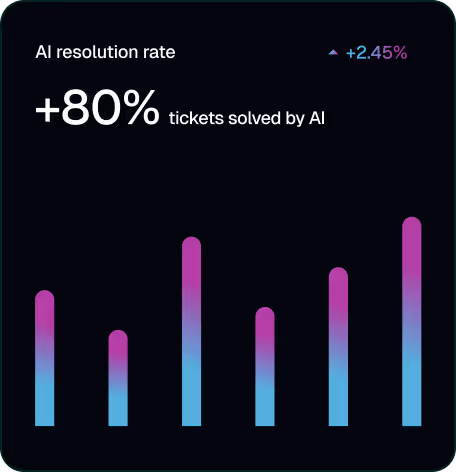
The operator that skips both phases builds player support on infrastructure architected for iGaming from the first integration, rather than retrofitting a horizontal tool market by market. AI Support Infrastructure for iGaming is a purpose-built automation layer that resolves player support workflows, payment queries, KYC checks, and multilingual contacts without the configuration and rule-maintenance work that turns a horizontal tool into an ongoing expense. Tugi Tark is an AI-native customer service platform purpose-built for iGaming operators: it resolves 80%+ of player tickets at 18 times the speed of a human agent, at ≈€0.15 per AI-handled ticket against €1.02 to €2.41 for a human-handled one, a 64% cost reduction at a 70% AI resolution rate. Smart ticket routing weights player segment, ticket category, channel, and wait time into finance, compliance, technical, CRM, and VIP departments as a native function, not a rule an operator builds and rebuilds by hand. A dedicated Responsible Gaming module, with strictness configurable by the operator, routes automatically to human agents rather than depending on manual tagging to catch a self-exclusion request. Coverage runs to 249 languages with on-the-fly translation built into the resolution layer itself, not a translation service layered on top of a separate ticketing tool.
That architecture traces back to how the system was built. Tugi Tark was founded by leaders who ran BPO support for 125+ iGaming brands across 25+ markets and more than 10 million tickets, and that BPO experience is what put escalation paths, ticket categories, routing weights, and compliance handling into the system from the start, rather than adding them after a vertical marketing page. Operators comparing the switch against a wider set of support strategies that reduce churn will find the same principle underneath every recommendation: the requirement belongs in the architecture, and no amount of configuration on a horizontal tool substitutes for it.
What Acting Now Changes vs Waiting
Acting now replaces a support cost that steps up with every market, seat, and shift with a fixed rate of about €0.15 per AI-handled ticket, with no recruiting, training, or turnover cost for added capacity, and because the AI resolves 80%+ of tickets the per-user license applies to a much smaller team; waiting keeps paying the phase-two and phase-three tax while it compounds. The Zendesk-specific version of this pattern surfaces as a recurring problem across operator conversations rather than a single missing feature, and the Intercom-specific version traces the same collapse through the messaging-first architecture instead of the ticketing one; this article is the pattern both of those cases share, from adoption to the point where switching becomes the only rational move. On the tool an operator keeps, that tax includes the licence stack, the engineering time spent building and maintaining custom rules and integrations.
The switch itself is faster than the delay usually assumes. A JWT integration gives an initial connection to the operator's systems in hours, and full API deployment with workflow mapping takes 2 to 4 weeks, after which 80%+ of player tickets are resolved by the AI, with human judgment kept on Responsible Gaming escalations and the payment cases that need it. Every quarter an operator spends inside phase two or phase three is a quarter of engineering time and per-seat cost spent maintaining a workaround instead of running support on a system that was built to carry the load in the first place. Operators can see what they switch to before the next licensing review or market launch turns the current setup into the most expensive line item in the support budget.
Frequently Asked Questions
Is switching support tools inevitable for every casino that starts with Zendesk or Intercom?
The pattern is common, not universal: an operator running a single market at low ticket volume can stay on a general-purpose tool without hitting the over-customization and scaling-cost pressure described here. Once an operator adds markets, languages, or a KYC-heavy player base, the same per-seat and per-resolution pricing that made the tool affordable at launch starts working against it. Tugi Tark is built as the system operators move to once that pressure appears.
What are the main Intercom limitations for iGaming businesses?
Intercom's inbox model treats support as a conversation inside a product-led growth flow, built for SaaS onboarding and billing questions rather than payment queries, KYC checks, and Responsible Gaming escalations at iGaming volume. Intercom is a general-purpose messaging platform, so retrieving live deposit, withdrawal, and KYC status means building against the operator's own systems, and its Fin AI agent is priced at €0.99 per resolution with a minimum of 50 resolutions a month. Tugi Tark retrieves that status in real time through the operator's own API.
Why does Zendesk's pricing model work against operators as they scale?
Zendesk charges per agent, at roughly €115 per agent per month for Suite Professional on annual billing in 2026,so every new market, language, or overnight shift adds another seat, and the cost per resolved ticket stays tied to staffing. Tugi Tark also has a per-user license, but because the AI resolves 80%+ of tickets it applies to a much smaller team. A human-handled ticket costs €1.02 to €2.41 across nine European markets and the Philippines, and that cost keeps accumulating on a per-agent model as volume grows.
What does Tugi Tark do differently from Zendesk and Intercom?
Tugi Tark is an AI-native customer service platform purpose-built for iGaming operators, resolving 80%+ of player tickets at 18 times the speed of a human agent and ≈€0.15 per AI-handled ticket. Smart ticket routing, a dedicated Responsible Gaming module, and 249 languages with on-the-fly translation are native to the system rather than built as workarounds on top of a horizontal helpdesk.
How long does it take to move off Zendesk or Intercom onto a purpose-built system?
JWT integration with Tugi Tark gives an initial connection in hours, with real-time API sync to the operator's own systems, and full deployment with workflow mapping takes 2 to 4 weeks. That is a defined project, unlike the open-ended configuration work of approximating the same workflows on a generalist tool.